
A first-year teacher resume does not need to imitate the career history of a veteran educator. Start with the grade levels and subjects you taught during supervised student teaching, add lesson or assessment evidence you can explain, and list your actual educator credential status. If you have not yet been licensed, do not use the word “licensed” based only on program completion. Show the school, placement dates, cooperating-teacher relationship and specific tasks, then include relevant field placements, tutoring or youth work to support your candidacy.
Use a first-year educator structure rather than a generic resume
For a recent teacher-preparation graduate, Education and Licensure may appear early because districts often screen for a particular degree and teaching endorsement. Then put Student Teaching and Field Experience near the top, followed by relevant employment, tutoring or campus service. University of Northern Iowa career services publishes separate examples for student-teaching placement, job-seeking teachers and experienced educators. These audiences need different emphases, even if the basic formatting looks similar.
A new teacher should not bury a substantive semester placement beneath an unrelated summer job. At the same time, do not omit paid experience that shows reliability, communication, or work with children. Keep employer names, locations and dates clear. Your opening profile, if used, should identify the grade or subject you are ready to teach and one or two demonstrable preparation strengths; avoid statements such as “expert classroom leader” before your first contracted teaching role.
Describe the placement without hiding supervision
List the actual placement school, grades or subjects and term. Say whether you prepared units, delivered lessons, used a rubric, supported small groups or assessed work under the cooperating teacher’s direction. University of Northern Iowa’s teacher resume guidance emphasizes student teaching for new candidates and recommends describing responsibilities and accomplishments, not only naming a school. The goal is to show what you practiced in the classroom while representing the supervised nature of the appointment.
A hypothetical bullet could read: “Planned and taught a supervised three-lesson fractions sequence for a fourth-grade class; used the cooperating teacher’s feedback to adjust small-group practice.” Keep the details only if they occurred. Do not announce that the placement produced a percentage-point test improvement unless the data are valid, attributable and shareable. The phrase “led a classroom” needs context if a licensed cooperating teacher retained responsibility for instruction and student records.

Explain licensure status in the employer’s terms
Teacher qualification requirements vary by state, grade band and subject endorsement. The Bureau of Labor Statistics describes public-school teacher licensing as a typical requirement, while private-school requirements can differ. On the resume, separate “license issued,” “application pending,” “recommended for licensure,” and “teacher preparation program completed.” Those terms do not mean the same thing. Use the exact credential name and its current standing rather than predicting that an application will be approved.
If a district asks for a license number, use the official application channel and follow its privacy instructions. Do not publish unnecessary personal numbers in public portfolio files. Candidates moving across states should check both the target state and district instructions instead of assuming automatic reciprocity. A date you expect to become eligible can be labeled as an estimate; do not call a pending credential valid before issuance.
Show the lesson design process, not a list of buzzwords
A strong student-teaching example connects objective, activity, evidence and revision. You might explain what the lesson aimed to teach, which materials you selected, how you checked student understanding and what you changed after a cooperating teacher’s observation. Use real lesson plans and notes that are safe to discuss. General words like differentiation and assessment carry more weight when paired with a truthful task than when repeated as disconnected skills.
If you participated in individualized supports, describe your contributions without disclosing student plans or suggesting you independently determined legally required services. For example, “Prepared instructor-approved visual supports for small-group reading activities” is more precise than “managed IEPs.” Explain how supervision and school policy shaped your response to a classroom challenge. This establishes judgment, not merely technical vocabulary.
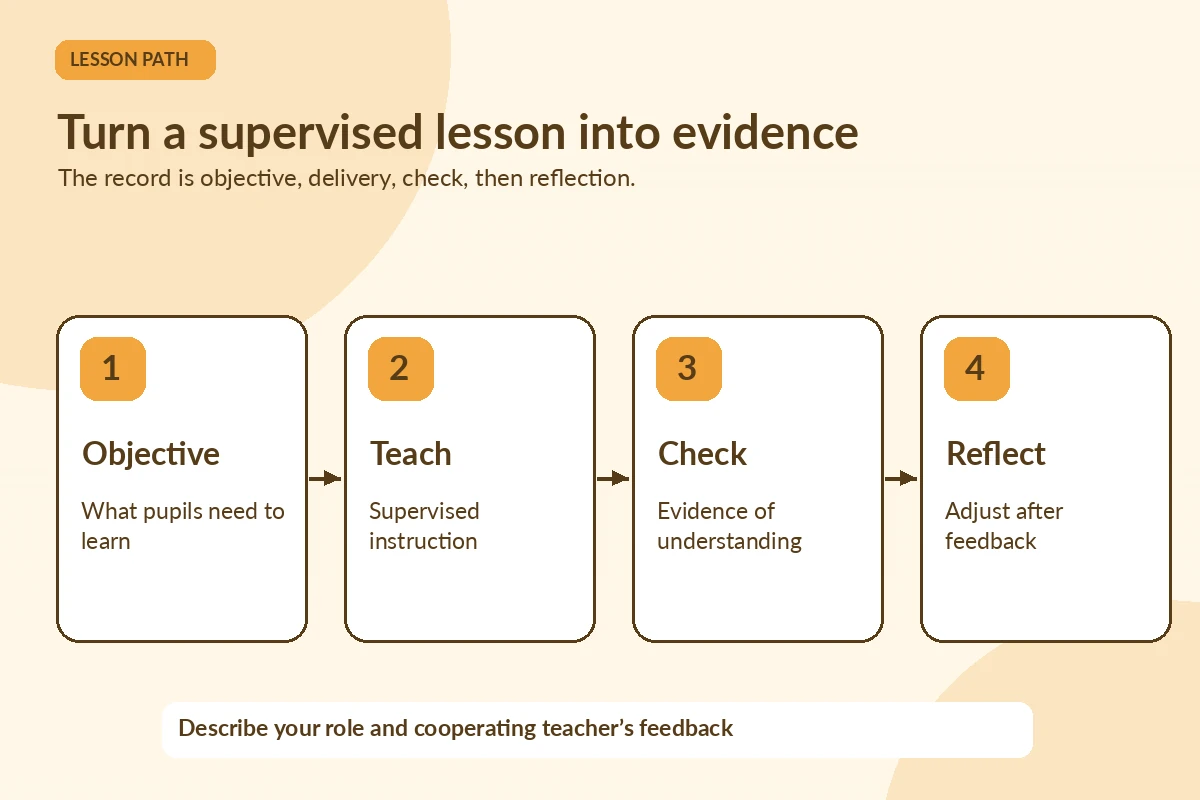
Separate field experiences from the major placement
Teacher education programs may contain early observations, short field placements, a culminating student-teaching term and unrelated classroom volunteering. Do not label all of those activities as full-time teaching. Use distinct headings or add concise role descriptions so a hiring manager can see the duration and level of involvement. If you watched lessons and completed written reflections, call that observation; if you taught under supervision, identify the sessions you led.
A field experience still has value when honest. Specifics such as preparing manipulatives, guiding a supervised small group or checking materials can demonstrate readiness. Add grade level and subject context where known, but avoid names of pupils, special education identifiers and confidential documents. When two placements are similar, keep the deeper one prominent and compress the less substantial one.
Prepare an interview-safe teaching portfolio
A resume can refer to a short teaching portfolio with a lesson outline, anonymized sample activity or reflection—but only when the school permits sharing. Student work and learning data may be protected; removing a name is not always enough to eliminate identifying details. Ask your cooperating teacher or program about consent and distribution before placing documents online. You can still present a self-created blank rubric or lesson template that does not contain student information.
Make sure each portfolio item supports an accurate resume claim. If the resume says you used formative checks, be prepared to explain the instructional question and how you adjusted instruction, without revealing individual student scores. If you only observed the practice, say you observed it. A small, coherent set of materials is more persuasive than a large collection of files whose provenance or permission is unclear.
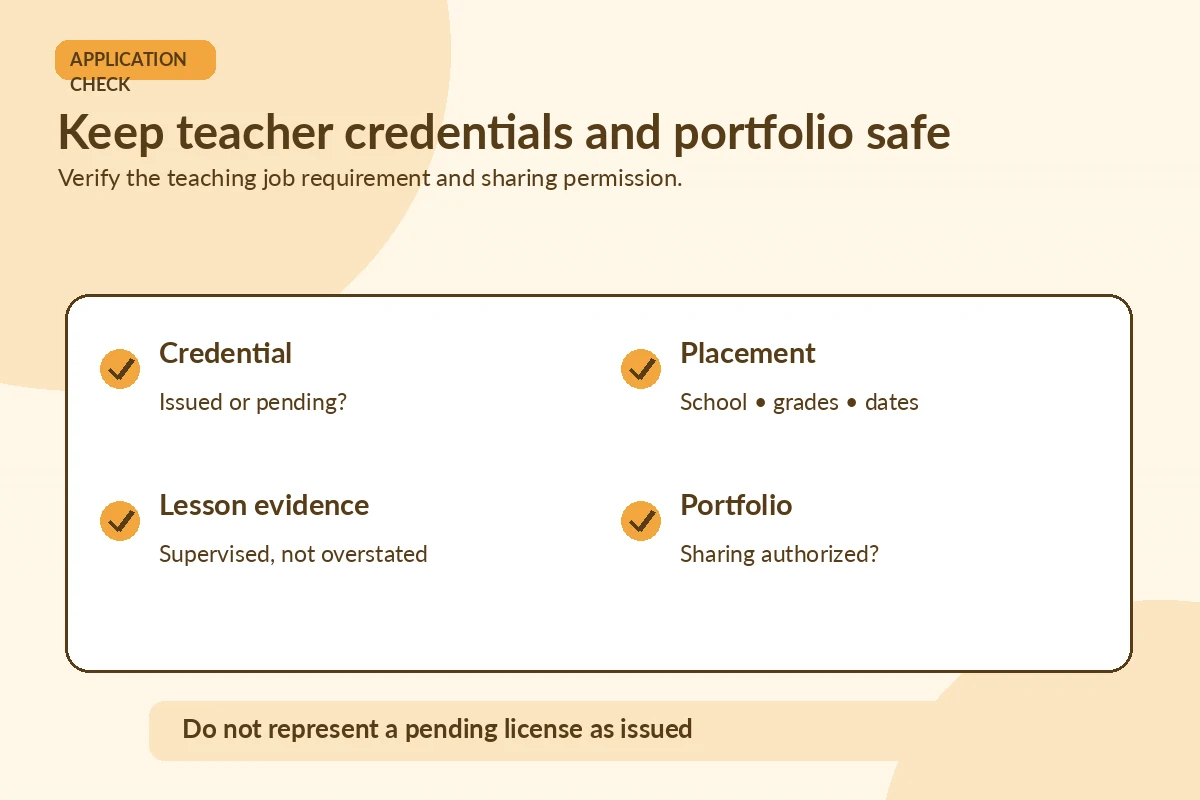
Match the exact vacancy and perform a final check
Read the school posting for required grade authorization, subject endorsement, district application forms and supporting documents. Translate general teaching experiences into evidence relevant to that vacancy: early literacy for elementary classrooms, disciplinary labs for science positions, or differentiated question prompts for mixed readiness levels. Do not copy an employer’s requirement as a skill you have not demonstrated. A first-year applicant benefits from clear role fit rather than broad statements about being able to teach every age.
Check the education credential, stage of licensure, placement dates, grade levels, subjects and names of supervisors before submitting. The Bureau of Labor Statistics outlines teacher responsibilities such as lesson preparation, evaluation and communication, but an entry-level resume should claim only what the applicant has done or is authorized to do. Confirm the final PDF is readable and that any portfolio link respects permission and privacy rules.
Compare the credential or experience with verified evidence
The comparison below is an editorial worksheet. It illustrates how to name your educational record, academic experience or application claim without exceeding what is documented. The real school, awarding body and application instructions determine your exact wording; examples in this page are fictional where labeled.
| Experience | Resume description | Accuracy boundary |
|---|---|---|
| Student teaching | Supervised lesson planning and delivery | Name placement and supervision |
| Early field placement | Observation, activities, limited teaching | Do not call observation employment |
| Educator credential | Actual license or pending stage | Do not claim issued before approved |
How We Research Education and Resume Guidance
We reviewed the primary career-service, educational and occupational resources listed below on November 6, 2026, compared intended search purposes with the supplied JobAsk WordPress inventory, and checked current public search context. The examples are editorial illustrations, not actual academic awards, endorsements or hiring outcomes. Institution and employer policies always govern credential verification and permission to disclose student data. See the JobAsk affiliate disclosure.
Source references checked on November 6, 2026: careerservices.uni.edu — University of Northern Iowa career materials for job-seeking teachers versus student teaching applicants.; careerservices.uni.edu — University of Northern Iowa teacher resume guidance on student teaching, grades, dates, field experiences and credentials.; www.bls.gov — Bureau of Labor Statistics description of elementary teaching duties and common educator licensing expectations..
More Resume and Cover Letter Guides
Often Education and Licensure followed by Student Teaching, especially when you have not yet held a contracted teaching role.
You can describe it as supervised teaching experience, but keep the appointment label and school dates accurate.
State the real stage such as application pending or recommendation for licensure, not an issued license.
Yes when they show relevant reliability or communication; give substantive student teaching more prominent space.
Only if the relevant institution authorizes sharing and privacy requirements are met; self-created blank lesson materials are safer.