
Graduate job interview preparation: Graduate job interview preparation is about explaining what you can do with real evidence, even when much of that evidence comes from classes, student projects or supervised placements. Choose relevant examples, name your actual role, distinguish a class result from an employer outcome, and show how you would continue learning. This guide addresses graduate-to-work translation rather than repeating generic advice on dress or first impressions.
Read entry-level job requirements as tasks you can demonstrate
Start with the job description, not a list of every course you completed. Translate each required task into an observable activity. “Analyze requirements” might connect to a research brief where you clarified a question and documented assumptions. “Communicate progress” could connect to scheduled project updates. “Check data quality” might connect to a class dataset with validation steps. Record what matches and what you have not yet done. Having taken a module does not automatically mean you can perform its professional equivalent independently.
For each task, note the setting, level of supervision, tools used, who received the work and the outcome you actually observed. Graduate study may include advanced technical work but limited exposure to business constraints; a first job may involve specific customer, confidentiality or documentation requirements. Do not hide that distinction. University of Pennsylvania’s career guidance for graduate students discusses using concrete examples from projects and work to show how you solve problems.
Separate classes, internships, research and community work
Build a small evidence inventory with four source types: coursework, supervised internship, research or thesis, and outside activities such as student organizations. For coursework, name the assignment and deliverable, not an invented employer client. For internship work, clarify whose approval was required and whether you saw the final production outcome. For a research project, explain the question, methods and limits. For an organization role, explain the real service or operations work rather than assigning yourself a corporate title.
Use a factual introduction such as “In a course team project…” or “While assisting a lab supervisor…” The label helps interviewers evaluate the evidence accurately. A student can show careful analysis without pretending to have managed a business budget or approved a regulated process. Do not disclose classmates’ personal data, unpublished research, internal employer documents or proprietary internship code. If you cannot show an artifact, describe your method and decision in a non-confidential way.

Translate one academic project into a job-relevant story
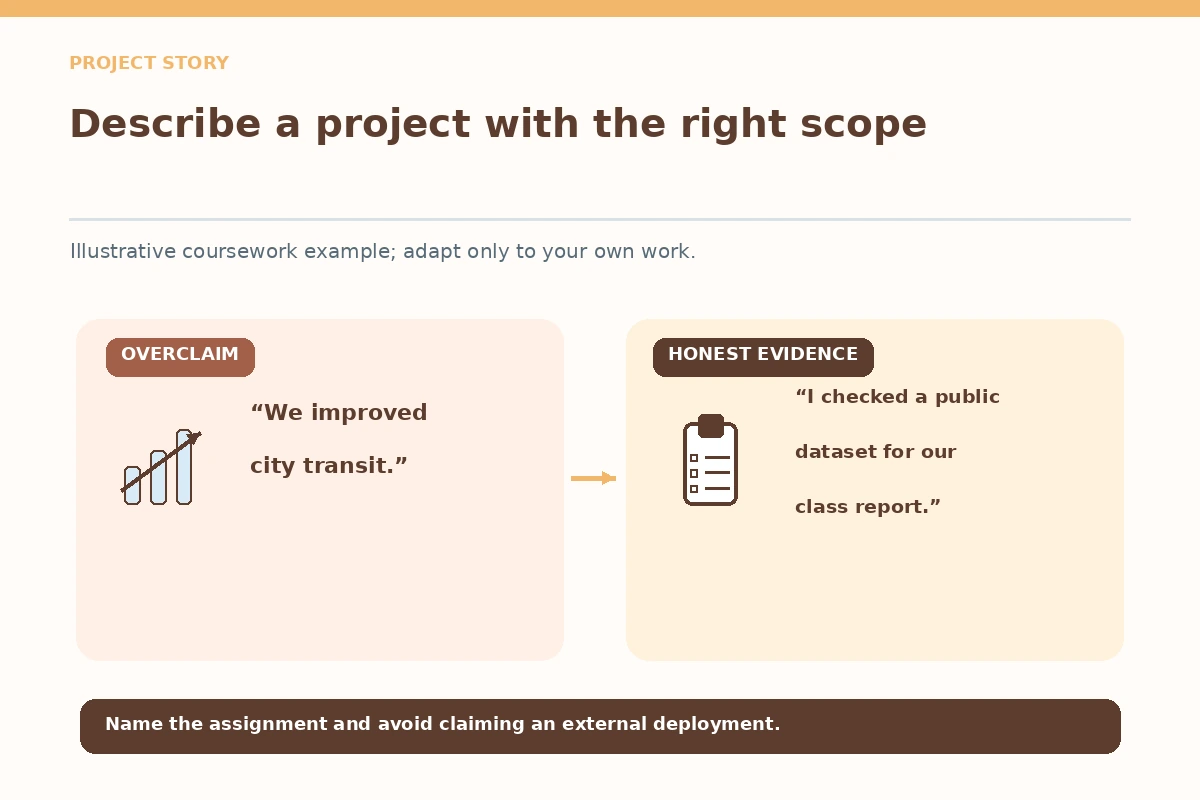
Take a fictional graduate project in which a small team compared local transit schedules using publicly available data. A vague answer would be “We developed a world-class transport platform and improved city mobility.” A defensible account would say: “Our class team cleaned a public dataset for a course presentation. I checked missing station codes, documented exceptions and explained the limitations in our slides. The instructor reviewed the project; it was not deployed by a transit agency.” These are illustrative details, not a real student’s achievement.
Now identify the transferable behavior: validating inputs, documenting a decision and communicating a limitation. If a job requires production database management, that experience is related but not identical. Explain what you know and what supervision or training you would need. This approach lets the interviewer evaluate actual readiness. Your answer should not turn a satisfactory grade into a guaranteed workplace performance metric, or a team assignment into a sole-authored commercial product.
Prepare the three questions graduates often need to connect
One common line of questioning asks “Why this job?” Answer from researched tasks and what interests you about the work, not flattery. Another asks “Tell me about a project you are proud of.” Explain your individual decisions and evidence. A third asks “What would you need to learn?” Name a realistic gap and your approach to training. These questions work together: interest, transferable work and an accurate development plan. They are practice prompts, not a prediction of an employer’s exact interview.
For a hypothetical entry-level operations analyst: “I enjoyed checking and communicating project data in my coursework. I’m interested in this role’s reporting and process-improvement work. I have not owned a production reporting schedule, so I would learn your review and approval process before changing outputs.” This signals useful preparation while respecting real team controls. Replace the sample with your actual degree, role requirements and experience. Do not imply any specific employer promises training if none were stated.
Practice ownership and outcome questions without exaggeration
Team projects are normal in graduate education, but interviewers may ask what you actually contributed. Prepare a version of each story that identifies your deliverable, inputs, methods and review. Then identify one contribution from a teammate. If you say “we launched,” be prepared to explain whether the work was a class prototype, a research publication or a deployed tool. If you lack a number, describe the observable output rather than inventing an accuracy gain or client savings.
Consider what you would do differently next time. A truthful improvement may be checking assumptions earlier or asking for clearer task allocation. Avoid the stock answer that your weakness is working too hard. Link learning to a specific task and process. The STAR structure described in university career guidance can organize a past example, but it cannot substitute for actual evidence. When you do not know a technical answer, explain what you would verify and where you would seek a review.
Research the workplace and choose useful questions
Study the employer’s official description of the team’s work and the vacancy’s responsibilities. Draft questions that help you assess the work: how new analysts receive feedback, which decisions need review, what an early project deliverable looks like, or how cross-team handoffs happen. Avoid asking for privileged strategy documents or assuming that a small employer has a formal graduate training program. A good question demonstrates a realistic understanding of what you can contribute and what remains to learn.
Match preparation to the invitation: phone conversation, structured panel, technical assessment, work sample or virtual meeting. Verify logistics, permitted notes and format rather than depending on an internet list of generic interview questions. If a timed task is required, practice with public or self-created example material, not leaked employer content. For a portfolio discussion, select authorized artifacts and prepare to explain what they prove and what they do not.

Audit your final examples for truthful professional scope
Review degree completion dates, research status, internship titles, group membership and software proficiency. If your degree is in progress, say so. If you used a library for one class, do not claim expert administration of the entire system. If you supported a supervisor, use assisted, analyzed or drafted rather than approved or directed. Strong early-career candidates can be clear about a real contribution without claiming senior responsibility they have not held.
Create a compact interview sheet: three job tasks, three relevant examples, a skill gap with a learning plan, and two questions grounded in the vacancy. Practice saying the connection in ordinary language. The employer still makes its own decision and may require experience you have not yet obtained; this article does not promise interview success. It gives graduates a truthful way to present academic evidence as related experience rather than pretending an assignment was a paid job.
How We Research Interview Preparation
JobAsk checked these occupational and university sources on November 4, 2026: Penn graduate interviewing guide (Graduate students can prepare interview stories by researching positions and structuring evidence). Penn masters career experience guidance (Masters students can draw concrete interview examples from academic and professional experiences). Penn transferable skills workshop (Graduate researchers can translate academic problem-solving, writing and collaboration for nonacademic roles). University of Washington STAR guidance (Behavioral answers benefit from context, specific personal actions and results). Source material describes general practices, not the private interview scoring scheme, exact schedule or requirements of a particular employer.
Every modeled question, quoted interview answer, classroom scenario and sample exercise here is hypothetical. Always use the real invitation, your own experience, and employer-specific rules; never disclose restricted or identifying work records. Review the site’s affiliate disclosure. We do not claim sponsorship, preferential access to interview questions, or guaranteed hiring outcomes.
More Interview Preparation Guides
Yes. Explain the assignment, your personal contribution and the actual deliverable, without presenting it as paid client work.
Use relevant internships, supervised projects, research and student organization work, with clear labels and honest scope.
Specify what you did and what others delivered. Do not claim sole ownership of a group outcome.
No. Identify the current stage, what has been verified and what remains to be tested or reviewed.
When relevant, yes. Pair a specific gap with an appropriate plan to learn procedures and obtain feedback.