
Academic job interview preparation: Academic hiring interviews are not one long version of a standard corporate interview. A first-round committee conversation, research presentation, teaching demonstration and campus visit may have different audiences and expectations. Prepare each separately from the invitation and department context, while preserving accurate claims about publications, funding, teaching authority and collaborators. Not every academic job includes every exercise.
Decode the academic interview invitation into separate tasks
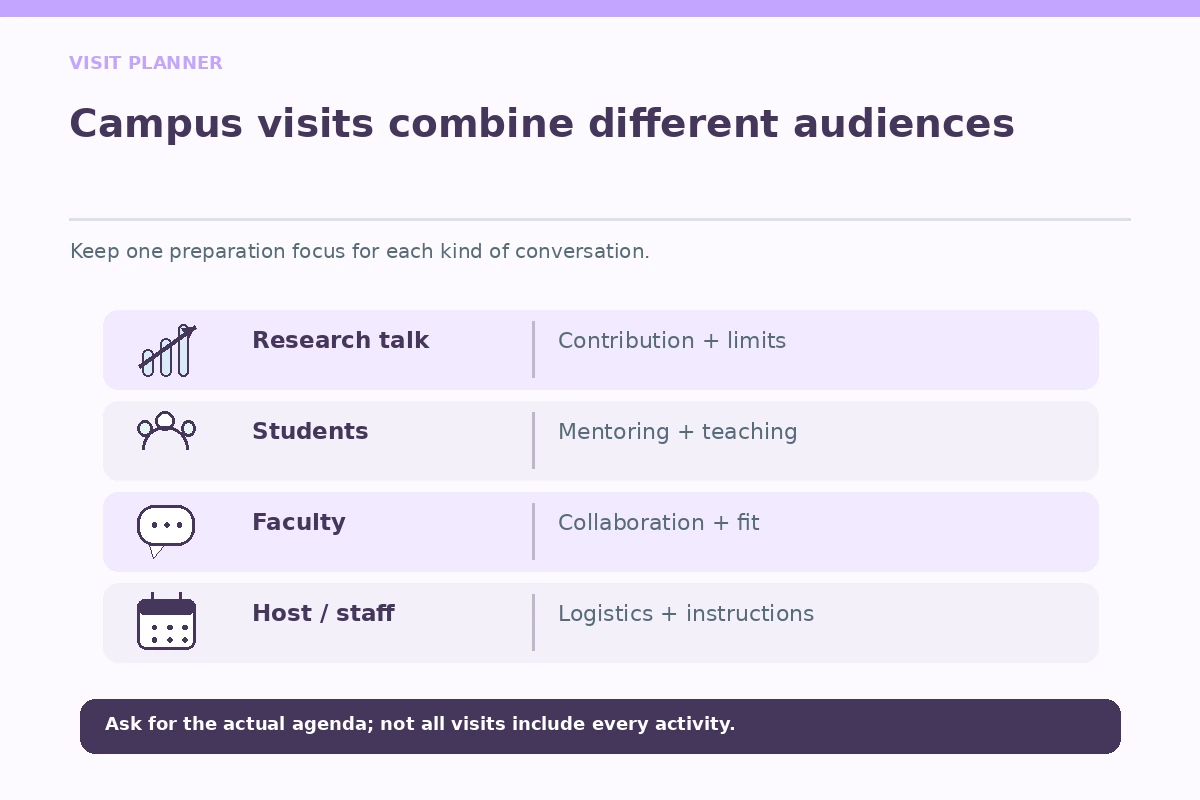
Read the invitation line by line. Identify whether it is an initial online committee interview, a campus visit, a research talk, a teaching demonstration or a sequence of meetings. Ask for the scheduled audience, time limits, topic instructions, technology and venue details where the invitation is unclear. A faculty campus visit often involves several activities, but the exact process varies by institution, discipline and rank. Illinois Graduate College describes job talks, meetings with faculty and students, and sometimes teaching demonstrations.
Build a preparation table with four columns: activity, intended audience, what the committee asked for and what you need to verify. A thirty-minute research talk requires a different structure than a short seminar discussion or a classroom demonstration. Never assume a teaching-focused position eliminates the need to explain research, or a research-intensive position has no teaching questions. Make the materials appropriate to the real posted role rather than copying another department’s interview schedule.
Build a research talk for listeners outside your subfield
A campus audience can include specialists, neighboring disciplines, students and administrators. Begin with an accessible problem and why it matters before moving to your method and contribution. Explain the research question, a defensible approach, the evidence and limitations, then the next research direction. An impressive list of publications is not the same as a coherent account of your intellectual contribution. Where work is coauthored, give accurate credit and describe your own part. Do not show unpublished or restricted material without permission.
Harvard’s recent search-committee guidance recommends clarifying expectations with the committee chair and making the talk accessible beyond one’s specialty. Prepare a short plain-English explanation and an optional deeper explanation for expert questions. Test slides on a normal screen, not only your laptop. Label charts, define terms and avoid unsupported claims about results or future grants. If an experiment is ongoing, identify it as ongoing rather than stating a completed finding. Your practice audience should include at least one person outside your specialization.

Treat a teaching demonstration as a lesson, not a research defense
Request the class level, subject, session length, what students already covered and whether the demonstration will include students or only observers. Plan a specific learning objective, a short explanation, an activity or question that lets learners demonstrate understanding, and a closing check. A teaching demonstration is not simply condensed lecture slides. For an introductory course, a clear example and thoughtful pacing can matter more than technical density. Keep backup materials ready if technology fails.
For a hypothetical ten-minute demonstration on evaluating evidence, the objective might be “distinguish a claim from its supporting observation.” The instructor could present two short examples, invite participants to identify the actual evidence, and close by checking their reasoning. Replace this sample with the discipline and level specified in the invitation. Do not assert that you have independently taught a course when you assisted, guest lectured or worked under a faculty supervisor. State the teaching scope exactly.
Plan conversations with faculty, students, and administrators
Each meeting can have a different legitimate focus. Faculty might ask about research fit, collaboration and future questions; students may ask about mentoring and course design; administrators may discuss departmental priorities and institutional procedures. Prepare two genuine questions for each audience and avoid answers that pretend one school is interchangeable with another. Study the department’s public curriculum, research areas and program structure, but do not claim access to internal budgets or undisclosed strategic plans.
Develop a clear statement of your teaching and mentoring practices grounded in events you participated in. A graduate mentor can discuss how they provided feedback on a draft, what they changed after a student question, or how they referred a student to an appropriate support office. Avoid sharing identifiable student records or describing private personnel matters. On a campus visit, be respectful to every participant and keep meals and informal conversations professional. They are part of understanding mutual fit, not an invitation to reveal confidential information.

Prepare defensible answers about authorship, projects and plans
Search committees may ask which work you led, what remains incomplete, which collaborators contributed and how you would develop future projects. Prepare a contribution statement for each significant project: your research question, method or design responsibility, collaborators’ roles, evidence, limits and next step. For papers under review, use their actual status. For grant concepts, distinguish proposals, applications and awards. A plan for future funding is not evidence that funds have already been awarded.
You may be asked how your scholarship would connect to available facilities, students or external partners. Use published information and explicitly label assumptions. If a teaching load or equipment access is unknown, ask rather than promising activities that require resources you have not confirmed. An answer that names a potential constraint and a thoughtful adjustment can be more responsible than an unconditional promise. Keep citations and figures in your slides traceable to research you can discuss.
Map the campus schedule and protect your materials
Ask for the agenda, contacts, presentation room, technology format and any travel or lodging instructions. A schedule may be tightly packed; carry the materials you must not lose in an approved secure form, with an offline copy if permitted. Confirm expectations about recording, unpublished research, remote meeting links and accessibility arrangements through the host. Do not assume expenses or reimbursement details; institutional policies vary. Keep personal information and sensitive research files separate from shared slide decks.
Practice transitions: one short research introduction, one teaching-method example and a concise answer about collaboration. During question time, identify the question before answering; it is acceptable to say a result is still being tested or that a policy must be confirmed. You can follow up on a factual question with a source later if the department invites it. Log who you spoke with only to support professional follow-up, not to compile personal student data or publish private remarks.
Perform an academic truth-and-fit review after rehearsing
Check academic titles, degree status, appointment type, teaching role, authorship order and funding status against your CV and public record. If a teaching session is hypothetical, say so; if your mentoring was informal, do not call it an official advisor appointment. Align every visual with its claim. A well-structured talk has a clear premise and evidence; a useful teaching demonstration has a learning objective and a way to assess understanding; good campus questions reflect the actual institution.
This guide is a preparation framework, not a promise that every search follows the same sequence or that an applicant will receive an offer. Use the committee’s invitation as the controlling brief. After the visit, send relevant thanks through an appropriate channel, keep an accurate record of the process, and evaluate whether the responsibilities and support fit your goals. Avoid treating one awkward question as a hidden hiring decision, and do not disclose committee conversations publicly.
How We Research Interview Preparation
JobAsk checked these occupational and university sources on November 4, 2026: Illinois Graduate College faculty interviewing (Faculty campus interviews can include research talks, teaching demonstrations, meetings, and meals). Harvard search committee guidance (Search committees advise tailoring research talks for mixed audiences and clarifying teaching demonstration expectations). Harvard teaching-centered faculty guidance (Teaching-centered institutions value clear pedagogical examples and teaching demonstrations). Source material describes general practices, not the private interview scoring scheme, exact schedule or requirements of a particular employer.
Every modeled question, quoted interview answer, classroom scenario and sample exercise here is hypothetical. Always use the real invitation, your own experience, and employer-specific rules; never disclose restricted or identifying work records. Review the site’s affiliate disclosure. We do not claim sponsorship, preferential access to interview questions, or guaranteed hiring outcomes.
More Interview Preparation Guides
No. Campus formats vary. Confirm the exercises and audiences from the invitation.
Open at a level accessible to the broader audience, then provide enough method and evidence for specialists to ask substantive questions.
Only if its level, objective, timing and activities match the committee’s brief. Adapt it to the specified learners.
Identify your precise contribution and acknowledge collaborators. Do not imply sole authorship or finalized work.
Yes, respectfully, using questions tied to research, teaching and the role. Do not assume unconfirmed funding or facilities.