
Virtual assessment center preparation: A virtual assessment center may combine interviews, timed case exercises, group discussions, writing tasks and individual presentations on one online schedule. It is not simply another video interview. Prepare for the stated exercises and observable work behaviors, verify which tools and materials are permitted, and make an honest technical contingency plan. The exact sequence and scoring remain employer-specific.
Understand assessment centers as several different observations
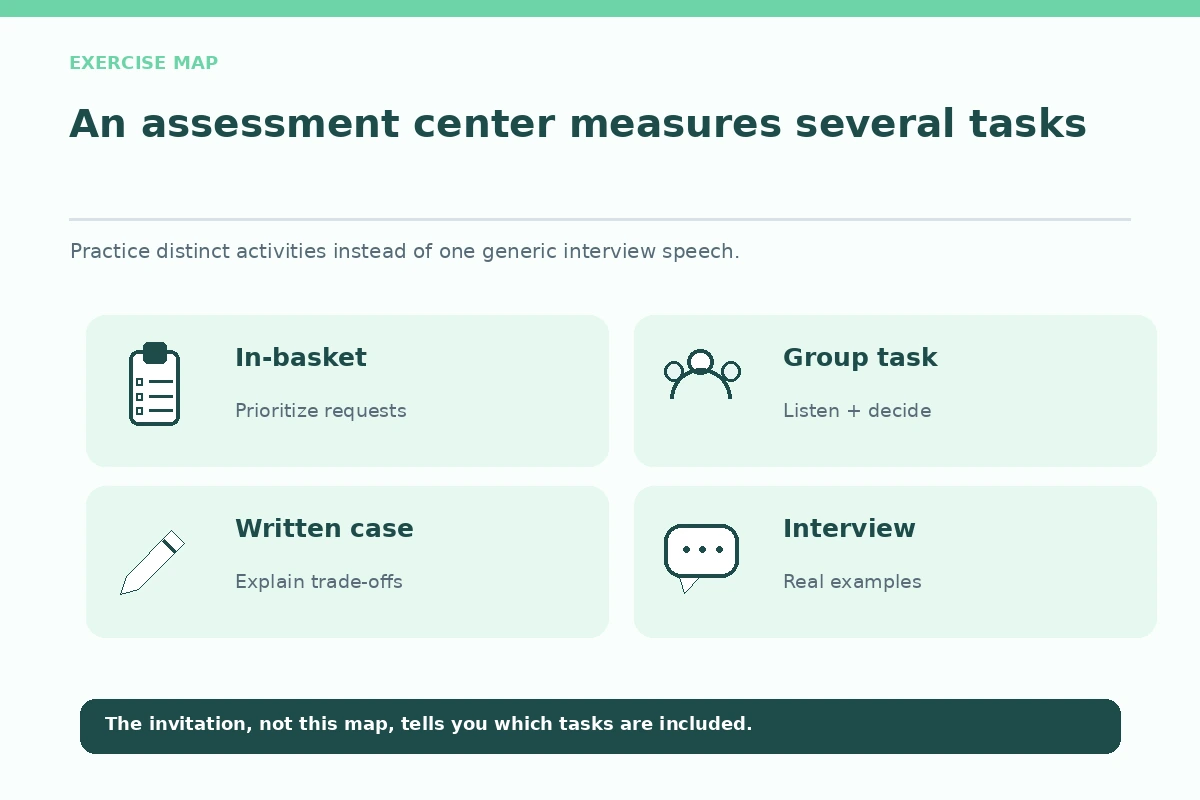
OPM explains that assessment centers combine multiple methods and exercises rather than being one place or test. An in-basket exercise may simulate handling incoming messages; a group exercise may ask candidates to solve a shared problem; a work sample may require a written recommendation or other job-related output. Read the employer’s invitation to determine what is included in your virtual event. Do not assume every assessment center uses a personality test, a ranking game or the same group format.
Create an exercise map with task, likely observable behavior, deliverable and question for the recruiter. A writing exercise might reveal whether you can separate facts from recommendations; a group conversation may reveal how you listen, explain trade-offs and support a decision; an interview may ask for evidence from prior work. These are preparation interpretations, not an employer’s official score sheet. Avoid coaching yourself to perform a personality or dominate others as a scoring trick.
Prepare an in-basket or prioritization exercise with a method
In a fictional exercise, a coordinator receives a routine request, an incomplete urgent message and a deadline reminder. A reasonable approach starts by reading all items, checking the stated priority rules, identifying missing facts and flagging authority limits. Then draft a concise action list: what you would address, what needs clarification, what would be escalated and why. Do not invent approvals, customer responses or a policy that the task materials never gave you. Make assumptions visible when the prompt permits it.
Your answer may be assessed for reasoning rather than a single magic order. Say which facts cause a priority to change and how you would document the decision. If the exercise states a fixed time limit, reserve a portion for reviewing your output; do not use invented numerical productivity claims to impress the evaluator. In a virtual format, verify whether the task uses a browser window, downloadable file or shared platform, and ask how submissions are made before the start when possible.
Contribute to a group exercise without controlling the room
In a group task, demonstrate how you help the team reason toward a result. Listen to a peer’s proposal, identify the shared objective, suggest a simple decision criterion, and keep the discussion connected to the prompt. If conversation stalls, ask a clarifying question or summarize the remaining options. If someone has not spoken and time permits, invite their viewpoint without putting them on the spot. Your visible contribution is collaboration and clear thought, not acting as the unofficial examiner.
A fictional online group might need to choose which community event requests to schedule using limited room availability. A useful contribution is “We have two constraints: time and accessibility. Can we list the options against those first?” A poor move is claiming final authority or describing other participants as weak. Do not share screenshots, recordings or identities of fellow applicants without permission. Follow any rule about private notes, chat tools and permitted collaboration.
Adjust presentations and written outputs to the remote brief
For a short presentation, identify the decision the audience needs, state the main recommendation, explain two supporting observations and name the important uncertainty. Test whether the screen-share layout remains legible in a small window. For a writing exercise, use concise headings, distinguish facts from assumptions, and answer each requested subquestion. If the instruction forbids external help or AI-generated content, follow that rule. Never submit a teammate’s writing or external material as your own.
Where a case includes restricted or fictional client data, use only the materials provided through authorized channels and do not save or redistribute them afterward. A remote format can make it tempting to open external notes, but permitted resources vary. Ask first. A persuasive answer is not one that guesses the evaluator’s hidden preferred conclusion; it shows the quality of the reasoning and how the outcome follows from the stated evidence.

Build a remote setup plan with a real fallback
Confirm the meeting platform, time zone, entry link, required identity checks, browser compatibility, microphone, camera and any exercise software. Test your equipment in a comparable call and close distracting notifications. Keep an approved alternative contact method available in case the connection fails; this might be a recruiter email or a number supplied in the invitation. Do not assume you may switch devices, use a phone for every exercise, or record the session. The invitation takes priority.
If technology fails, preserve an accurate record of the problem, contact the designated organizer promptly and follow their instructions. Do not claim that all employers automatically grant a retake. For accessibility or participation needs, use the employer’s stated process to request appropriate arrangements before the event where feasible. Your contingency plan should include both who to contact and how you can rejoin, not just “have backup Wi-Fi.” Keep private assessment material secure.
Practice transitions between exercises rather than one perfect answer
A virtual center may require you to move quickly among solo work, group rooms and direct questions. Rehearse noticing what each activity asks you to produce. At the end of a writing task, verify the submission is complete; when joining a group, listen for the current decision; in a structured interview, respond to the actual question. Different exercises can reveal different strengths. One weak moment does not reveal the assessors’ hidden overall score.
Consider a practice run with a short inbox exercise, a timed discussion of a fictional resource trade-off, and a concise spoken recommendation. Focus the debrief on clarity, assumptions, listening and integrity, not competitive comparison with other candidates. Write down examples of where you corrected a misunderstanding or asked for missing evidence. Do not let the same generic script replace independent reasoning across tasks. Avoid rehearsals that require restricted employer materials or sharing previous candidates’ confidential exercises.

Finish with a compliance and deliverable check
Before the session, confirm the actual list of exercises, the allowed resources, platform links, deadlines and how your work will be collected. For each possible exercise, make a small reminder: read the instructions, determine the question, clarify assumptions, state your reasoning, review the deliverable. Keep the reminders short enough to use without appearing distracted. A candidate cannot know the employer’s proprietary scoring decisions unless these have been provided; do not purchase supposed insider answers or fabricate expected results.
After the event, confirm any required submission receipt through the approved channel and record the next communication date if one is provided. Do not publish or reuse proprietary prompts. An assessment center can offer several opportunities to demonstrate useful skills, but the actual outcome depends on the employer’s process. Your best preparation is competent work under the stated rules, with a practical remote fallback, rather than performance tricks or exaggerated expertise.
How We Research Interview Preparation
JobAsk checked these occupational and university sources on November 4, 2026: OPM assessment centers (Assessment centers combine several exercises, including in-basket and group discussions, to observe job-related competencies). OPM work samples and simulations (Work samples simulate job activities and assess observable task performance). Prospects assessment centers overview (Assessment centers can include group tasks, tests, presentations and interviews). Source material describes general practices, not the private interview scoring scheme, exact schedule or requirements of a particular employer.
Every modeled question, quoted interview answer, classroom scenario and sample exercise here is hypothetical. Always use the real invitation, your own experience, and employer-specific rules; never disclose restricted or identifying work records. Review the site’s affiliate disclosure. We do not claim sponsorship, preferential access to interview questions, or guaranteed hiring outcomes.
More Interview Preparation Guides
No. It may combine interviews with individual and group exercises, timed tasks and presentations. Check the actual invitation.
No. Show listening, structured reasoning and an appropriate contribution rather than trying to control the group.
Only when the employer’s exercise instructions permit them. If unclear, ask the organizer before starting.
Use the official backup contact and reentry instructions. A reschedule or retake is not automatic.
Methods vary by employer and exercise. Do not assume a publicly available universal rubric or invent a score.