
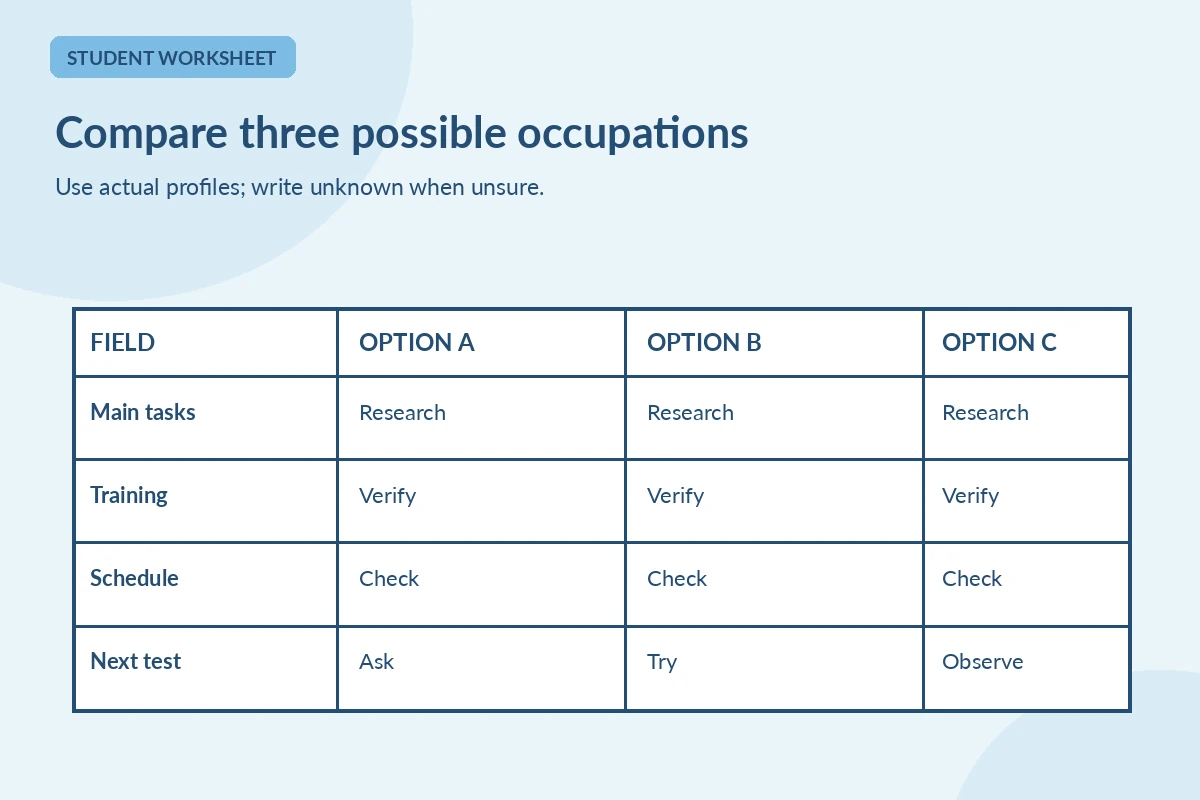
A useful career exploration worksheet for high school students should help you compare real work, not force you to choose a lifelong job. Pick three occupations that seem interesting, then record what people do, typical entry training, work conditions and one safe way to learn more. Use My Next Move and the US Bureau of Labor Statistics Occupational Outlook Handbook for research, and verify program-specific rules with a school counselor or training provider. The right outcome is a next question or experiment, not a permanent label or a promise that a particular major guarantees work.
Start with three roles rather than a dream title
Write down a job you already know, a related job with a different type of daily work and an unfamiliar job from an area you want to explore. For example, a student interested in helping people might investigate a school administrative role, a community outreach role and an IT help-desk role. These are illustrative options, not a personal recommendation. Avoid choosing three almost identical job titles, because then the exercise will reveal little about what kind of tasks you prefer.
For each job, describe the daily activity in plain language. Do not write “helps people” for every role; identify whether someone answers questions, troubleshoots devices, coordinates appointments or keeps records. My Next Move provides occupation summaries with tasks and skills, while BLS profiles explain work conditions and typical training. If the exact title is not listed, look for the nearest occupational profile and make a note of the difference instead of pretending it is the same job.
Use a worksheet that separates facts from guesses
Create columns for occupation, three real duties, possible workplaces, normal training route, hours or environment, source, and unanswered questions. Record where you found each detail. If a website says that many workers have a particular type of education, do not rewrite that as a legal requirement for every vacancy. Some roles have state-dependent licenses or employer-specific credentials. Mark anything you cannot confirm as unknown, especially costs, program admission rules and which tasks are restricted.
A sample row might say “IT support—answers user requests, documents problems, escalates complex issues—verify training from occupation profile; ask a professional about shifts.” That is more honest than “requires a four-year degree, pays six figures” without context. The worksheet is most helpful when it identifies research gaps. If the role you are investigating has health or safety responsibilities, avoid suggesting that a student can perform the work without the required training or direct supervision.
Compare education routes without assuming college is the only one
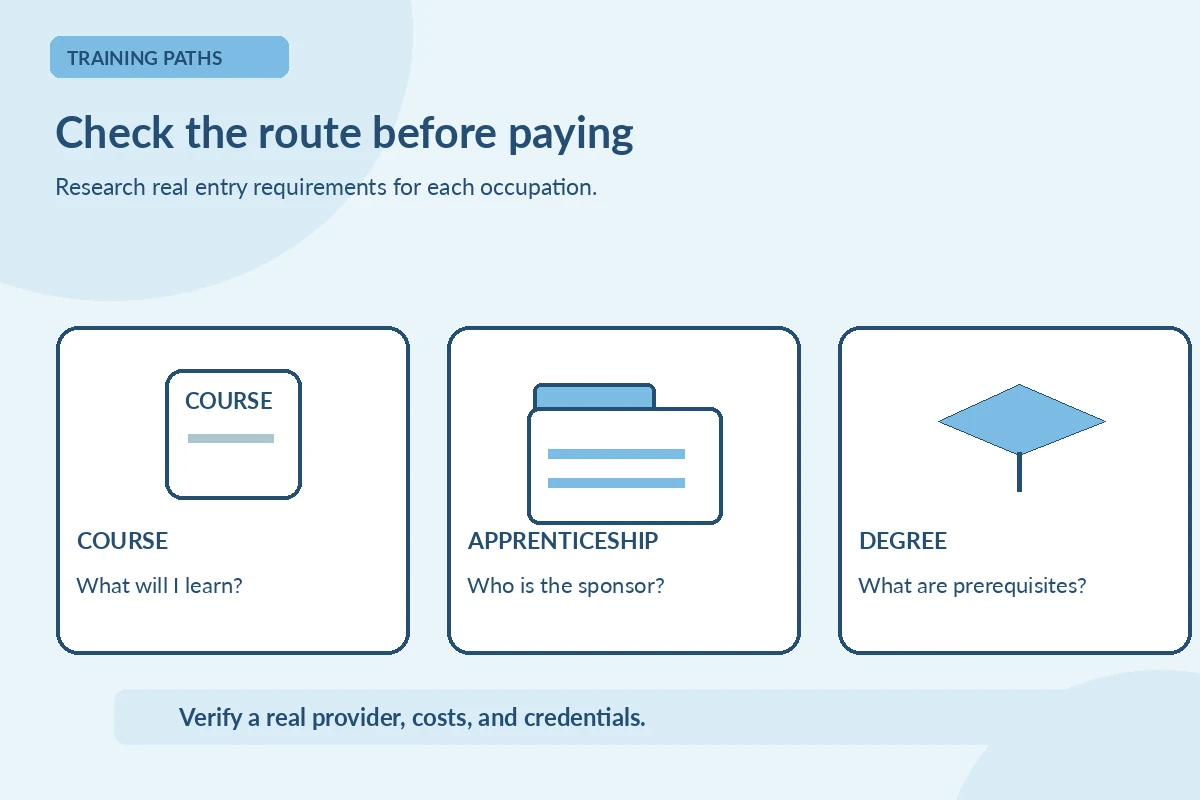
BLS occupational profiles describe typical educational entry levels, work experience and on-the-job training. Use that overview, then look at actual admission requirements for programs in your area. Depending on the occupation, relevant routes may include a degree, approved certificate, paid training, apprenticeship or employer-supported experience. Apprenticeship.gov describes registered apprenticeships as combining paid employment and related instruction, but open opportunities and application rules are specific to each sponsor.
Distinguish “possible pathway” from “accepted credential.” A course you find online may teach a skill but not meet licensing or accreditation requirements. Ask a counselor or the relevant authority what credentials count and whether prior classes transfer. Before paying for a program, compare actual fees, schedule, prerequisites and completion requirements using the official program’s information. Avoid claims that a single certificate guarantees a role or that a student can skip mandatory supervised practice.
Test each career idea with a permission-safe activity
An experiment can be small: watch a recorded professional talk from a trusted source, build a practice spreadsheet with fictional data, ask a guest speaker about a routine workday or arrange a school-approved workplace observation. If you are a minor, use your school’s procedures and a parent or guardian when required. Do not volunteer to access private customer records, clinical situations, financial transactions, hazardous equipment or other tasks you are not authorized to handle. Observation itself may also be restricted.
Write one thing you liked, one thing that surprised you and one skill or rule you still need to learn. A short structured conversation with a school counselor or approved mentor may reveal more than a long personality quiz. Be respectful of professionals’ time and privacy. Do not publish personal contact information or images from a workplace without permission. The experiment helps answer whether everyday tasks fit your interests, not whether an employer will hire you.
Include work conditions and life constraints
Consider typical schedule, physical environment, contact with the public, commuting needs and training duration. The BLS Occupational Outlook Handbook has a Work Environment section that can help identify typical settings, but individual employers differ. If a field commonly involves night shifts or prolonged standing, that might matter to you even if the job tasks sound appealing. Do not assume every role offers remote work or every employer pays for training.
Your current interests may coexist with practical constraints: transportation, family obligations, school course availability, accessibility needs or budget. You do not need to publish private details in your worksheet. Use a simple marker—feasible now, needs research or not feasible under current conditions—and explain why. A career choice often becomes clearer after comparing conditions with authentic requirements rather than ranking occupations on prestige or one advertised salary.
Ask better questions before choosing next-year classes
Take your worksheet to a counselor and ask which classes develop transferable skills, how to sample an occupation safely and which local programs have reliable requirements. A student who likes organizing information could test a statistics course, writing project or technology class without making an irreversible commitment to one major. Ask what the course actually teaches and how it relates to potential occupations; the name alone may be misleading.
If the path involves regulated work, seek official program or licensing guidance rather than anecdotal advice from a video. Plan a realistic next action during the school year, such as an informational interview, a course question or a public-data project. Track that action and revisit the worksheet afterward. A strong plan preserves alternatives and does not pretend that high school interests determine a single permanent future.

Complete the worksheet with a comparison, not a winner
After researching three occupations, circle the one you want to explore next—not necessarily the highest-paying or most familiar. Write what evidence made it worth another test, what important requirement remains unclear and who can help verify it. You might discover that none is a great fit; in that case choose a fourth option informed by what you learned. Career exploration is a process of eliminating unsupported assumptions and building questions you can actually answer.
Keep copies of sources and dates, not other people’s private data. Record an occupation profile separately from a local job ad, since the latter may have requirements that differ from national descriptions. Use the completed worksheet to guide another conversation, course choice or supervised experience. Its value is in your better reasoning and safer next step, not in producing a polished document for an adult to grade as a final career decision.
Use this practical comparison worksheet
This table uses illustrative examples rather than actual candidate results or employer promises. Adapt its fields to legitimate requirements, your own work history, and the support or permission available in your setting.
| Worksheet field | Illustrative response | Verification |
|---|---|---|
| Occupation | IT support specialist | Find closest O*NET/BLS profile |
| Daily tasks | Triage and log user requests | Read actual task descriptions |
| Training | Possible routes differ | Check a legitimate program |
| Career test | School-approved Q&A | Obtain required permission |
How We Research Career Planning
JobAsk compared this topic with the user-provided WordPress article inventory and reviewed public search results, US career research resources and primary occupational guidance on November 6, 2026. Examples are hypothetical, not verified testimonials or hiring outcomes. Any role-specific authorization, educational program or employer policy must be confirmed separately. See our affiliate disclosure.
Sources checked November 6, 2026: www.mynextmove.org — My Next Move shows typical tasks, skills, training and career information for occupations and links to interest exploration.; www.bls.gov — BLS Occupational Outlook Handbook profiles describe occupation duties, working conditions, typical training, wages and outlook, not personal hiring guarantees.; www.bls.gov — BLS Occupation Finder and Handbook let readers compare training, responsibilities, environment and job outlook across occupations.; www.apprenticeship.gov — Apprenticeship.gov describes registered apprenticeship as paid work plus related instruction and employer- or sponsor-specific applications.; www.onetcenter.org — O*NET Interest Profiler identifies six occupational interest areas and offers career-starter materials; scores are exploration leads, not hiring credentials..
Explore Related Career Guides
Three contrasting options make an effective first comparison; add more if your initial list is too similar.
No. The purpose is to learn about duties, entry routes and feasible next experiments rather than make a lifetime commitment.
No. Schools, employers, age rules, confidentiality and safety requirements may limit observation; arrange only approved experiences.
No. Profiles describe common occupation characteristics, while an individual job posting may have additional requirements.
Research accredited programs, financial and time requirements, alternatives and legitimate advice before committing to paid training.