
An individual development plan (IDP) is a short, adjustable record of a skill you want to build, how you will practice it, what help you need, and how you and a manager will recognize progress. Start with one objective that matters to your current or next job. Write a real activity, a check-in date and observable evidence; do not treat finishing a course as proof of competence. The US Office of Personnel Management describes IDPs as ongoing employee-supervisor partnerships, not stand-alone performance appraisals. An employer may use its own form, so follow that process first.
Choose a development objective instead of a vague wish
“Become more professional” gives neither an employee nor a supervisor a clear basis for learning. Instead, identify an observable capability: writing accurate shift handoffs, presenting a concise project status update, organizing intake records or describing quality exceptions. Ask what task you can already perform and which part still needs guidance. Review the current job description, recent work, and feedback you can disclose appropriately. A development goal should represent your own work, not a convenient aspiration copied from someone else’s performance review.
A fictional office support employee might write: “By the next review, prepare a weekly handoff note that identifies unresolved requests, responsible owners and questions requiring a supervisor’s decision.” This is a learning objective, not permission to make final decisions. A strong IDP contains a narrower, testable next action than a generic career goal. It leaves room for the supervisor to suggest a more relevant competency or a different standard based on actual job duties.
Use a one-page plan with distinct fields
The employee profile, current role, development skill, learning action, support, target date, success evidence and next review can fit in a concise table. OPM’s career-development guidance lists goals, developmental objectives, activities, estimated and actual dates, and employee-supervisor agreement among common IDP elements. It also cautions that agencies have their own rules. The point is not to impose a universal form on every employer; it is to capture decisions that otherwise get lost between meetings.
Keep learning activities separate from measurements. “Attend training” describes an activity, but the result should reflect a skill demonstrated in work. In a hypothetical example, the employee might shadow a coordinator, draft two practice handoffs using approved sample information and request feedback. The reviewer could compare them with an agreed checklist for clarity and escalation. Record what actually happened, including a rescheduled session; do not fill in results before you have evidence.

Agree on access, time, and support before practicing
A development activity may require manager approval, a mentor, a safe data set or time during the workweek. Ask who can authorize access and how the practice assignment fits existing duties. A plan to learn scheduling software should not require unauthorized use of staff records. For clinical, financial, technical or security-sensitive work, supervised learning is not equivalent to having a license, credential or permission to perform the task independently. Write the boundary directly into the action field.
The employee can suggest opportunities without promising that the employer will fund a course, alter shifts or provide a promotion. Record support as “request supervisor review of sample reports,” not “manager guarantees access.” If approval is unavailable, agree on a lower-risk alternative: mock documents, a public tutorial, a nonconfidential process map or observation where permitted. A useful plan is feasible within organizational rules and does not silently assume an entitlement to paid training time.
Create evidence that a reviewer can actually inspect
Possible evidence includes a revised checklist, anonymized sample, project debrief, completed training assessment, supervisor-observed demonstration or specific feedback. Choose the kind that matches the skill, then check workplace privacy and ownership rules before storing it. You normally should not upload customer records or restricted screenshots to a personal portfolio. “Completed a webinar” can support learning, but it does not prove that the employee can independently apply a complex procedure without review.
For the handoff example, the employee could prepare a sample status note and ask whether every unresolved issue has an owner and escalation path. The reviewer might mark one item unclear, leading to another practice round. That revision is progress even without a flattering numerical score. Set a reasonable measure: a supervisor can tell whether the note is accurate and usable. Avoid fabricated percentage improvements or claims that the team already adopted a new process.

Schedule a real check-in and change the plan when needed
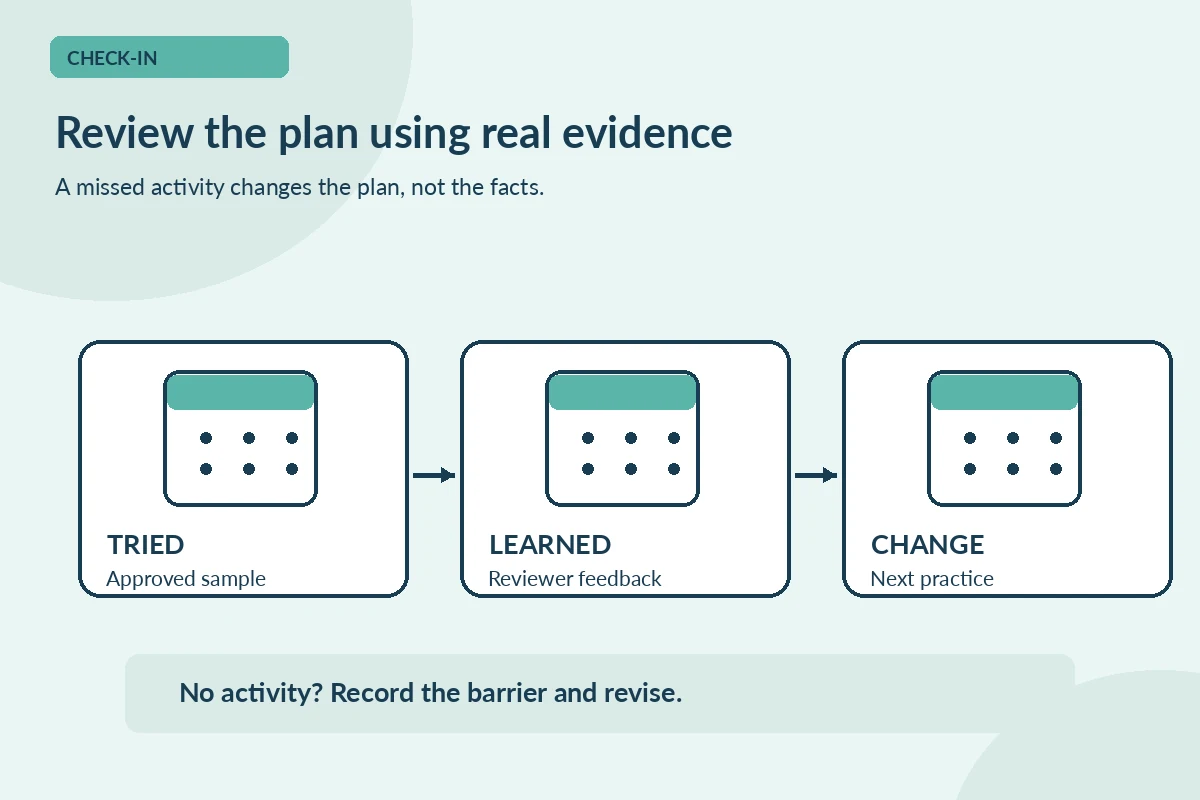
An IDP is not a signed promise that the role or employer will stay unchanged. At the agreed review, bring completed activities, actual feedback and obstacles. Compare progress against the original learning objective and ask what should continue, stop or change. UC Merced’s development plan template separates target completion from a next review date: they serve different purposes. A check-in can happen before the skill is fully developed so that the reviewer can adjust support or scope.
If a project was canceled, do not mark the goal complete; replace the assignment with a comparable, approved exercise. If an activity exposed a different gap, refine the goal and capture that reasoning. A practical review note can be just three lines: what was tried, what the evidence showed and the next approved step. Keep the old version for context rather than silently backdating the plan to make an unfinished activity look completed.
Discuss the plan with your manager without overselling it
Introduce the IDP as a proposal: “I would like to improve our handoff notes and get feedback on two samples. Does this fit the team’s priorities, and who should review them?” This asks for role alignment and supervision rather than implying the manager has promised a new title. OPM says employee and supervisor jointly develop IDPs, but private employers and specific agencies use their own procedures. Respect the meeting format, evaluation boundaries and any union or internal policy that applies.
Do not confuse professional learning with a guaranteed raise or a performance rating. The plan helps structure evidence and conversations, while advancement decisions may involve separate criteria and opportunities. If your manager cannot support the desired activity, ask what is realistically available in the existing role. You can still use a personal version of the plan for self-directed learning, clearly distinguishing it from any official employer-approved document.
Keep the final document specific, secure, and current
Before sharing, check that every objective names a behavior, every action has an owner, every needed resource has a request or approval path, and every measure has a reviewer. Avoid attaching confidential coaching notes, private coworker information or internal files to an outside service. Use employer-approved storage for any workplace plan. Save dates truthfully; a future check-in is not evidence that a skill was achieved. If personal goals differ from current work, state that distinction respectfully.
The most useful IDP will not necessarily be the longest or most ambitious. A single competency, practiced in a real context and reviewed with clear boundaries, can be more defensible than ten aspirational promises. Use it as a living agreement that helps you learn, notice what still needs work and make a better career decision. The objective is an evidence-backed development conversation—not a decorative form or an automatic promotion application.
Use this practical comparison worksheet
This table uses illustrative examples rather than actual candidate results or employer promises. Adapt its fields to legitimate requirements, your own work history, and the support or permission available in your setting.
| Plan field | Illustrative entry | What to verify |
|---|---|---|
| Skill objective | Improve weekly handoff notes | Supervisor agrees on scope |
| Practice activity | Draft two approved samples | No restricted customer data |
| Evidence | Reviewer comments on clarity | Comments are real, not predicted |
| Review | Discuss next practice task | Record actual date and changes |
How We Research Career Planning
JobAsk compared this topic with the user-provided WordPress article inventory and reviewed public search results, US career research resources and primary occupational guidance on November 6, 2026. Examples are hypothetical, not verified testimonials or hiring outcomes. Any role-specific authorization, educational program or employer policy must be confirmed separately. See our affiliate disclosure.
Sources checked November 6, 2026: www.opm.gov — OPM defines an individual development plan as a joint employee-supervisor tool for objectives, learning activities and ongoing feedback; not a performance evaluation.; www.opm.gov — OPM explains that agency-specific processes differ and that employee and supervisor should both contribute to an IDP.; hr.ucmerced.edu — UC Merced IDP template distinguishes development goals, action steps, success measures, completion date and next review.; www.naceweb.org — NACE names career and self-development alongside communication, critical thinking and other career-readiness competencies and observable behaviors..
Explore Related Career Guides
No. OPM distinguishes ongoing development planning from a performance evaluation; follow your employer’s actual process for either.
No. It helps organize learning and evidence, but advancement depends on separate role requirements and decisions.
Not necessarily. One specific goal with meaningful practice and an agreed review can be better than a long unsupported list.
Ask for an authorized alternative such as observation, sample work or a suitable learning activity without assuming access or budget.
Bring completed work you are allowed to share, actual feedback, barriers and a proposed next step; do not prefill fictional results.