
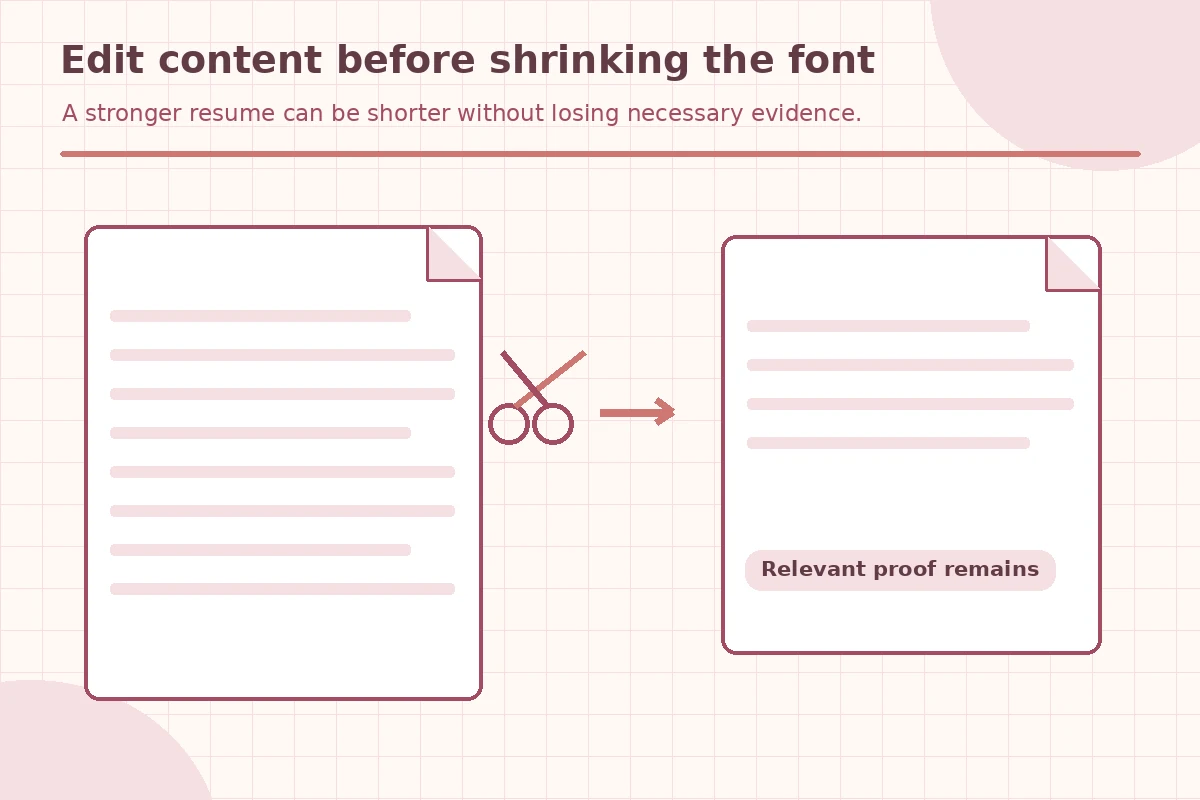
Shorten a resume by removing repetition and low-relevance material before shrinking the font. Start with the target job’s real requirements, identify the strongest verified evidence that you meet them, then prioritize those bullets. Compress routine duties that duplicate better examples and reduce unrelated detail without changing accurate dates or credentials. The objective is a document a reader can evaluate quickly, not a particular page count achieved by hiding proof.
Choose evidence based on the actual vacancy
Read the posting and identify which qualifications, tasks and systems you genuinely know. Match each resume entry to one or more requirements. A bullet about reconciling inventory discrepancies might be directly relevant to a purchasing assistant job but less important for an unrelated role. Decide on importance before removing words. A shorter resume that omits a necessary certification or the only evidence for a required task may be worse than the longer original.
Separate required qualifications from general preferences. The most relevant items should be visible without searching the entire page. A current role may deserve more detail than a very old unrelated one, but the reverse is possible if a past assignment provides the only strong evidence for a specialized skill. Never invent a current job title or rewrite the nature of old work just to make the top section fit.
Classify each bullet as keep, compress, move or remove
Give every bullet one of four labels. Keep a strong, verifiable achievement linked to the role. Compress an important task buried in extra words. Move a secondary experience lower if it is useful but not central. Remove a line that repeats a stronger bullet without adding a meaningful distinction. This is an editing workflow, not an algorithmic grade of the applicant or a promise about what a recruiter will prefer.
Three bullets that all say ‘entered data,’ ‘updated files’ and ‘maintained records’ might describe the same workflow. If accurate, one richer line such as ‘Maintained weekly receiving records and flagged count discrepancies for supervisor review’ can preserve the substantive contribution. Do not merge different jobs into a false single responsibility or imply that you approved records when another employee held that authority.
Replace long introductions with precise actions
A phrase like ‘Responsible for the day-to-day activity of making sure that…’ consumes space without naming an accomplishment. An honest rewrite can begin with the actual verb: ‘Prepared weekly meeting packets for department leads.’ Keep the object and useful context, because ‘Prepared materials’ by itself may be too thin. Use present tense for duties you still perform and past tense for finished work. This improves clarity without expanding the claim.
Numbers should remain only when they are defensible. A fake 40% improvement is not better than a shorter, truthful line without a statistic. If you have genuine counts, frequencies or tracked results, include them when they help a reader understand your scope. Avoid squeezing unrelated metrics into one sentence merely to make it look evidence-rich. Clear tasks and supported outcomes are the goal.
Remove duplicates across the opening and work history
The summary, skills list and experience section should do different work. An opening statement can say which role you fit and identify a key strength; the work section should demonstrate that strength. If ‘organized’ appears in every line, replace generic adjectives with one actual scheduling or records example. Keep the skills section for tools, technical methods or qualifications you really possess rather than repeating the same soft skill across the page.
When two jobs involved similar routine work, allow the more recent or more relevant entry to carry the richer explanation. The older role may need only one or two short bullets. Preserve truthful employer names, titles and dates if they belong in the document or are requested in the application. Editing emphasis is different from concealing employment. Likewise, do not transform volunteer work into formal paid employment to fill an apparent gap.

Reduce less relevant history selectively
CareerOneStop suggests emphasizing work that adds the most value when experience is extensive and keeping unrelated roles concise. That is not an instruction to delete every older job. An older specialist project may deserve space when it directly demonstrates a requirement, even if several more recent roles were in another field. Rank evidence by connection to the next job rather than by age alone.
For a career change, consider retaining a truthful earlier example that proves a transferable skill and compressing newer but unrelated routine duties. Keep the date timeline understandable. If the employer explicitly requires a full history, supply it in the official application form even if the resume itself is selective. Distinguish standard private-sector resumes from federal applications where specialized experience and particular work details can be essential.
| Label | Decision | Reason |
|---|---|---|
| Keep | Required qualification with proof | Direct job fit |
| Compress | Useful task with extra wording | Clarity with less text |
| Move | Relevant but secondary example | Better top-page focus |
| Remove | Duplicated or unrelated claim | Reduce repetition |
| Correct | Unsupported metric or false status | Protect factual accuracy |
Adjust layout only after the content pass
A dense page with tiny text is not automatically better. Before changing margins, shorten redundant sentences, remove unnecessary blank paragraphs and check whether one-word line wraps can be resolved through simple edits. CareerOneStop recommends readable formatting and a straightforward column structure. Complex graphics, text boxes or columns may be difficult for some applicant systems to process; do not assume any design guarantees success or failure everywhere.
Open the exported PDF or other requested format and inspect the document at ordinary viewing size. Do not shrink the font until dates and contact details are hard to see. If an employer gives a specific page or font requirement, follow it. USAJOBS currently describes a two-page federal resume maximum, which makes accurate prioritization important but does not excuse leaving out mandatory qualification evidence.
Check that important proof survived every cut
An over-edited resume may become a list of unsupported adjectives: hardworking, organized, efficient and motivated. Replace one of those labels with a real task where possible. ‘Compared shipment counts with receiving records and reported discrepancies’ is more informative than ‘Excellent attention to detail.’ If a reader cannot tell what you did and where, the shortened resume may need slightly more concrete detail rather than less.
Use a quick what/how/why check: what work did you perform, how or with what tool, and why was it relevant? Not every bullet needs all three parts, but the action and context should remain understandable. Respect confidentiality and do not reveal client information or fabricate savings, customer ratings or productivity numbers. If you cannot support a metric, remove the metric without erasing the actual contribution.

Proofread the exact file that will be submitted
Compare the revised version against the master history and the vacancy. Are the required qualifications easy to see? Did the edit accidentally remove a license, change a job date or make a description imply extra authority? Review tense, punctuation and section headings as well as page count. Check that important links remain usable and that the final file opens on a normal device. A short document should not be harder to verify than the original.
UW–Madison Career Center explains that tailoring may involve reordering material and revising specific bullets rather than rebuilding an entire resume. Preserve the verified master and save the submitted version. The useful measure is whether the next employer can find your real, relevant evidence without wading through repetition. There is no defensible promise that cutting a specific number of words will produce more interviews.
How We Research and Check Resume Guidance
JobAsk compared this question with the supplied WordPress article list, public search results and primary career guidance on November 7, 2026. Examples are hypothetical and do not represent actual applicants or promise any ATS or hiring outcome. Follow the current employer instructions and verify your own facts. Read our affiliate disclosure.
Source: careercenter.education.wisc.edu — UW–Madison Career Center recommends tailoring resumes by reordering and updating relevant evidence.
Source: cloudfront.careeronestop.org — CareerOneStop recommends consistent formatting, readable dates, recognizable acronyms and document names.
Source: cloudfront.careeronestop.org — CareerOneStop explains how to prioritize relevant past positions and verify job details.
Source: careercenter.georgetown.edu — Georgetown Career Center recommends concise claims, consistent punctuation and appropriate tense.
Source: help.usajobs.gov — USAJOBS explains current federal resume length, month-and-year work dates, job-specific qualifications and plain language.
More Resume and Cover Letter Guides
No. Length depends on career history, target role and employer instructions. Current USAJOBS guidance limits federal resumes to two pages.
Remove redundant, low-relevance or unsupported material before deleting evidence that directly demonstrates job qualifications.
Only if readability remains strong and the employer allows it. Cutting repetitive text is usually a better first step than making everything smaller.
It depends on relevance and the application requirements. Do not misstate the timeline or omit history the employer explicitly requests.
Yes, if the consolidated line truthfully represents the work and does not invent extra authority, metrics or a result.