
Spell out resume acronyms when a qualified reader outside your immediate team may not know what they mean. A useful first-mention pattern is the full name followed by initials in parentheses, then shorter wording later if necessary. Widely recognized terms can remain abbreviated when the context is clear. Never put initials after your name to imply a certification you do not hold, and never use internal jargon to hide what you actually did.
Distinguish credentials, public tools and internal shorthand
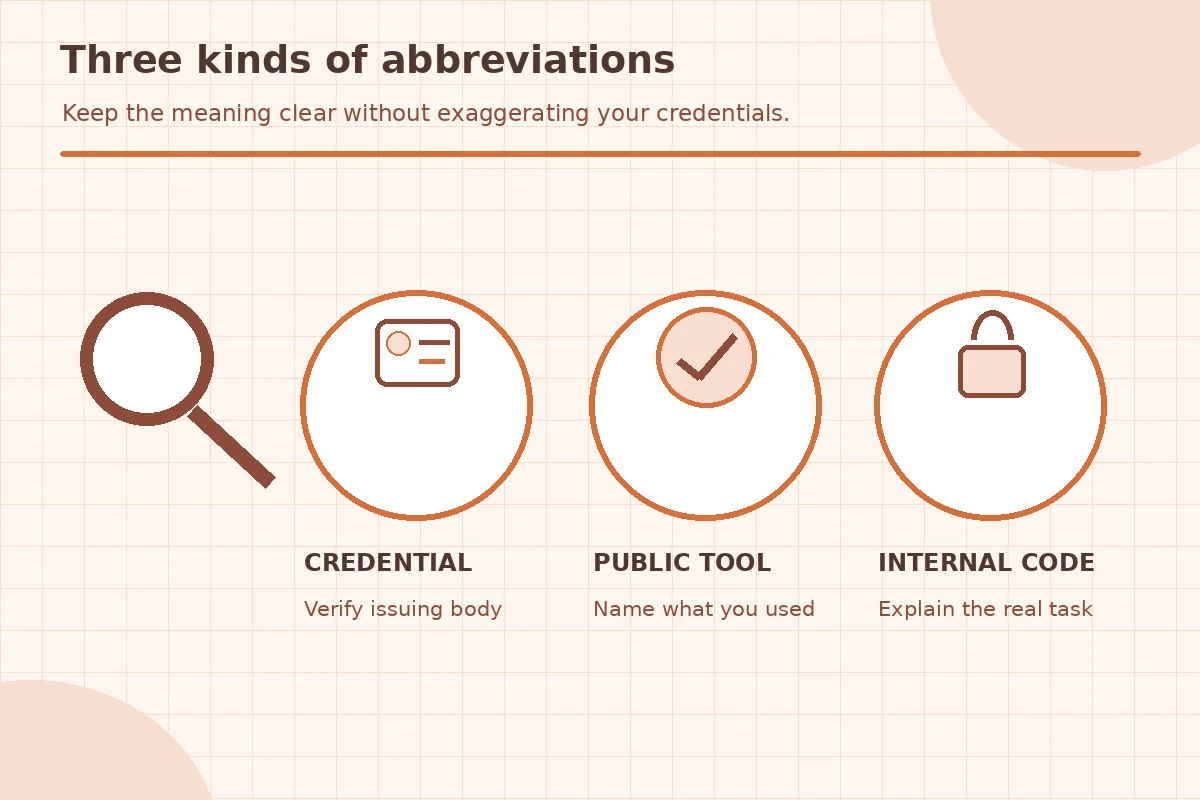
A professional credential has an official name, issuer and sometimes an active-status requirement. A well-known tool or method has a public meaning that your audience may recognize. An internal nickname for a report, customer code or project may be understandable only inside one organization. Those are different writing problems. Start by categorizing each abbreviation rather than automatically spelling out every three-letter group on the page.
Ask a practical reader question: can someone understand your contribution without decoding the initials? ‘Maintained the ARX sheet’ conveys little outside the original team. ‘Maintained the weekly discrepancy log for inventory checks’ explains a transferable task and protects private workflow labels. When the original code is not required to demonstrate qualifications, replace it with a plain-language description rather than a long, unexplained alphabet soup.
Introduce unfamiliar abbreviations at their first useful mention
For an uncommon certification that you truly hold, use the official full designation and the recognized initials in parentheses on first reference. ‘Certified Information Systems Auditor (CISA)’ is an example of a formal credential name, not a suggestion to claim it without being certified. Later references may use the acronym. If the abbreviation appears only once and the full term is short, you may not need the acronym at all.
Common software terms may not need expansion for a specialized technical hiring audience. For a general recruiter, a short clarification can prevent ambiguity. Do not invent a plausible expansion: the same initials can mean different things across industries. Confirm unfamiliar terms with the relevant public documentation or credential issuer. Accuracy matters more than squeezing another search keyword into a skills section.
Verify certification and license wording independently
A credential, a workshop certificate and a course in progress are not interchangeable. Check the correct title, issuing body, expiration date and whether you may legitimately use a designation. If a license or certification is required for the job, the employer may expect a particular status and verification. Do not add initials that suggest your training is completed when the official assessment has not been passed.
For hypothetical administrative experience supporting an IT group, ‘Logged access requests for security team review’ may tell a clearer story than adding security certification acronyms the applicant has never earned. Describe the duties performed and whose approval was required. A recruiter should be able to connect the wording to an actual qualification without interpreting the resume as proof of authority or certification it does not establish.
Replace private product codes with transferable descriptions
An internal dashboard nickname, restricted customer abbreviation or ticket code is unlikely to help a new employer. Describe the nature of the tool and the work you did: ‘Updated service-case records in the support system’ instead of a private code. If you genuinely used a named public product and disclosure is permitted, its actual name can be useful; otherwise a general system category can be both honest and readable.
Be cautious with ambiguous initials. ‘QA’ often means quality assurance, but not necessarily in every workplace. ‘Reviewed quality-assurance checklists for missing inspection records’ is better than ‘Owned QA’ when the applicant performed document checks but did not authorize final product release. Clear descriptions also prevent implied professional powers that belong to a supervisor or a licensed reviewer.

Use job posting terminology only where it is true
A job posting may list many software packages, frameworks and credential initials. Copying all of them into a resume does not create experience. Circle the requirements you truly meet and identify a concrete project, job or course that supports each one. Use the employer’s terminology naturally where appropriate, but connect it to work you can explain. If you have never used a platform, do not insert its acronym to chase a speculative ATS score.
CareerOneStop recommends spelling out less familiar acronyms, and USAJOBS guidance asks federal applicants to use plain language rather than assuming reviewers can infer expertise. Neither source promises a keyword combination that passes every screening system. A readable achievement with genuine evidence is more trustworthy than a string of unexplained initials and unrelated jargon.
| Acronym type | Reader-friendly treatment | Required truth check |
|---|---|---|
| Verified professional credential | Official name plus initials | Issuer and current status |
| Recognized public tool | Use clear tool name | Actual use of product |
| Internal system nickname | Describe transferable task | Disclosure permission |
| Ambiguous role jargon | Expand or clarify once | Correct meaning |
| Unfinished coursework | Describe training status | No false designation |
Keep school names and employers identifiable
On a resume, the complete name of a university, employer or voluntary organization may be needed to evaluate experience. A local group’s abbreviated name can be followed by a short descriptor if the title is not widely known. Spell the real name correctly and do not replace it with an invented national-sounding organization. Where a past employer changed names, preserve an accurate reference that can be verified from appropriate records.
Abbreviations can also hide education status. ‘B.S. coursework completed toward degree’ differs materially from claiming a completed bachelor’s degree. If the degree is unfinished, say so accurately using the actual institution and attendance status. When a professional qualification is subject to active licensing, the official name, issuer and current status matter more than stylistic neatness.
Apply the reader test to dense technical bullets
Underline each abbreviation in a draft bullet. Decide whether it is a credential, a public software name, a recognizable process or a private internal code. Expand a meaningful unfamiliar term once. Remove codes that only make sense inside the old employer. Then ask whether the bullet states what you personally did. A technically correct acronym is not useful if it conceals the central work or shifts credit from the team to the applicant.
A hypothetical draft ‘Updated DQ and KPI packs for SLA review’ could become ‘Compiled weekly data-quality and service-level summaries for supervisor review.’ The rewrite does not imply a particular measured improvement or business result. If actual metrics are verified, include them where they clarify the contribution. Do not disclose confidential customer names or sensitive system labels while trying to make the text more specific.

Recheck first-use wording and exported layout
Review the final document from the top down. A recruiter may encounter the skills section before the experience section, so ensure unfamiliar initials have enough context at their first meaningful appearance. Confirm the official spelling of credentials and organizations. Remove repeated parenthetical expansions that make every line difficult to scan. Ask a reader from another department to explain what your densest bullets describe.
After exporting the requested file format, check parentheses, long names and wrapping at normal display size. Avoid expanding an acronym so aggressively that it crowds out relevant evidence elsewhere. The goal is not to make every reader an expert in your field; it is to help a hiring team recognize your genuine experience and decide whether to discuss it further.
How We Research and Check Resume Guidance
JobAsk compared this question with the supplied WordPress article list, public search results and primary career guidance on November 7, 2026. Examples are hypothetical and do not represent actual applicants or promise any ATS or hiring outcome. Follow the current employer instructions and verify your own facts. Read our affiliate disclosure.
Source: cloudfront.careeronestop.org — CareerOneStop recommends consistent formatting, readable dates, recognizable acronyms and document names.
Source: help.usajobs.gov — USAJOBS explains current federal resume length, month-and-year work dates, job-specific qualifications and plain language.
Source: www.ohio.edu — Ohio University Career Services discusses acronym expansion and naming resume files clearly.
Source: careercenter.georgetown.edu — Georgetown Career Center recommends concise claims, consistent punctuation and appropriate tense.
More Resume and Cover Letter Guides
No. Expand unfamiliar or ambiguous terms where clarity improves, and avoid repeating full expansions without a reader benefit.
Only when the designation is genuinely earned and appropriate to use. Verify the official requirements and status.
Only when it truthfully describes a skill, tool or credential you possess. The posting does not authorize inventing experience.
Use a truthful generic description of its function and your role without disclosing restricted information.
No universal improvement is supported. Prioritize relevant, understandable qualifications rather than guessing about a proprietary ranking process.