
After an internal job interview, follow up through the recruiting contact or the hiring manager’s stated channel once the expected decision window has passed. State the position and interview date, confirm your continued interest, and ask whether there is an updated timeline. Internal applicants may know interviewers socially, but that does not make hallway conversations, team chats, or repeated manager reminders appropriate ways to seek a decision. Keep your current work and transfer plans separate until a formal outcome is communicated.
Separate the interview decision from your current reporting line
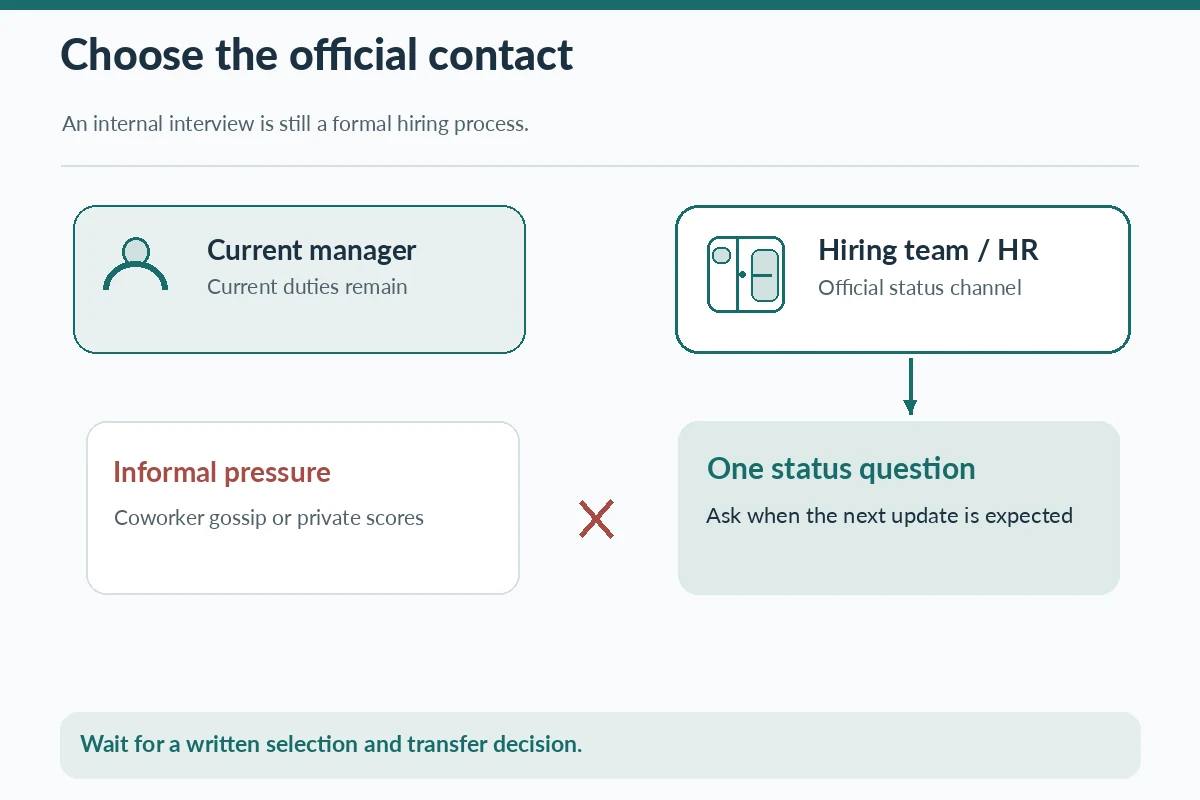
An employee applying for a different team is still a candidate in a selection process. A current supervisor may need to know about an internal application under company policy, but the supervisor is not automatically the decision-maker. Re-read the vacancy, the internal transfer policy and the interview invitation. Identify who owns scheduling, selection communications and any eligibility checks. In a large organization these duties can belong to different people; in a small one they may overlap.
Do not assume that being a known employee puts you ahead of outside applicants. You can mention relevant internal experience, such as a handoff process you helped improve, but you should not suggest that relationships guarantee selection. If policy requires notifying your current supervisor before or after a stage, follow that policy. If you are unsure, ask HR for the correct process instead of discussing a confidential recruitment outcome with coworkers.
Choose the single contact who can actually answer
Start with the interviewer or recruiter who gave the next-step timeline. A hiring coordinator can confirm whether decisions are still pending; a potential future teammate may have no approved status information. Use the existing email thread if it identifies the position and the organization accepts replies. If recruiting takes place through an internal portal, use its designated messages or support route instead of sending the same question through every available channel.
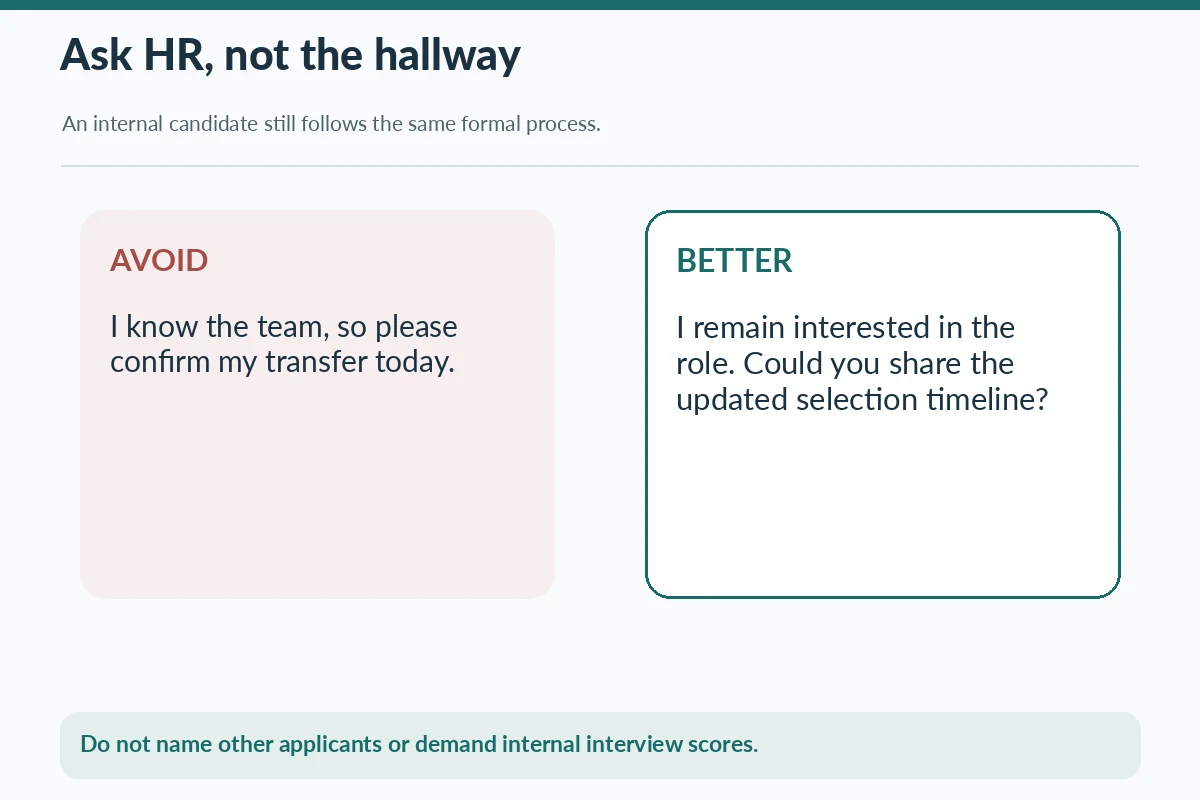
A useful short note can say: ‘I enjoyed discussing the Operations Coordinator opening on Tuesday. I remain interested in the role and wondered whether the selection timeline has changed.’ The day is illustrative; replace it with the correct interview date. Avoid cc’ing your current manager simply to increase pressure, and avoid asking an acquaintance to inspect private interview notes. Internal familiarity should improve your professionalism, not reduce it.
Write an internal follow-up that asks only for a useful next step
Subject: Follow-up on internal Operations Coordinator interview. Hello [Recruiter Name], thank you for arranging my interview for the Operations Coordinator position on [date]. Our discussion clarified how the team manages weekly handoffs and coverage. I remain interested in contributing my experience with [real process]. When convenient, could you share the expected timing for the next hiring update? Thank you, [Name]. This is a hypothetical model; remove every claim you cannot support.
The note does not disclose your salary, current performance review, a colleague’s candidacy or private department discussions. One specific detail is enough. Do not attach internal metrics or confidential reports to prove your contribution unless the hiring process explicitly authorizes sharing them. If a new document is requested, ask how it should be transferred through approved systems. Information already accessible to you at work is not necessarily approved for use in a job application.
Respond when a manager offers informal encouragement
A hiring manager might say they enjoyed the conversation or think your background could fit. Treat that as encouraging feedback, not a confirmed offer. Request the next process step through the recruiting channel and avoid announcing a transfer, setting a resignation date or changing your current workload. If asked to discuss start dates, clarify that scheduling depends on any required internal release, handoff and approval steps. Keep the answer conditional until the appropriate parties agree.
If a colleague asks whether you got the job, a simple response such as ‘I have not received an official decision’ is enough. You need not share the identities of interviewers, feedback on competing candidates or detailed future team plans. An internal application can affect relationships, which is precisely why the formal process matters. Don’t let an informal chat become an unofficial promise to either department.
Handle a delayed decision without lobbying the team
When the stated decision date passes, allow for the normal business-calendar variation described by the recruiter, then send one concise update request. Boston University and Penn career guidance both support patient, limited status follow-up rather than frequent reminders. If HR says the process is still underway, acknowledge it and ask whether they will contact candidates when the timing becomes clearer. Do not ask HR to reveal how other applicants scored or why a manager hasn’t responded.
If there is no answer after a reasonable interval, one additional message through the same channel may be appropriate; then continue your career planning without repeated pressure. Keep working as promised in your present position. An uncertain internal process is not evidence that your existing role has ended. Your personal notes can record whom you contacted, when, and what response you actually received, without copying restricted hiring information.
Protect the work relationship regardless of the outcome
If selected, request a written confirmation of the new role, start date, reporting line and transfer procedures. Follow HR’s instructions before discussing coverage plans with colleagues. If not selected, you can ask the authorized contact whether developmental feedback is available, but a request is not a right to see confidential evaluations. Treat specific improvement areas as useful only when they are actually provided; don’t invent explanations for the result.
A constructive message might say, ‘Thank you for considering my application. If there is appropriate feedback on skills to strengthen for future openings, I would appreciate it.’ You can then decide which training, projects or mentoring opportunities are realistic in your current job. Avoid arguing over colleagues’ qualifications or turning your follow-up into a public disagreement about selection.
Confirm the final message is accurate and appropriately private
Before sending, check the requisition title, interview date, recipient, intended question and whether an internal hiring portal specifies another route. Remove speculative details, references to other applicants and unnecessary confidential files. The email should be understandable even if it is forwarded to a coordinator who did not attend the interview. A reader should see one legitimate status question and an accurate statement of interest, not an attempt to influence internal politics.
Save the message and any genuine response in your own job-search notes in accordance with employer policy. Do not copy restricted organizational documents into a personal cloud folder. If a coordinator gives a new review date, record it and wait for that date before considering another inquiry. The goal is to maintain credibility in both teams while getting the information the recruitment process can lawfully and appropriately share.

| Question or stage | Best first route | Important boundary |
|---|---|---|
| Selection update | Recruiter or hiring contact | Ask for a timeline, not scores |
| Current role | Current supervisor under policy | Keep current duties intact |
| Transfer date | HR and authorized managers | Wait for formal confirmation |
How We Research and Check Follow-Up Advice
This guide compares documented interview-follow-up recommendations with primary institutional guidance for this specific situation. Examples are hypothetical; they do not describe a real applicant, actual selection, guaranteed response date, or employer policy. We reviewed the cited sources on 2026-11-05 and compared this article with the site topic inventory for distinct intent. Employer and school instructions override generic timing suggestions. For relationship and funding disclosures, see the JobAsk affiliate disclosure.
Sources reviewed: Boston University — Boston University advises a brief status inquiry after the stated decision window and discourages repeated follow-up messages.; University of Pennsylvania — Penn career services explains that a professional status inquiry can follow a missed employer decision date after allowing additional time.; UW–Madison HR — University of Wisconsin–Madison HR illustrates formal candidate communication channels and position-specific hiring updates.. Use the vacancy instructions and the documented recruiting channel for your own case.
More Interview Preparation Guides
Only if that person is the designated hiring contact or internal policy instructs you to do so. Otherwise use HR or the coordinator who owns the process.
Avoid doing so. Teammates may lack authorized information, and the request can create unnecessary pressure or confidentiality problems.
No. Treat encouragement as feedback until the organization issues a formal decision and confirms any transfer requirements.
Only when requested and approved for that hiring purpose. Describe your work without forwarding restricted documents or personal data.
Ask the authorized contact whether development feedback is available, keep your current responsibilities and consider concrete skills to improve.