
Helpful interview body language is not a performance of constant eye contact or a fixed number of smiles. It is a way to make listening and turn-taking easier: face the speaker or camera as comfortable, sit or stand in a stable position, let the question finish, pause briefly, and answer clearly. Use gestures that are natural for you. Your examples, honesty and ability to explain decisions matter more than following a supposed universal code for posture or hand placement. Adjust for accessibility and cultural differences instead of trying to imitate a single ideal candidate.
Make listening visible without overacting
Listening can be communicated by facing the conversation, minimizing unrelated device use and allowing the interviewer to finish the question. Occasional nods or brief verbal acknowledgment may help, but repetitive nodding can distract. You can keep your hands still or gesture when explaining a process. There is no verified rule that the successful candidate must lean forward at a precise angle or maintain unbroken eye contact.
Notice the content of the question, not just your own expression. If the interviewer asks for a specific example of handling conflicting priorities, do not launch into a generic biography while trying to appear enthusiastic. Restating the topic briefly can establish understanding: ‘You’re asking how I handled two urgent deadlines at once.’ Then explain what you actually did. That listening behavior is more useful than a staged smile.
Use a deliberate pause before your answer
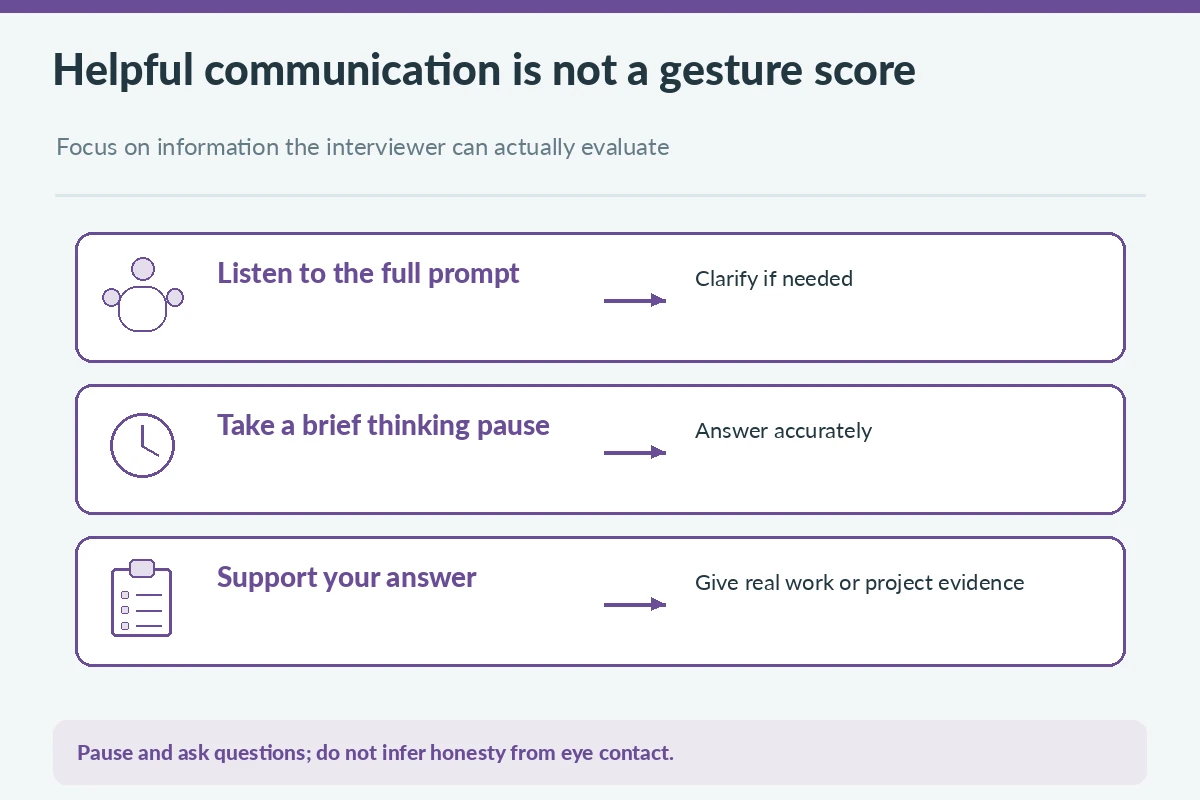
A brief pause lets you choose an appropriate example and protects against interrupting someone who is still speaking. CareerOneStop notes that it is acceptable to take time before responding or ask for clarification. When you need a moment, try, ‘Let me choose a relevant example.’ Avoid filling every gap with repeated apologies or speaking faster to hide uncertainty. Interviewers usually need a coherent answer, not an immediate reflex.
For a complicated technical question, explain your thought process at a level the interviewer requests. If you truly do not know a tool or procedure, say so and describe the verification steps you would use, without claiming work you have not done. Taking a pause is not the same as refusing a question. A thoughtful short delay can be part of accurate communication.
Use eye contact as a connection, not a test
In person, direct your attention toward the speaker when comfortable and naturally look away while recalling details or consulting allowed notes. On video, occasional glances toward the camera can help, but constant staring at a lens makes it harder to read the other participant. Some people communicate differently because of culture, disability or personal style; eye contact alone is not a reliable measure of honesty, respect or competence.
If you struggle with sustained gaze, focus on following the conversation and delivering clear answers. Choose a comfortable visual anchor near the speaker or camera rather than forcing a behavior that reduces your ability to think. Interview preparation should support access and meaningful evaluation, not teach you to mask needs or perform for an arbitrary body-language score.

Support spoken answers with calm posture and gestures
Position yourself so you can breathe, hear the interviewer and use notes if they are permitted. Keep hands where you can reach your materials without repeatedly searching through bags. Natural gestures may help explain a sequence, size or comparison. If you tend to tap a pen or swivel a chair while concentrating, place the pen down between notes or choose a stable seat; the aim is to remove avoidable noise, not to suppress every movement.
For video interviews, frame your face and upper torso, make sure lighting lets your expression be seen and minimize pop-up notifications. CareerOneStop recommends practicing natural gestures and checking your technical environment. You do not need a perfect home office; choose the quietest practical setup and communicate about unavoidable interruptions. Do not share private household details or internal workplace material visible on your screen.
Handle interruptions without fighting for the floor
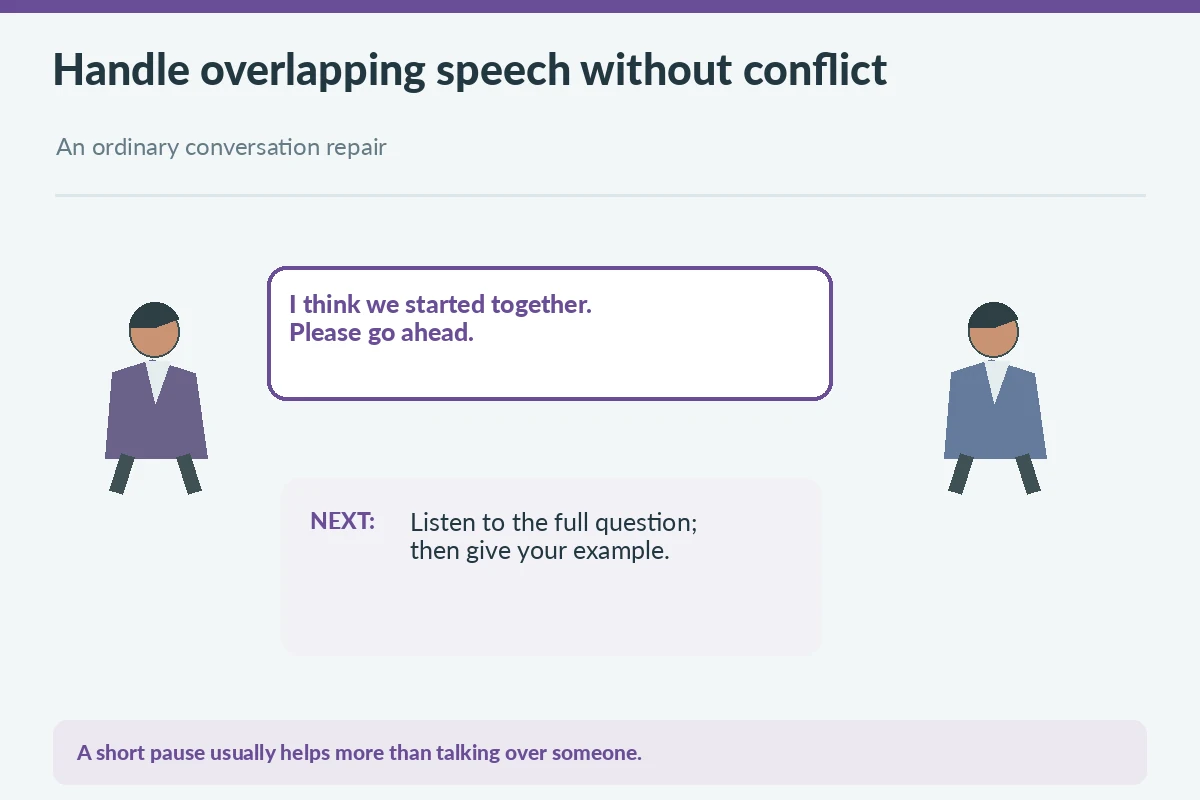
An interviewer may interrupt to redirect the answer or recover time. Stop at a natural point, listen to the correction and answer the new question. If you are not sure whether they want more detail, ask, ‘Would a brief example help?’ Do not interpret every interruption as hostility or continue speaking over the other person to finish a script. Effective turn-taking gives the interviewer the information they are trying to gather.
If several panelists speak at once, wait a moment and clarify who would like the question answered first. In a video call, slight audio delays may cause accidental overlap. You can say, ‘I think we spoke at the same time—please go ahead.’ This is a practical repair of the conversation, not a reason for extended apologies. Remain focused on the job requirement under discussion.
Avoid treating nervous behaviors as character flaws
Sweaty palms, shifting posture, looking down while thinking or speaking with a different rhythm do not prove dishonesty or lack of preparation. Interview advice often describes how people may be perceived, but those perceptions can be inaccurate. Use practice to identify behaviors that block the conversation—such as an audible phone alert or constant chair movement—without trying to erase your personality or conceal an accessibility need.
If you require a change to the interview format, the EEOC describes possible accommodations during hiring and how to request them. Make the request through the recruiting contact as appropriate. A clear example of your work and a practical explanation of your role are stronger evidence of fit than speculative interpretations of someone’s facial expression.
Practice with useful feedback rather than video scoring
Ask a practice partner to listen for three observable items: did you allow the question to finish, did your response address the actual prompt, and could they identify your specific action? If practicing on camera, also check audio clarity and whether your notes are accessible. Avoid making judgments about intelligence, motivation or truthfulness from how often someone blinks, looks away or smiles.
A simple rehearsal uses one question, a three-second thinking pause and a 60–90 second example, followed by a follow-up question. These durations are practice tools, not employer rules. Focus on how the story changes when the interviewer asks for evidence or a detail. Adapt answers to real experience rather than memorizing a performance.
Close the conversation with clear next steps
When the interviewer asks for your questions, sit comfortably and ask a relevant one about the work, team or expectations. Listen to the answer and acknowledge it without pretending to agree with everything. If the session is ending, thank the participants for their time, confirm any stated next step and leave or log off according to the host’s instructions. You can write notes after the call if using paper during the discussion would distract.
A good final check is whether you came across as attentive and truthful rather than whether you matched a particular pose. Communication is an exchange between people, not a test of predetermined gestures. Treat job-specific answers and verifiable examples as the center of your preparation; use body language to make that exchange easier.
| Situation | Useful action | Avoid |
|---|---|---|
| Question is still being asked | Listen and wait for the end | Do not rehearse out loud over speaker |
| Need time to recall an example | Take a brief pause or ask to clarify | Do not invent an experience |
| Video audio overlaps | Yield briefly, then resume | Do not argue about who spoke first |
How We Research Interview Etiquette
We checked the latest JobAsk WordPress topic inventory supplied for this project, reviewed recent draft titles for overlap, and compared the specific recommendations with the primary guidance below on 2026-11-05. Interview practices and dress codes vary by employer, profession and location; accessibility, privacy and facility safety requirements may control what is appropriate. Illustrative messages, schedules and interview scenarios are invented teaching examples, not employer rules, real candidate testimonials or promises of selection. See the JobAsk affiliate disclosure for information on commercial relationships.
Sources reviewed on 2026-11-05: UC Berkeley Career Engagement — UC Berkeley explains listening, nonverbal communication and relevant examples during interviews.; CareerOneStop (U.S. Department of Labor) — CareerOneStop discusses effective video posture, practice, gestures and settings.; U.S. Equal Employment Opportunity Commission — EEOC outlines access and accommodation rights for job applicants.. Guidance is general; always confirm the actual interview invitation and local workplace procedures.
More Interview Preparation Guides
No. Eye contact preferences vary, and looking away while thinking does not prove a lack of honesty or ability.
Use natural gestures if helpful. Prioritize clarity, avoid noisy fidgeting, and do not imitate a rigid script.
Yes. A short pause can improve accuracy. You can also request clarification when a question is unclear.
Listen to the redirection, address the new question and offer brief additional detail only if useful.
Focus on communicating your abilities; if you need an interview accommodation, contact the employer through the appropriate process.