
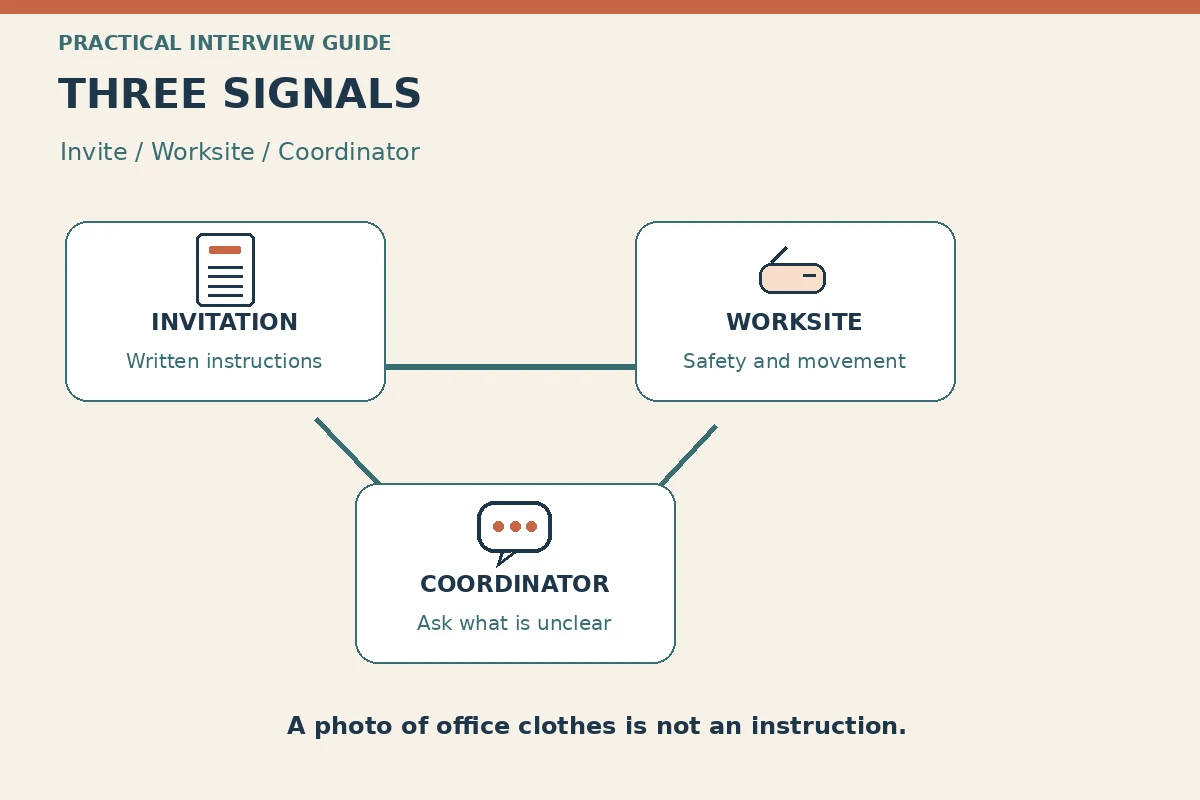
If an invitation does not explain the interview dress code, you do not need to guess based on a single photo of the office. Start with any written instructions, the role and location, and the coordinator who scheduled the meeting. A clean, comfortable outfit that lets you focus on the conversation is a stronger default than expensive clothing that you cannot move or work in. The best choice depends on the employer’s actual expectations, not a universal rule about colors or suits.
Read the invitation before interpreting company photos
Start with the exact words in the scheduling email. ‘Business professional,’ ‘business casual,’ ‘smart casual,’ ‘closed-toe footwear,’ and ‘wear clothes suitable for a facility tour’ are different instructions. Confirm whether the meeting will involve an office, laboratory, kitchen, warehouse, clinic, outdoor site or remote video. A safety or hygiene requirement should not be downgraded because an employee photograph looks relaxed. If the invitation includes an explicit instruction, follow it or ask the coordinator for a feasible alternative.
Company photos can provide context but they are not a reliable dress code. A website may show employees at an informal social event, in required uniforms or at a photo shoot. An interviewer may also dress differently from staff during a normal shift. Make a small evidence note: what the invitation actually says, what is uncertain, and who can confirm it. Avoid assuming a luxury brand, a particular hairstyle or gender-specific clothing is necessary to be taken seriously.
Ask a specific question without apologizing for uncertainty
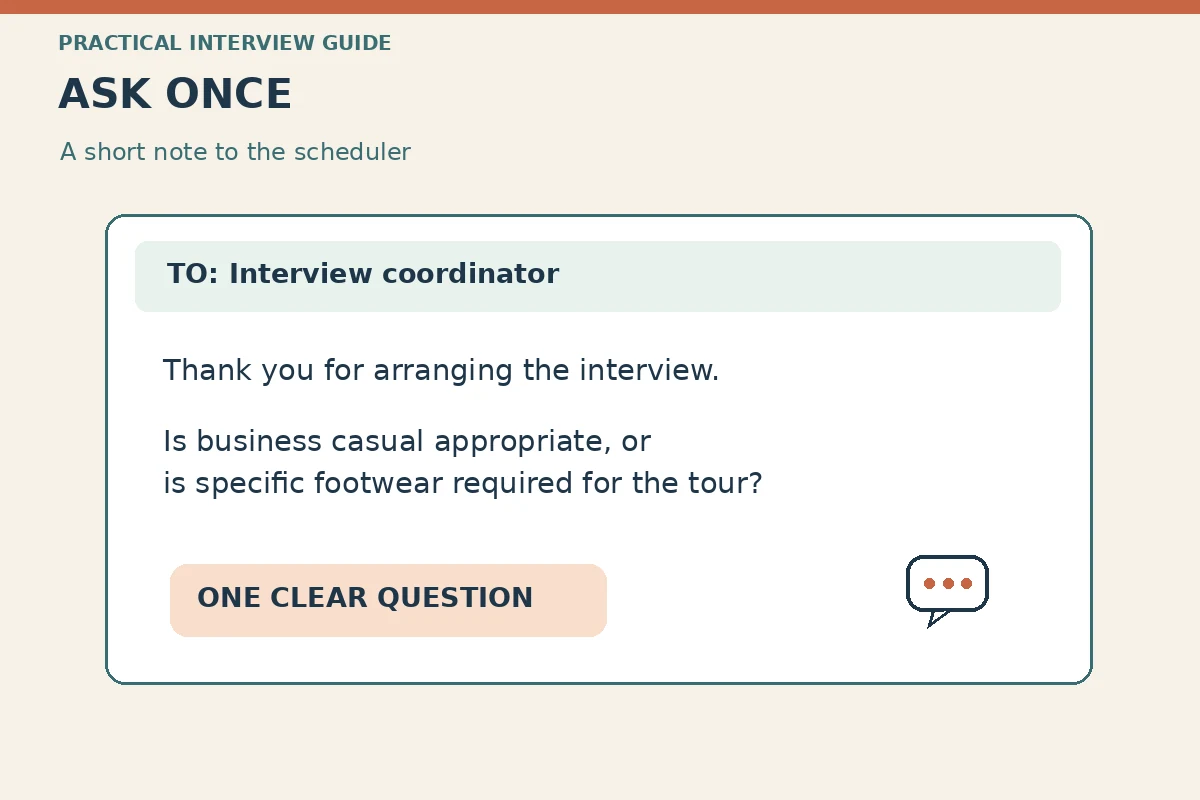
When the wording is vague, asking is reasonable. Texas A&M and the University of Tennessee explicitly recommend checking with the person arranging the interview when the dress expectation is unclear. Send one short message as soon as you can, ideally before the day of the meeting. Example (hypothetical): ‘Thank you for arranging Tuesday’s interview for the operations assistant position. Is business casual appropriate, or is there any site-specific clothing or footwear requirement for the visit?’ This makes it easy for the coordinator to answer.
Do not send a long photo gallery or make the coordinator decide between five outfits. If you already received a dress instruction, ask only about the detail that could affect participation, such as protective footwear or the need to move around the worksite. If the employer cannot reply, choose a neat, flexible option suited to the setting and carry any permitted safety equipment you were asked to bring. Do not claim that any particular outfit guarantees a positive hiring decision.
Translate dress labels into practical choices
A business-professional expectation generally points toward a coordinated jacket or other polished, structured separates and work-appropriate shoes. Business casual usually permits tailored pants or another neat lower garment with a collared or otherwise polished top; a sweater or jacket can be useful. More casual workplaces may permit simpler clothing, but this does not make a stained shirt, torn garment or distracting message a good interview default. Boston College and UT Dallas both describe variation by sector and workplace, not a single compulsory uniform.
Fit and function matter more than a color superstition. Check whether you can sit, stand, reach for materials and walk comfortably. Choose shoes appropriate for the site, especially if a tour is possible. If clothing is borrowed or secondhand, that does not make it less suitable. If a sensory, mobility, religious or other need shapes what you can wear, focus on meeting the actual worksite requirement; you can ask the coordinator about access or safety needs without disclosing unnecessary personal details.
| What you know | Practical next move |
|---|---|
| Invitation gives explicit attire | Follow the instruction; clarify any site or access conflict. |
| Invitation says business casual | Choose polished, comfortable separates suited to the role. |
| Invitation says casual, no details | Check job setting; ask if there are footwear or safety rules. |
| Invitation says nothing | Email the coordinator with one short, specific question. |
Use the interview setting as the deciding factor
An office interview and a plant walk-through may require different choices even at the same employer. For a virtual meeting, consider how your top looks under your actual camera, lighting and background; keep the complete outfit practical in case you need to stand. For a worksite visit, prioritize any explicit closed-toe-shoe, PPE or hygiene directions. Do not borrow lab coats, safety vests or badges to appear more qualified, and do not assume you can enter a restricted area without an escort.
For a customer-facing role, tidy, understated presentation may matter in a different way than for an equipment-focused role. Still, a dress code does not tell you the entire job. A candidate who cannot afford special clothes can ask a university career closet, library or local workforce program about available resources, if applicable. Any outfit plan should leave time to prepare real stories about the work; interview content is more important than memorizing an arbitrary clothing checklist.
Run a simple comfort and accessibility check
Try your planned outfit for the actual tasks of interview day: travel, walking to reception, sitting for an hour and presenting a portfolio if requested. Check hems and fasteners, comfortable shoes, pockets and any needed personal or assistive equipment. If a video interview is scheduled, sit in front of the camera and check how the garment appears without relying on a full-length mirror alone. Keep a backup layer nearby if temperature or weather could change.
A colleague or friend can give useful feedback, but there is no need to solicit opinions about your body or identity. Ask them to evaluate just the practical questions: does the clothing look clean, fit the reported setting, and allow comfortable movement? Do not add scented products or distracting accessories merely because you think a traditional interview requires them. A consistent, respectful appearance and thoughtful answers are enough to work from.
Know what to do if the room is more casual than you expected
If you arrive in a jacket and the interviewer is in jeans, no apology is required. Greet them, settle in and answer the first question. If you were told the dress code accurately, following that instruction was reasonable even if individual interviewers dress differently. Changing clothes in the lobby or explaining every wardrobe choice adds unnecessary attention to something that may not matter to the role.
Afterwards, note the actual work environment for your own decision-making, but do not treat a single interview as proof of a permanent workplace policy. If a second-round invitation includes a site tour or a practical activity, confirm its separate footwear or safety rules rather than blindly repeating the same outfit. Your next step is a clear question, a usable outfit and evidence-based interview preparation—not further shopping by default.

How We Research and set the limits of this advice
We compare guidance from university career offices and distinguish their general recommendations from mandatory employer policies. Suggestions and quoted sample phrases here are hypothetical examples, not guarantees or a substitute for the hiring organization’s instructions. The final choice depends on the role, interview format, accessibility needs, confidentiality obligations and any explicit site rule. We checked the linked guidance on November 9, 2026.
Sources and related guidance: University of Tennessee career. Boston College career. Texas A&M career center. UT Dallas career office descriptions of formal, business-casual, and casual interview dress. See also our affiliate disclosure. This is informational advice; no commercial affiliation is implied by these references.
More Interview Preparation Guides
Yes. A short, role-specific question about the recommended attire or worksite requirements is professional, especially when the invitation is unclear.
No. The employer, industry, site and instructions matter. Some interviews expect business professional; others allow business casual or require functional worksite clothing.
Clean, well-fitting clothing you already own or can borrow can work. Some campuses and workforce centers offer interview-clothing resources; availability varies.
Not automatically. Photos may depict special events or uniforms. Written instructions and a coordinator answer are better signals.
Ask about footwear, PPE, access and hygiene instructions before arriving. Do not assume that ordinary office attire is safe for restricted or industrial spaces.