
For a scheduled phone interview, answer with your name, confirm that you can talk, and let the interviewer lead. You do not need a polished speech before learning who is calling. A natural hypothetical opening is ‘Hello, this is Taylor Morgan speaking.’ Listen for the caller’s introduction, then say, ‘Thank you for calling; I’m ready.’ During the call, speak clearly, allow small pauses and ask for repetition when you miss a question. Close by thanking the interviewer and checking the actual next step.
Confirm the call arrangement before interview day
Check the time zone, expected caller, phone number or dial-in instruction and estimated length. Ask whether the recruiter will call you or you should call a meeting line. Northeastern and Princeton advise keeping the contact details and a quiet, reliable location ready. Charge your phone, test reception, silence alerts and put your resume plus a few key questions on a surface that will not rustle. Avoid driving or taking the call in a public place where you cannot concentrate or keep the conversation private.
A scheduled call can arrive from a number you do not recognize. That alone is not proof of authenticity. When you answer, listen for the caller’s name and organization and compare it with the invitation. If something does not match, politely verify through an official contact channel before providing personal or sensitive information. A job interview never requires you to give account passwords, one-time login codes or payment information to a stranger.
Start with a clear greeting rather than a memorized speech
The first few seconds establish whether both parties can hear and identify one another. Try: ‘Good afternoon, this is Morgan Lee.’ Wait for the caller’s introduction. If they identify themselves as your interviewer, ‘Thanks for calling, I’m glad to speak with you’ is enough. If they ask whether it is a good time, answer accurately. Do not start reciting your employment history before the interviewer has begun. Let the normal conversational exchange set the pace.
If a recruiter calls without scheduling an interview, you may ask for a more suitable time rather than attempting a full screening while distracted. Example (hypothetical): ‘I’m interested in speaking about the role, but I’m not somewhere private. Could we schedule a time today or tomorrow?’ Give realistic availability rather than promising an immediate callback you cannot make. Do not make up a technical problem as an excuse if the issue is simply timing.

Replace awkward silence with purposeful listening
On the phone you cannot use the other person’s facial expression to know when to begin. Let the interviewer finish, then pause briefly before answering. A thoughtful pause is normal. If you need a moment, say ‘Let me think of a relevant example’ and then deliver a focused situation, action and outcome. Do not fill every gap with additional claims or keep talking until you run out of breath. Northeastern’s phone guidance specifically emphasizes pacing and concise answers.
The interviewer may pause while taking notes, selecting a follow-up or checking the next question. A pause does not necessarily mean you failed to answer. If the silence is unusually long, a light check-in can help: ‘Would it be useful to go into more detail?’ Do not repeatedly ask whether your answer was good. Use a steady conversational tone and keep a glass of water nearby if appropriate; mute only when necessary and announce if you need to reconnect.
| Call moment | Useful phrase |
|---|---|
| Expected call | Hello, this is [name] speaking. |
| Unexpected call | Could we schedule a time when I can give this my attention? |
| Audio unclear | I missed the last part. Could you repeat that? |
| Closing | What is the next step and expected timeline? |
Recover from bad audio without guessing the question
If you miss a word or the call drops momentarily, ask for a repeat before answering: ‘I lost the last part of the question. Could you repeat it?’ If you heard only part, state what you understood and ask whether that was the intended topic. Never invent a response to a question you did not hear. Repeated audio trouble may justify switching to the approved backup number or rescheduling, but check with the interviewer rather than unilaterally changing platforms.
Keep the employer’s contact number visible in case you need to call back. If the connection drops, wait a short moment for their return call or follow the instructions in the invitation; if needed, use the verified phone or email contact to explain the disconnection. Do not assume the interviewer deliberately hung up. A concise recovery message is more useful than a long apology about network quality.

Answer in short work examples and ask one grounded question
Without visual cues, long answers can become hard to follow. Choose one work example that matches the specific question. Say what the task was, what you personally did, and a result you can substantiate. A student may describe an academic or volunteer example clearly without implying it was paid work. If the interviewer asks for a detail you do not know, acknowledge the gap instead of improvising a credential or numerical result. Silence the temptation to read a full script.
At a natural opening near the end, ask about something the caller can realistically answer: the next round, role scope or how the team structures its interviews. An initial recruiter may not have the technical detail of the hiring team. Keep sensitive questions relevant and use an appropriate channel for detailed documentation later. Ask one clear question and listen, rather than pushing through a long list when the allotted call time has expired.
Close the call with a verified next step
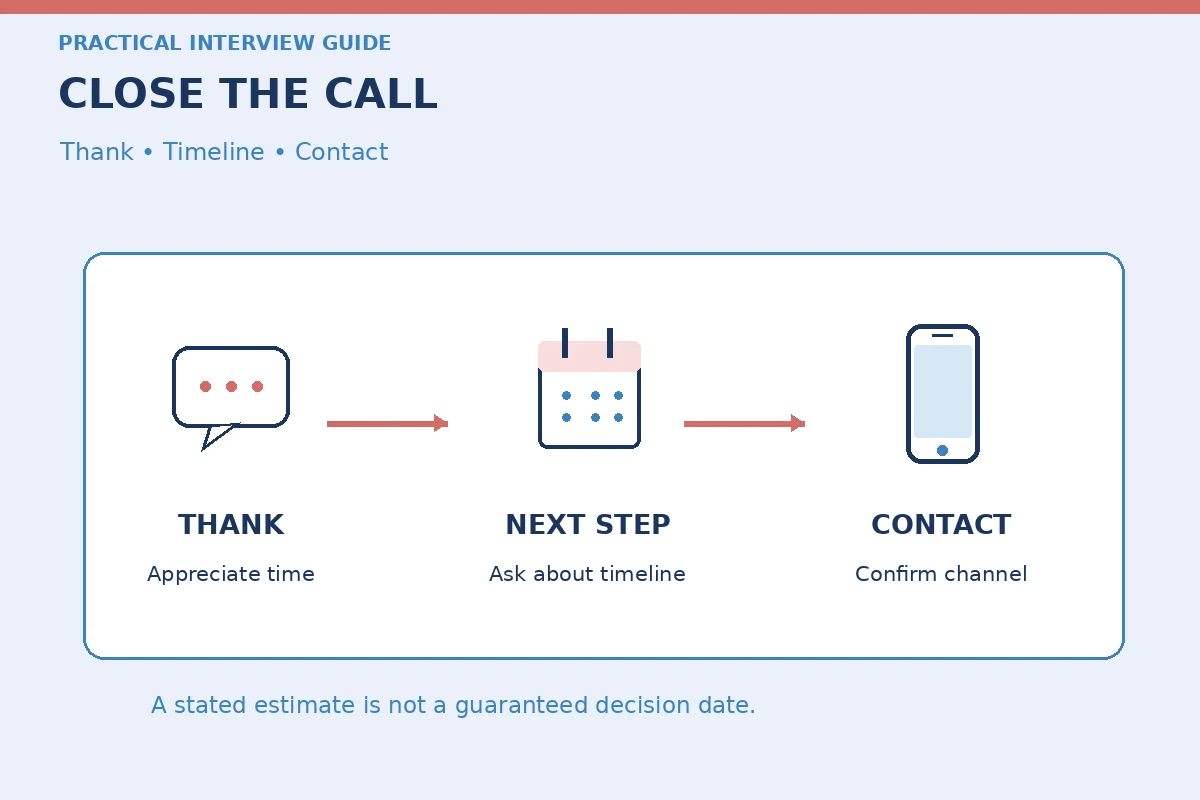
When the interviewer signals the end, thank them for the conversation and briefly restate your interest if that remains true. Then ask: ‘What is the next step, and when do you expect to contact candidates?’ The answer may be a rough estimate rather than a guarantee. Confirm how the interviewer prefers to communicate and the role title if the recruiter represents several openings. Do not insist on an immediate decision or promise you are available 24 hours a day.
After the call, write down the confirmed timeline and a specific point you discussed. If you send a thank-you note, keep it relevant to the actual conversation and use a verified address. This is separate from chasing a status update the same day. If a message arrives later asking for unusually sensitive information, verify the request independently; a friendly phone screen does not remove the need for normal privacy checks.
How We Research and set the limits of this advice
We compare guidance from university career offices and distinguish their general recommendations from mandatory employer policies. Suggestions and quoted sample phrases here are hypothetical examples, not guarantees or a substitute for the hiring organization’s instructions. The final choice depends on the role, interview format, accessibility needs, confidentiality obligations and any explicit site rule. We checked the linked guidance on November 9, 2026.
Sources and related guidance: Northeastern. Princeton. UMass. Boston University interview-day. See also our affiliate disclosure. This is informational advice; no commercial affiliation is implied by these references.
More Interview Preparation Guides
State your name clearly, allow the caller to introduce themselves, then confirm you are ready to talk.
You may request a mutually convenient time rather than holding a full interview when distracted or unable to speak privately.
No. Brief pauses can show thoughtfulness. If you need time, say so and then provide a concise, relevant answer.
Ask them to repeat the question, and use a verified backup number or agreed rescheduling plan if the connection repeatedly fails.
Thank the interviewer, ask about confirmed next steps and record the appropriate contact and timeline afterward.