
If you already have a genuine job offer with a response deadline and you are waiting to hear from another employer after an interview, you can ask that second employer for an update. State the role, your continued interest, and the actual date by which you must respond. Ask whether they can share a realistic next-step timeline; do not demand an offer or imply that they owe you an accelerated decision.
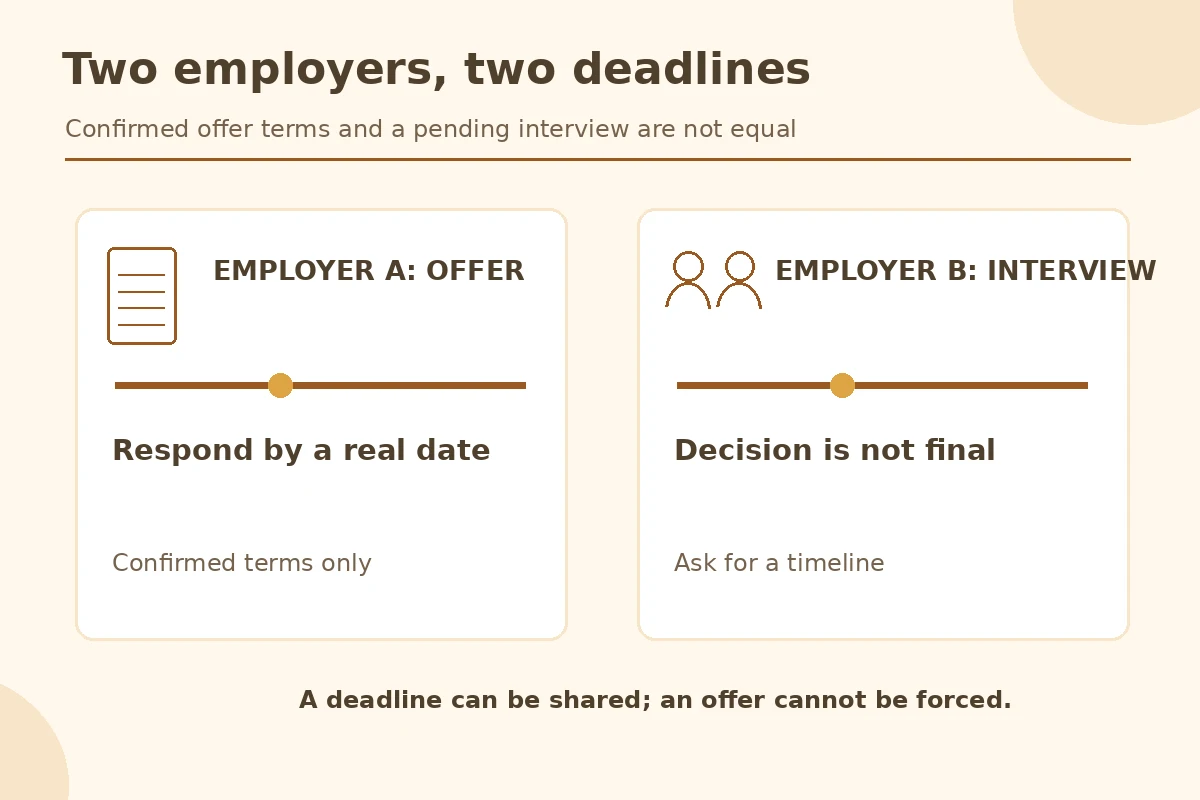
The offer you hold is a real decision with consequences. The interview you are waiting on is only a possibility. Career-center guidance from Colorado College and UMBC supports a courteous timeline inquiry in this situation, but the hiring team may be unable to change its schedule.
Verify what the first employer actually offered
Before contacting the second company, read the first offer rather than relying on a verbal impression. Note the job title, terms that have been stated in writing, whether any conditions remain, and the response deadline. A pending screening step or informal expression of interest is not necessarily a finalized offer.
If the terms are unclear, ask the offering employer for clarification. Record its deadline in the correct time zone. Do not tell the second employer you have a “signed offer” if you only received a recruiter’s statement that an offer might come soon. Your credibility depends on using accurate language.
Place the two hiring timelines on one page
Make a private two-column timeline: Employer A has offered a role and expects your answer by a specific date; Employer B interviewed you and either supplied a decision window or did not. Highlight what is confirmed and what remains unknown. This exposes the risk of waiting past a real deadline for a decision that may never come.
If you are still excited about Employer B, contact the recruiter or coordinator who controls updates. State a real constraint, not a fabricated deadline. A useful question is whether a decision or next-step estimate is possible before the other offer expires; it is not whether Employer B can guarantee a job.
Write an accurate message without an ultimatum
Illustrative email — subject: Hiring Timeline for Program Assistant Role. “Hello Jordan, thank you again for speaking with me about the Program Assistant position. I remain very interested. I have received another offer that requires a response by November 10, and I wanted to ask whether you could share any update on your hiring timeline before then. I understand if your process cannot be accelerated. Thank you, Avery.” All names and dates here are examples.
This message discloses only the information needed for scheduling. It does not name the other organization, reveal private compensation terms, or claim to have leverage. Keep the tone collaborative and leave space for a candid reply.
Consider asking the offering employer for more time
If you need additional time to review written terms, you may ask Employer A whether an extension is possible. Ask before the actual deadline, explain the time requested briefly, and respect the answer. The employer may say no. Do not treat a requested extension as approved until you receive confirmation.
If the offer has an unusually short response window, seek advice from a career counselor if available. University at Buffalo’s guidance discusses offer phases and deadlines, but it does not create a universal right to extra days. Plan around what the employer actually grants, not what you hope it might grant.

Read the second employer’s reply precisely
A message such as “We are still interviewing” is not an offer. A promise to update you tomorrow is a new timeline, not a guarantee of employment. An invitation to another stage means further evaluation is required. Ask only the follow-up question needed to understand your choice, and avoid interpreting politeness as selection.
Even if Employer B says the interview went well, you must compare the certainty of Employer A with the uncertainty of B. An informal verbal indication should not cause you to miss an actual deadline. If the hiring team cannot respond in time, make your decision using the offers and facts you have.
Choose without making a false commitment
Before the response date, list the considerations that matter: responsibilities, worksite or remote requirements, schedule, salary and benefits if supplied, start date, and any unresolved conditions. Decide whether Employer A is acceptable on its own merits. Do not accept merely to hold a place while intending to abandon it immediately if another company writes.
If you decline a real offer, communicate respectfully and on time. If you accept, follow through on the terms you agreed to and promptly withdraw from other recruiting processes. If you need individual legal advice about an agreement, use a qualified professional rather than treating a general career article as a contract review.

Record the outcome and close the loop
Keep the offer date, response deadline, each organization’s written update, any approved extension, and your final response together. Avoid saving confidential attachments in shared devices or forwarding offer documents to another employer. A short private record prevents confusion when deadlines move.
Once you choose, thank the other hiring team if appropriate and state that you are no longer available. If you remain in consideration, only follow up again when new substantive information changes the timeline. No follow-up email can force an employer to make a decision, but an accurate message can help you make your own.
How We Research Interview Follow-Up Decisions
We reviewed guidance from university career services about post-interview communication, employer timelines, contact preferences, and offer decisions. We distinguish those source recommendations from our practical examples and checklists; specific intervals are guidance rather than rules binding all employers. Every sample message and person in this article is illustrative. None implies that a follow-up improves hiring odds, guarantees a response, or replaces employer instructions.
Source: COLORADO career guidance — Colorado College Career Center explains how to ask for a hiring update when another offer has a firm deadline.
Source: UMBC career guidance — UMBC Career Center recommends waiting until an employer-provided decision date has passed and contacting the organization when another offer needs an answer.
Source: BUFFALO career guidance — University at Buffalo guidance discusses balancing recruiting timelines and other offers without assuming a hiring decision.
Source: WASHU career guidance — Washington University career guidance recommends promptly sending requested interview materials and respecting employer timelines before further contact.
For the site’s funding and relationship information, read our affiliate disclosure. The external career-center references are informational citations, not paid endorsements.
More Interview Preparation Guides
Usually the actual response deadline is sufficient. Share more only if you have a specific, appropriate reason and want to.
No. You generally do not need to disclose a private offer document to request a hiring-timeline update.
Compare that request with your real deadline and any written extension approved by the first employer. Do not assume an extension will be granted.
No. Describe the status truthfully: pending decision, expected offer, or actual received offer are different circumstances.
There is no guarantee. The purpose is to communicate a genuine timing constraint and obtain a clear response if one is possible.