
Quick answer: A two-employer timeline and message examples help you make a responsible offer decision without pretending a pending interview is a second offer. The safest next step is to verify the employer and the exact written offer before communicating a final commitment. A clear response should name the decision you are actually making, not imply agreement with missing terms.
This guide covers a specific situation in the accepting-offers process. It is not a substitute for your offer, employer policy, or legal advice. All scripts below are hypothetical; use only accurate details from your own correspondence and documents.
Put Both Timelines on Paper
Write down the date the real offer arrived, its response deadline, and what information you still need. On a second line, record where the other employer’s process stands: application submitted, interview completed, reference check requested, or final decision promised. Do not label a promising interview as an offer. A recruiter’s encouragement does not provide a firm start date or terms you can compare.
Your decision should be based on verified facts. A timeline makes the main uncertainty visible: the job you can accept now has an actual deadline, while the other opportunity may have no decision date at all. If your preferred role is truly a priority, clarify the process rather than simply waiting in silence.
Tell the Pending Employer About the Real Deadline
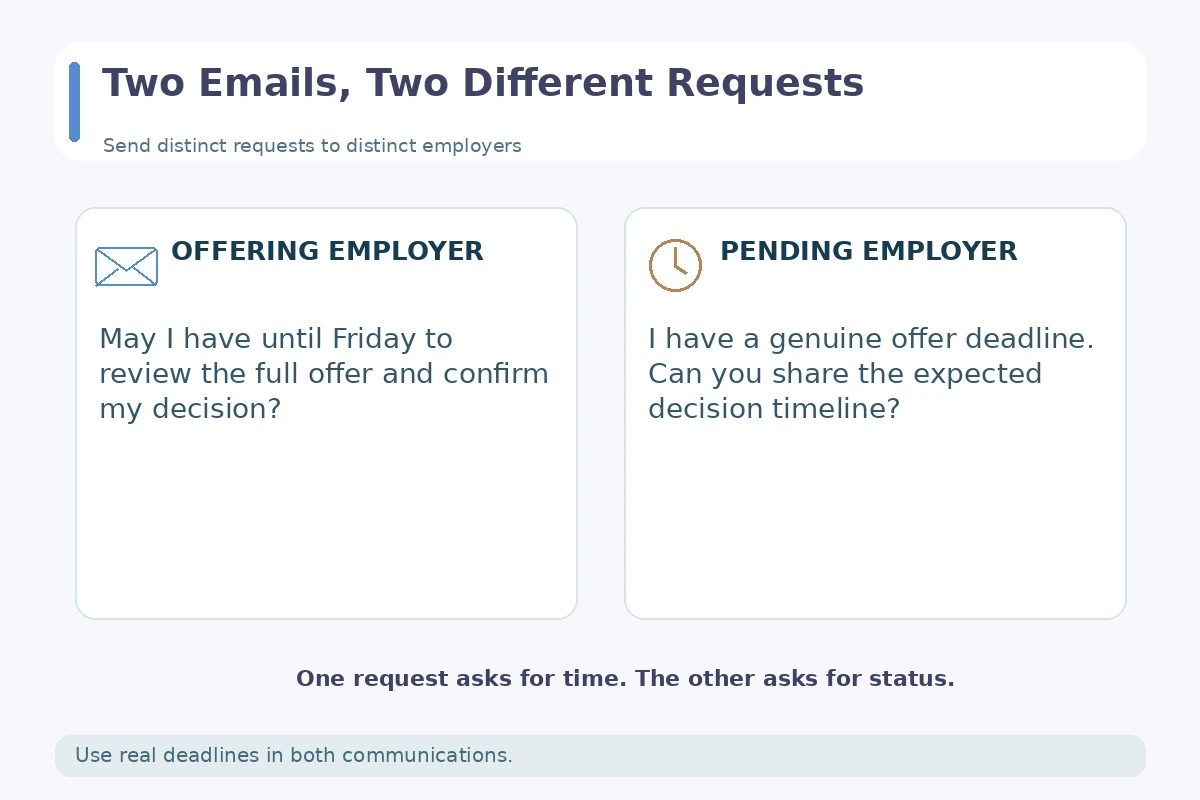
Contact the other employer through the normal recruiting channel. Hypothetical email: ‘Thank you for the interviews for the Product Support role. I remain interested. I have another offer with a response deadline on November 2. Are you able to share the status of my candidacy or an expected decision date?’ This is a timeline question, not an ultimatum.
The University of Pennsylvania career center recommends proactive communication with employers when a genuine offer deadline is approaching. Do not falsely claim multiple offers, make up a deadline, or demand an immediate decision. A professional request gives the other team a chance to clarify its process.

Ask the Offering Employer for Time if Needed
If you need more time to make an informed decision, ask before the original deadline expires. Identify the offer, thank the employer, and propose a concrete date. Hypothetical request: ‘I appreciate the Operations Associate offer and would like to review the full details carefully. Would a response by November 5 be possible?’ Do not imply that an extension was granted until the employer confirms it.
UCLA career guidance notes that requesting an extension can be appropriate when completing interviews. The employer may say no because of staffing needs; that does not create permission to ignore the original deadline. Save any revised deadline in writing.
Compare a Real Offer With Uncertainty, Not a Fantasy Offer
You can evaluate the confirmed role’s tasks, manager, location, schedule, salary structure, and advancement opportunities. You cannot fairly compare those details with the imagined benefits of a company that has not yet made an offer. Make two columns: ‘verified facts’ and ‘unknowns.’ If the second employer has only a job posting, mark pay and start-date expectations as unverified.
Consider why you are drawn to the pending role: subject matter, location, team, or development potential. Can you ask the current offering employer a legitimate question that would clarify those same factors? Use the information to decide what is acceptable, not to manufacture leverage with unconfirmed promises.
Know What a Conditional Yes Can and Cannot Do
‘I accept for now, but might change my mind if the other firm calls’ is not a reliable way to reserve an offer. It can create a commitment the offering employer expects you to honor. A better message is a candid extension request. If you do accept, do so because you intend to take the role, not because you want a placeholder on the calendar.
The Cambridge Careers Service cautions against firmly accepting when you are still unsure whether you want the role. If you later change course, consequences depend on the arrangement and rules; do not assume every acceptance can be withdrawn without professional or legal implications.
Make a Decision Before the Verified Deadline
Set a personal checkpoint earlier than the employer’s deadline. By then, review the complete written offer, the status update from the other employer, any requested extension, and what you actually value. If the pending employer cannot give a reliable timeline, decide whether the existing offer is good enough on its own merits. You do not have to accept every offer, but a decision should be intentional.
Send a clear acceptance or decline through the requested channel by the stated time. Do not allow uncertainty to turn into silence. Keep copies of your emails and the document version that you considered.
What If the Second Employer Responds Too Late?
If a second company responds only after you have already accepted another job, do not pretend the first commitment did not happen. Review the agreement you signed and consider the ethical and practical implications carefully. Where contract terms are complex, seek professional advice rather than relying on internet generalizations about whether you can simply walk away.
If you declined the first employer, the later offer can be evaluated normally. If you did not respond by its deadline, do not assume the opportunity is still open. Contact them only if you genuinely want to ask whether they will reconsider, and be prepared for a no.

Use Two Different Scripts for Two Different Audiences
The company with the offer needs your decision or a respectful extension request. The other company needs a factual status inquiry with the real date. Do not send an identical ‘still interested’ message to both; that hides the difference between an available job and a pending process. Keep each email focused on the recipient’s action.
Review the subject line, dates, time zone, and role name before pressing Send. When you receive new information, update your private decision table. The objective is not to make two employers compete artificially; it is to make one honest decision with the facts available.
How We Research Offer Acceptance Decisions
We checked the original career-center and consumer-protection sources on October 28, 2026 and separated their documented principles from the hypothetical messages and workflow examples in this article. University career guidance University career guidance University career guidance. Offers, deadlines, contract rights, and employer processes vary; check the actual written documents and the organization’s authorized contacts.
This article is informational; no employer, job offer, paid placement, or affiliate relationship is asserted. Verify each term with the actual employer and read the JobAsk affiliate disclosure. We cannot verify private WordPress drafts or your own offer from public sources.
Related Workplace Guides
- Email a Signed Job Offer Letter: Attach the Right Final Copy
- Thank-You Email for a Job Offer Before You Make Your Decision
- After Accepting a Job Offer: An Onboarding Checklist Before Day One
- How to Acknowledge a Job Offer Without Accepting It Yet
- What to Say When You Receive a Job Offer Without Accepting Yet
You may explain that you are completing your decision process and request a specific extension; be truthful without disclosing private details you do not wish to share.
Yes, if it is true. Share the genuine deadline and ask whether they can provide an update.
Evaluate the offer you actually have, request an extension if useful, and choose honestly rather than treating a possible future offer as guaranteed.
That creates a real commitment and can harm trust. Avoid accepting if you do not intend to honor the decision.
You can ask for an extension, but an employer may decline. Use the current deadline unless an authorized new date is confirmed.