
Quick answer. Thank the person who offered the role, confirm that you received the offer, ask for the written terms and the response deadline, and state when you will reply. That acknowledgment is not an acceptance. Do not say “I accept” until you have reviewed the information and decided to commit.
Separate the First Response From the Final Decision
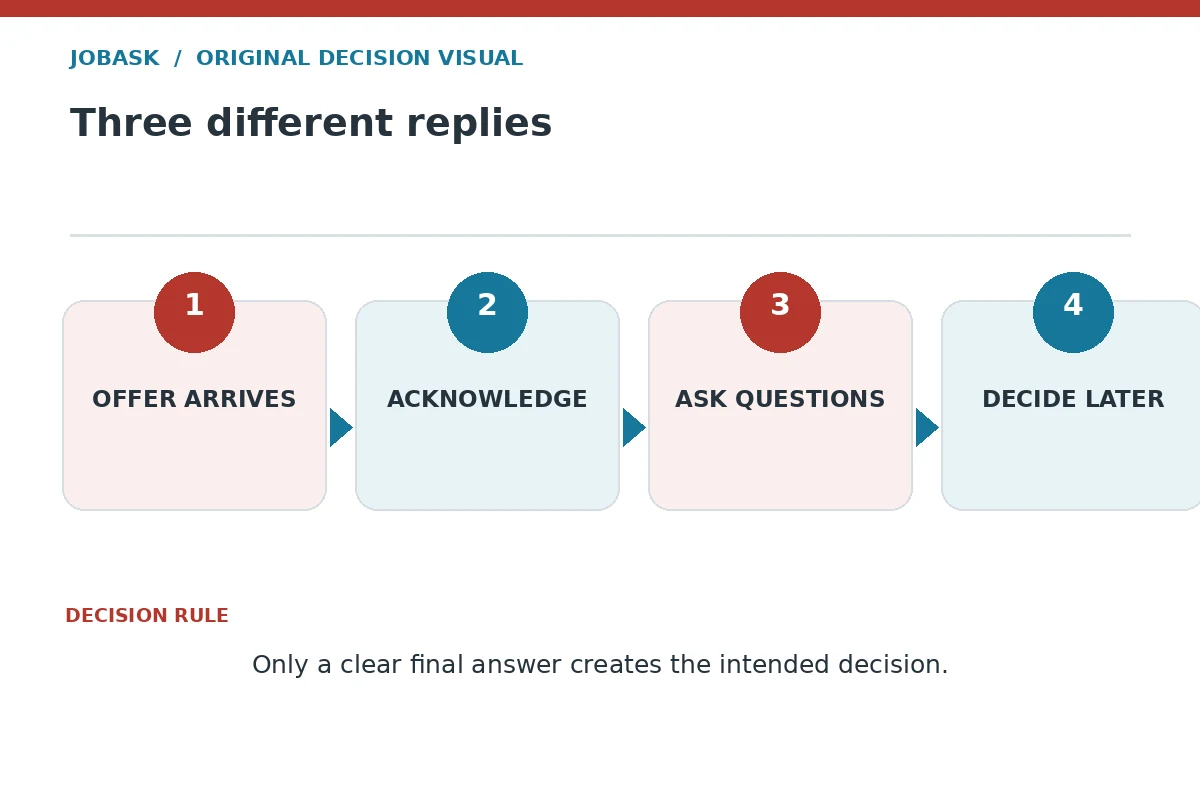
Being pleased about an offer and agreeing to take the job are two different messages. A recruiter may call with exciting news when you are in transit, working or not ready to check a start date. You can sound positive without giving an answer you did not mean. Use a clean three-part response: appreciation for the invitation, confirmation that you want to review the written offer, and a specific next contact point. This makes your interest visible while preserving the decision you still need to make.
The safest distinction is verbal precision. “Thank you, I’m glad to receive the offer and would like to review the details” expresses interest. “I’m delighted to accept” communicates a decision. Avoid an ambiguous “sounds good, I’m in” unless you truly intend to accept and have reviewed everything material. If the caller interprets enthusiasm as agreement, clarify immediately in calm, direct language. Do not assume an informal setting means the words have no significance.
Use a Two-Sentence Acknowledgment on the Phone
For a phone offer, write the recruiter’s name and job title down before the conversation ends. An original hypothetical response: “Thank you for offering me the operations assistant position. I appreciate the opportunity. Would you please email the written details and let me know the deadline for my reply?” It does not invent an employer, request a different package or make an acceptance. Speak slowly enough that the person can confirm each detail. If you are unable to talk privately, ask to arrange a call rather than handling a consequential decision in a noisy place.
If you hear a deadline you cannot meet, do not promise an impossible return time. Say when you can review the document, then ask whether that timing works. You can write: “I can review the written terms this evening; may I return my decision by Thursday?” The date here is a hypothetical placeholder, not an entitlement. Harvard’s career center recommends prompt acknowledgment and genuine thanks; Berkeley recommends reading the written offer carefully. Neither means you must decide instantly just because the initial news arrived by phone.
Reply to an Email Without Creating Confusion
An email offer benefits from an equally brief first reply. Hypothetical example: “Subject: Re: Operations Assistant Offer. Hello [Recruiter], Thank you for the offer. I’m pleased to receive it and am reviewing the written details. Could you confirm the response deadline? I’ll send my decision by the agreed date. Best, [Name].” The role and names are placeholders; check the company’s actual instructions before sending. If the email already includes a decision deadline, restate it rather than requesting information you already have.
Keep the acknowledgment separate from a later acceptance, decline or request for changed terms. That separation helps when you need to consult a schedule, compare commute requirements or review the benefits summary. Avoid attaching sensitive identity documents to a first acknowledgment. The FTC has documented fraudulent recruiters who ask for money or financial data; if the offer was unsolicited or the sender looks unfamiliar, verify the organization through independently found contact information before following links or onboarding instructions.
Capture the Offer Facts in a Review Log
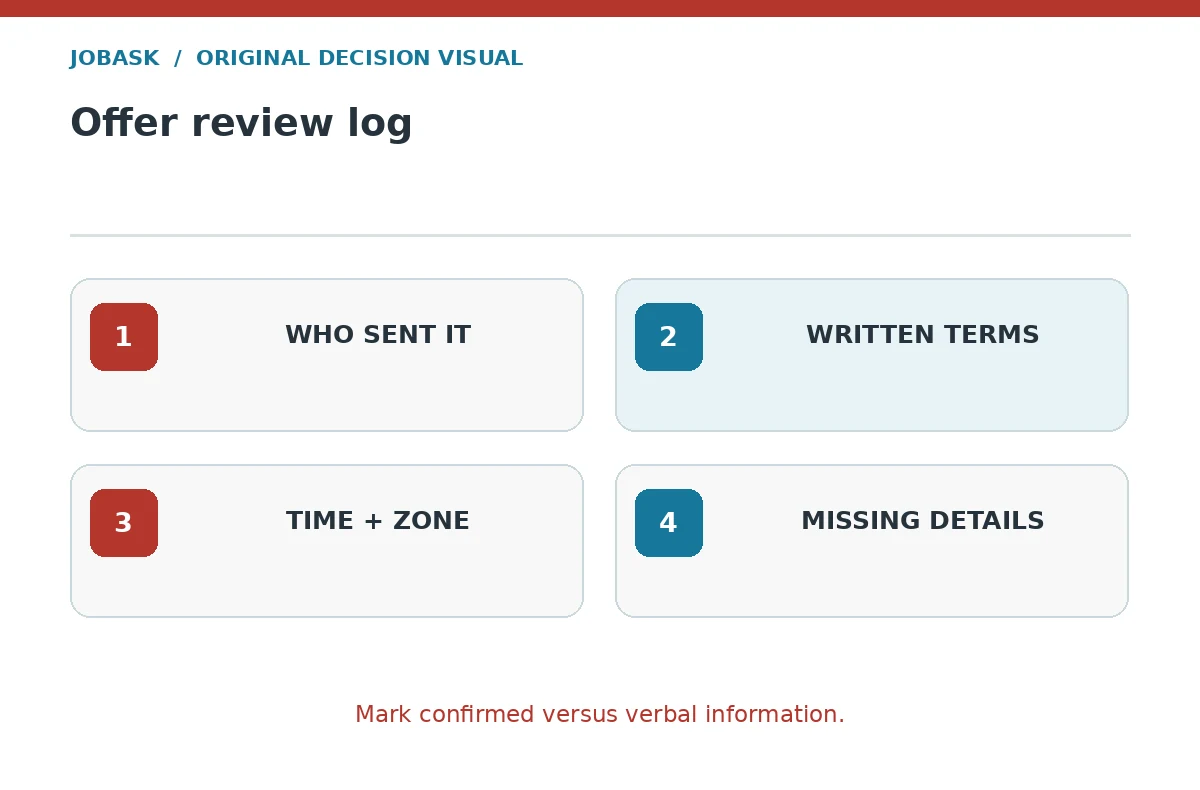
Start a small one-page log instead of depending on recollection from a fast call. Record when the offer arrived; who sent it; the exact role and location; the promised written document; the response deadline and time zone; and the person who can answer questions. Treat each field as “confirmed,” “mentioned verbally” or “not supplied.” This matters because a start date said on a call may differ from a placeholder in a standard attachment. Request a correction where appropriate, not a silent guess.
A fictional log might read: “Role: operations assistant — written; start: early November — verbal only; schedule: unclear; reply deadline: Friday 3 p.m. Pacific — email.” The value lies in identifying the missing schedule and lack of written start date, not in collecting detailed pay figures. Berkeley’s offer checklist includes the job title, start date, supervisor and deadline. The exact list you need may be longer depending on the work arrangements, but every entry should trace back to an actual source.
Ask About Missing Information Before Committing
Review the offered duties and work setting first. Confirm location, expected schedule, start date, reporting contact, and how the employer will transmit its formal terms. If any of those facts could change your decision, ask the question while you are still evaluating. Phrase it neutrally: “Before I respond, could you confirm whether the role is based at the office every weekday or on a hybrid schedule?” Questions are not negotiations by themselves; they are a request for accurate information.
Do not send a list of a dozen speculative questions simply to delay. Rank the essential unknowns, ask the person who can answer them, and keep your reply deadline visible. If you need more time, ask before the stated date and wait for confirmation; an extension is not automatic. The University of Michigan and Berkeley both emphasize evaluating the job as a whole, not only the initial excitement. When the details are settled and you are ready to decide, move to a separate, unmistakable final response. Our guide to questions to ask before accepting a job offer and how to email them goes into more detail.
| Offer response state | What you can safely write |
|---|---|
| Acknowledging | Thank you; I have received the offer and will review it. |
| Clarifying | Before making a decision, could you confirm the schedule? |
| Requesting time | May I send my decision by the agreed date? |
| Accepting | I am pleased to accept the position as described in the written offer. |
Choose the Next Message Based on the Actual State
There are three appropriate routes. If written details are complete and you are committed, accept using the employer’s requested channel and confirm the agreed basics. If a decision-critical detail is missing, ask for clarification and avoid acceptance language. If the position does not meet your needs, decline politely rather than allowing the deadline to drift. A fourth temporary state is an acknowledged offer awaiting review; it is legitimate only while you have a workable deadline and are communicating responsibly. If you want the full process, read how to accept a job offer by phone and follow up in writing.
Test your draft by underlining every verb that describes a decision: accept, commit, agree, decline, confirm or review. Does the verb match what you truly intend today? If not, edit the line. Keep a copy of the written offer and your response in a private, secure location. Don’t paste entire confidential documents into public tools. The purpose of this workflow is clarity between two parties, not creating a record to win a disagreement later.

Recognize Warning Signs Before You Reply
A surprise offer from an unverified messaging account is not automatically a legitimate hiring process. The FTC advises independent checks when recruiters request upfront money or sensitive data. Look up the employer’s official career page, and contact the company using a number or domain obtained independently of the incoming message. Do not pay a fee to receive wages, deposit an employer “equipment check” and return funds, or share a bank login as a condition of acknowledging an offer.
If the offer seems real but the paperwork is confusing, request clarification through the verified recruiting contact. You are not obligated to respond on an unfamiliar platform immediately. Keep an accurate account of what the recruiter communicated, but avoid speculating that every unusual delay is fraud. The sensible decision is to verify independently, ask specific questions, and only proceed when the role, organization and terms are sufficiently clear for you to decide.
How We Research This Job Offer Decision
We compared university guidance on acknowledging verbal and written offers, separated first contact from final commitment, and checked FTC warnings for unsolicited offers. The scripts and log are original hypothetical teaching aids, not accounts of actual employer communications.
Sources and Editorial Transparency for This Guide
Source pages checked October 20, 2026: www.career.berkeley.edu — source 1; careerservices.fas.harvard.edu — source 2; consumer.ftc.gov — source 3. We link to these resources so readers can check the original guidance. This is general career communication guidance, not individual legal, financial or employment advice. For disclosures see the JobAsk affiliate disclosure. We have not claimed any affiliate approval for resources linked here.
Related Workplace Guides
- How to Acknowledge a Job Offer Without Accepting It Yet
- Thank-You Email After Accepting a Job Offer: What to Say Next
- After Accepting a Job Offer: A Practical Checklist Before Day One
- Before Accepting a Job Offer: Compare the Terms That Matter to You
- Decline a Job Offer After Accepting Another: Close the Loop Professionally
Not by itself. Thanking an employer can acknowledge receipt without stating a final decision. Use explicit language to show whether you are reviewing or accepting.
Yes, requesting written details makes it easier to check the role, start date, schedule and other key terms before you reply definitively.
Thank them, explain that you would like to review the written offer, and ask for a specific mutually acceptable reply deadline.
Yes. Ask targeted factual questions, explain that you are assessing the role seriously, and keep to the agreed response timeline.
Verify the employer independently and do not send money or sensitive financial information to an unknown recruiter; review FTC job-scam advice.