
Journalism job websites can help you find reporting, editing, multimedia and newsroom production work, but a keyword such as “writer” is too broad to show the difference. Begin with the kind of reporting or editorial responsibility you want, then examine a real newsroom’s assignment structure, schedule, location requirements and sample-work expectations. The Society of Professional Journalists maintains a career center that can serve as one discovery route.
The best search record links the exact employer posting to work samples you are permitted to share. A published story, an edited piece and a production segment may all be relevant, but they demonstrate different contributions. Avoid claiming sole reporting credit for team work, and never disclose an unpublished source or private interview material merely to make an application impressive.
Separate Reporting, Editing and Multimedia Roles
Reporting listings may emphasize interviews, public records, beat research and deadline filing. Editing jobs may require copy review, assignment planning, headline decisions, fact checking and collaboration with writers. Multimedia roles may combine video, audio, photography, field production and digital publishing. The Bureau of Labor Statistics describes a range of journalism work settings, but individual newsrooms decide how duties are divided.
Make a lane map before searching. If you have published reported work, consider beat and general-assignment searches. If your strongest proof is correction of drafts, workflow planning or content editing, search editing and production titles too. A candidate transitioning from another field can present transferable research or writing experience honestly without relabeling promotional content as independently reported journalism.
Use Journalism Career Centers With Employer Verification
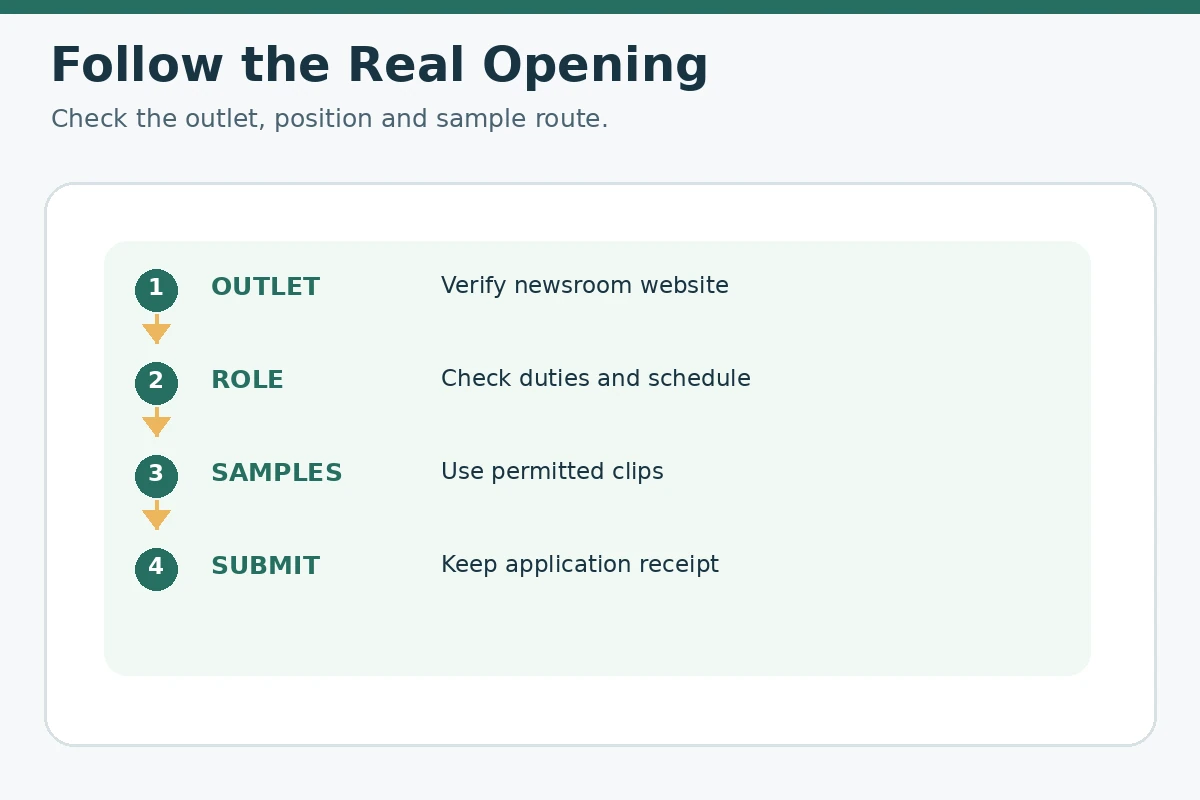
The SPJ career center lists openings in journalism and related communications roles. A listing appearing under journalism does not mean every job involves reporting: examine the employer, assignment, job family and actual duties. Local news organizations, public media, magazines, digital outlets and educational institutions may use different titles. Save the original job announcement and look for the same opening on the publisher’s own careers page.
Some newsroom postings are distributed through association boards, professional networks or a publication’s direct hiring page. Search all three channels, but record one verified application record per position. A newsroom may list remote or hybrid work yet still require geographic proximity for reporting assignments. The job-board summary is not proof that location or travel conditions will work for you.
| Newsroom path | Evidence sample | Accuracy boundary |
|---|---|---|
| Reporting | Published article with clear byline | Do not expose unpublished sources |
| Editing | Approved edited piece or workflow summary | Credit the original author |
| Multimedia | Published audio/video segment | State filming, scripting and editing roles |

Choose Clips That Demonstrate the Requested Work
For a reporting position, choose a few relevant, authorized published clips and explain the reporting you completed: sources contacted, documents examined, fact-checking work and any limitations. For editing, clarify whether you commissioned, revised, checked, packaged or only proofread the piece. For video or audio, state the role you had in shooting, scripting, recording, editing or publishing. A link alone rarely explains your contribution.
A hypothetical applicant may have produced a school-newspaper feature and edited a colleague’s short video. That can be meaningful early evidence, but the materials must be labeled accurately and used with permission. Avoid displaying unpublished tip messages, source identities, private recordings or internal editorial notes. If a published story has corrections, provide accurate context rather than silently deleting the history.
Read Beat, Schedule and Safety Expectations
A job description may specify a geographic beat, irregular hours, breaking-news rotation, field reporting or travel. Ask whether the job provides appropriate training, editorial support and procedures for sensitive assignments. Do not assume that being hired for digital journalism always means working from home; many roles require being present at events or meeting sources. Make sure the schedule and location fit before applying.
Journalists work under deadlines and editorial review, and each newsroom has its own standards and processes. Ask about the correction workflow, legal or standards review and whether the position expects you to contribute multimedia files. If you have not handled a specialized beat, be clear about the learning you would need. Do not present risky investigative activity as an unreviewed personal initiative.

Screen Newsroom Openings and Protect Sources
Verify the employer through the publisher’s genuine website and public contact information. If a supposed editor approaches you from a personal messaging account, confirm identity using an independently found channel before sending work samples. Scam messages can impersonate recognizable employers; the FTC advises against paying to get hired or sharing sensitive financial details before the hiring process is real.
Your clips should not expose sources who expected confidentiality. Remove restricted material from any sample packet and consider providing a public link or a permitted summary instead. If a newsroom asks for a test assignment, clarify scope, publication rights, deadlines and whether compensation is involved before doing substantial work. A role’s legitimacy and a sample’s ethical use are separate checks.
Build a Search and Clip Tracker That Saves Time
Track the outlet, role type, beat, location, schedule, sample-work format, verified application URL and submitted date. Keep a separate clip index showing title, public URL, publication date and your actual contribution. This makes it easier to tailor a packet without sharing sensitive material or repeating the same sample indiscriminately. Preserve original dates instead of implying all work was recently published.
Review results weekly and adjust for role fit. If a board returns mostly communications or PR jobs while you seek independent reporting, refine the query to newsroom and reporting tasks. If you seek editorial operations, include copy editing, assignment desk and production language. The goal is to find a newsroom where the work and professional standards are clear, not to treat every media-related listing as the same occupation.
How We Research and Verify Job Boards
Checked on 2026-11-14, using the following primary career-center and public-interest resources: Society of Professional Journalists career center (The Society of Professional Journalists maintains a career center for journalism and related openings.); U.S. Bureau of Labor Statistics, journalists (BLS describes reporter and journalist tasks, newsroom settings and the role of published work samples.); Federal Trade Commission, job scam guidance (FTC warns about impersonated recruiters, requests for money and premature demands for sensitive personal information.). We checked the supplied WordPress title inventory, the original JobAsk production plan and the immediately preceding article package for overlapping intent. Board inventories and employer requirements change, so this guide describes a verification method instead of claiming that any particular vacancy remains available. All hypothetical examples are illustrative and are not actual offers or employer endorsements. For monetization transparency, review the JobAsk affiliate disclosure; no paid affiliation is claimed here.
Related Job Search Guides
The SPJ career center is one specialist source. Also check verified outlets’ career pages and relevant professional networks.
Requirements vary. Use authentic work samples suited to the posting and explain your actual contribution, including student or permitted project work.
Do not disclose confidential source material. Ask for permission where appropriate or provide a lawful, non-sensitive account of your method.
No. Some job boards include both, but responsibilities, editorial independence and deliverables differ. Read each job description.
Do not pay for a job. Verify the contact with the employer through an independent channel and consult FTC job-scam guidance.