
STAR, CAR and SOAR are related ways to organize a true behavioral interview story, not three different standards you must master to be hired. STAR uses Situation, Task, Action, Result. CAR commonly means Context, Action, Result, though some sources use Challenge instead of Context. SOAR commonly uses Situation, Obstacle, Action, Result. Choose the version that helps you explain the actual event, your own decisions and what happened.
This comparison is useful when a recruiter suggests a different acronym or when a short answer needs less setup. UC Berkeley explains CAR, while Southern Illinois University describes SOAR. Terminology varies across sources and employers, so follow the particular interviewer’s instructions where given. None of these acronyms licenses invented achievements or a made-up numerical result.
Understand What Each Framework Makes Explicit
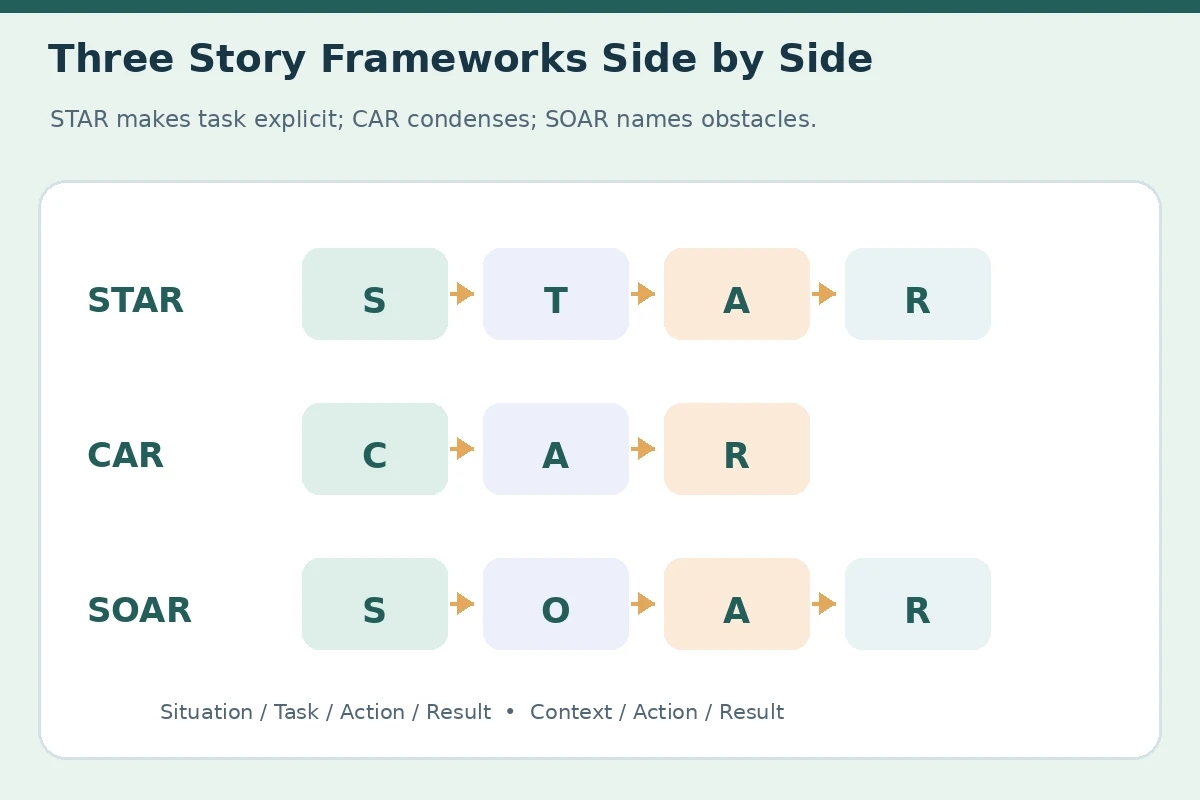
STAR gives Task its own place so you can state precisely what you were expected or authorized to do. That is especially valuable in team work or supervised settings, where the project’s overall goal can be confused with your responsibility. Situation provides context; Action explains your choices; Result describes the observed consequence. The four labels do not need to become four stiff paragraphs in speech.
CAR compresses the opening into Context, then gives the most room to Action and Result. Some employers call C Challenge. SOAR brings Obstacle to the front: what made progress difficult? Southern Illinois University uses the Situation-Obstacle-Action-Result version. Other institutions may explain the acronym differently. Do not assume the letter alone proves what a particular employer wants; clarify unfamiliar terms.
Use STAR When Scope and Responsibility Need a Separate Sentence
Suppose a fictional campus team had to correct a registration sheet before an event. A STAR answer could say: Situation—duplicate names appeared on the list. Task—I was assigned to flag uncertain records, not approve deletions. Action—I compared two authorized files and marked possible duplicates for the coordinator. Result—the coordinator approved corrections before check-in. Every statement belongs to the same invented teaching case.
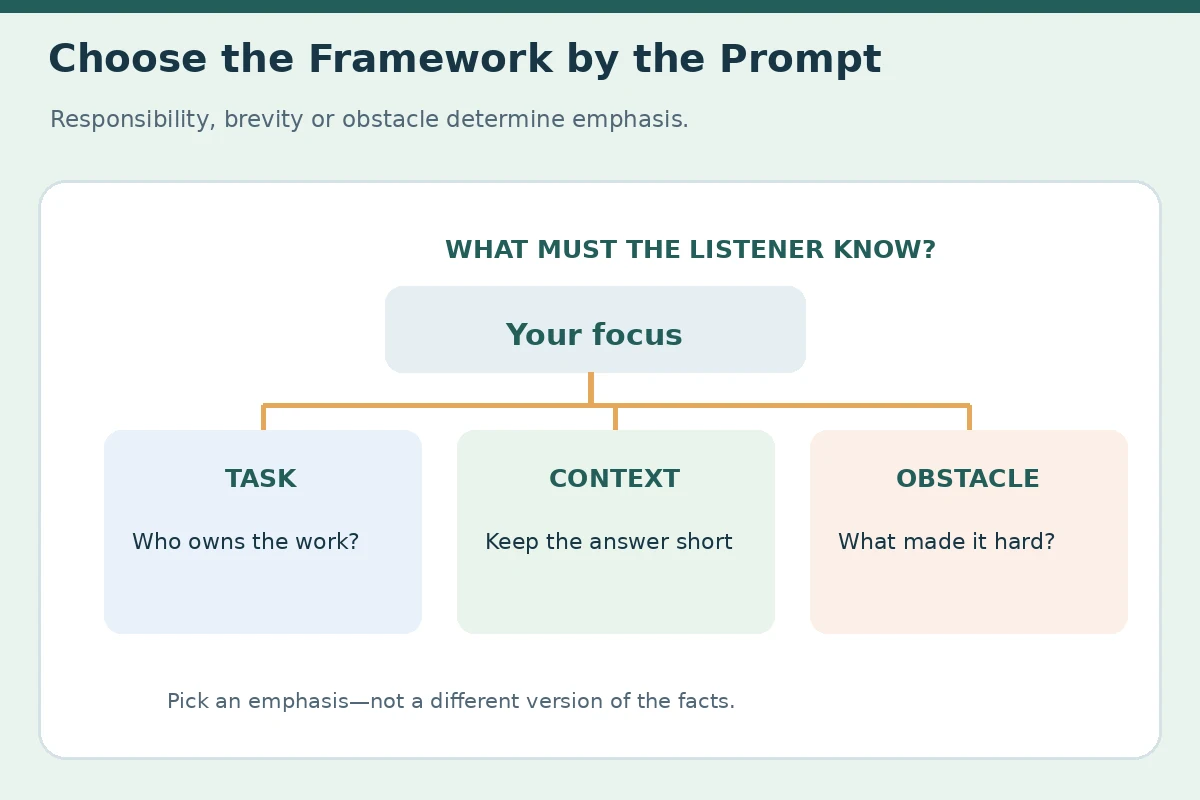
The Task line protects the distinction between group objectives and personal authority. Use it when another person approved your work, an assignment changed mid-project, or an interviewer may otherwise assume you led the entire effort. STAR does not require you to spend an equal amount of time on each label. The goal is a coherent description that foregrounds what you actually did.
| Format | Distinct part | Best use |
|---|---|---|
| STAR | Task has its own label | Responsibility and supervision matter |
| CAR | Context combines setup and task | Short behavior example |
| SOAR | Obstacle is called out | Constraints shaped your choices |
Use CAR for a Shorter Version of the Same Event
With CAR, the fictional story becomes: Context—the team discovered duplicate event registrations, and I was responsible for checking the roster. Action—I compared approved records, flagged uncertain matches and asked the coordinator to review. Result—the coordinator approved a corrected list before check-in. No facts have changed. The Task is included inside Context, which makes the spoken opening shorter without concealing ownership.
UC Berkeley career material emphasizes Context, Action and Results as a way to compose a concise answer. CAR may be useful when the interviewer requests a quick example or has already supplied plenty of context. But shorter is not automatically better: if the listener cannot tell what your own task was, add a clarifying clause. A framework is a tool for understanding, not a contest in brevity.
Use SOAR When the Obstacle Explains Your Judgment
SOAR draws attention to what blocked the work. In the same fictional case: Situation—the event team prepared a check-in list. Obstacle—the two authorized records disagreed, and removing a name without review could affect attendance. Action—I marked the inconsistencies and requested coordinator confirmation. Result—the coordinator approved the revised list. The obstacle explains why the assistant chose a cautious handoff rather than an unauthorized deletion.
The obstacle may be a time limit, a missing resource, a conflicting instruction or incomplete information. It should be real and relevant, not dramatic language added for effect. If a safety or privacy rule limited your options, include it accurately and identify any required approval. An obstacle-focused answer should still reveal your own action and honest result; listing obstacles alone does not show problem-solving.
Keep the Underlying Facts Fixed Across All Three Versions
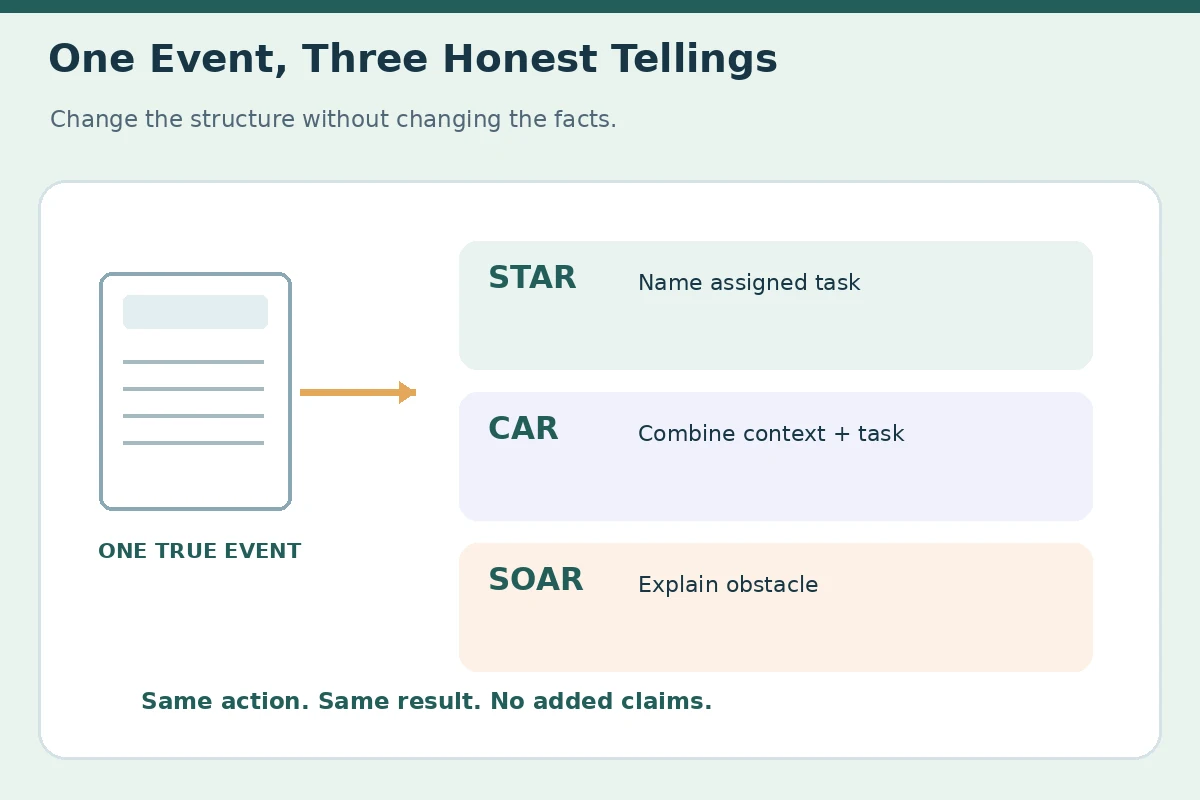
Use the same event record regardless of the acronym: setting, goal, your actions, people who owned decisions and the observed end. When practicing, label what you personally know and what you inferred. Changing “I flagged the issue” to “I resolved the issue independently” merely to fill an Action box distorts the story. So does replacing “the revised list was approved” with an unmeasured improvement in customer satisfaction.
A useful exercise is to write the full STAR story once, then compress it to CAR and reframe it as SOAR without adding facts. Compare what the interviewer understands. Does CAR hide your assigned task? Does SOAR overstate the difficulty? Does STAR spend too long in background? Choose the format that answers the actual prompt most clearly, then abandon the visible labels in natural conversation.
Follow Employer Prompts Rather Than Arguing About the Acronym
Some questions ask for a past event; others ask what you would do in a hypothetical future scenario. OPM distinguishes behavioral descriptions from situational questions in structured interviews. If a panel asks for a real example, provide one; do not disguise a hypothetical plan as past experience. If it asks for a proposed response, reason through the scenario while identifying assumptions and approvals.
A company may supply a competency guide with its preferred wording, scoring criteria or specific behavioral dimensions. Use those instructions where available. If a recruiter says “tell us using SOAR,” you can ask whether they mean obstacle or objective. Do not claim any of these formats guarantees a strong evaluation; the quality and relevance of the evidence matter more than which heading you memorize.
How We Research Interview Story Guidance
We reviewed the cited primary career-center and government sources on 2026-11-14: UC Berkeley CAR interview tips — UC Berkeley describes CAR as Context, Action and Results and recommends separating one’s own actions from team activity.; SIU interviewing — Southern Illinois University presents STAR and SOAR as interview-story options, with Obstacle in SOAR.; Wisconsin STAR method — Wisconsin La Follette career guidance discusses STAR and alternative CAR/CCAR terminology and emphasizes individual actions.; WTAMU interview frameworks — West Texas A&M University discusses STAR and a Challenge-Action-Result reading of CAR.. We also compared this narrow interview topic with the supplied WordPress post-title export and existing JobAsk STAR and behavioral-answer guides to reduce overlap. All candidate stories and suggested responses are fictional illustrations unless explicitly attributed to a cited source. The frameworks are coaching structures, not employer-wide scoring rules or hiring promises. Read our affiliate disclosure; no partnership or paid recommendation is claimed.
More Interview Preparation Guides
They overlap. CAR usually combines setting and responsibility into Context, while STAR labels Task separately.
No. Sources differ; the versions cited here use Situation, Obstacle, Action, Result. Check an employer’s definitions.
Yes, if doing so helps answer clearly and the interviewer has not required a particular format.
STAR can help distinguish your Task from the team’s goal, but a clear CAR or SOAR answer can also do this.
They were developed mainly for evidence-based stories; label hypothetical reasoning honestly instead of presenting it as history.