
A graphic designer resume objective is strongest when it connects the design role you want to work you can actually show. Rather than claiming to be a “creative visionary,” identify the medium, the type of brief, and your contribution to a finished or clearly labeled in-progress artifact. Employers may ask whether you created the concept, prepared production files, or only adjusted a layout under a designer’s direction. Your objective should not claim ownership of team work or reveal unpublished client material. A short, job-specific line plus an accessible, permission-cleared portfolio is more persuasive than vague enthusiasm.
Find the real design brief behind the job title
Graphic design postings vary: marketing assets, packaging, print production, social content, presentations, and interface graphics require different deliverables and review cycles. O*NET describes designers creating layouts, discussing requirements, reviewing drafts, and preparing final files. Those tasks suggest what to look for in the job description, not a universal list of software every designer must know. Circle two types of deliverable you have genuinely produced; ignore attractive terms that do not match your projects.
A student applying for production design support can highlight the accuracy of print-ready files and response to feedback. Someone transitioning from social content into brand design should identify which assets were theirs and which required a senior designer’s approval. The objective should make the direction clear, not falsely assert that you directed brand strategy. A specific target such as junior graphic designer or production designer may help when it matches the employer’s vacancy.
Match your portfolio to your actual contribution
For each selected project, write down its brief, audience, what you personally designed, and what happened after review. A class poster with a defined assignment can demonstrate hierarchy and iteration; an unpaid group project may show collaboration. Neither automatically proves client management or commercial campaign performance. State if the concept, copy, artwork, or final export belonged to another contributor. A portfolio note that credits the team can be stronger than inflated ownership.
Use links only to work you have permission to show. A rejected campaign concept, confidential brand draft, or paid client asset may be subject to agreements and should not be uploaded without authorization. If you cannot show a deliverable, use a self-created demonstration project clearly labeled as such. Keep the objective focused on your craft and proof, not on private client names or results you cannot verify.

Write an entry-level objective with portfolio proof
Illustrative objective: “Junior graphic designer seeking a production-focused role; created course projects in poster layouts and social graphics, revised files from instructor feedback, and maintains a portfolio of original approved samples.” This wording shows medium, revision process, and context. Replace every project type with the work you have actually done. If a sample is only a mock-up, label it a mock-up. You do not need to invent a brand or employer to show a disciplined design process.
A weak alternative is “Award-winning expert with designs that triple customer engagement.” Without real awards, data, and attribution, it creates more questions than value. An honest transition version might say, “Marketing assistant moving into graphic design, with verified experience updating approved layouts and preparing files for team review.” That opening supports role progression without pretending the applicant developed every concept. Add a short portfolio URL near your contact details and test access from a signed-out browser.

Explain review and delivery instead of just naming tools
A tool list does not show whether you can deliver usable work. Explain an actual review loop: receive brief, propose layout, gather feedback, revise, verify dimensions and file type, and prepare approved output. If the client or creative lead approved the final design, say that person approved it. A resume objective can mention iteration and handoff if you did those tasks, while the experience section holds details about file formats, brand guides, or collaboration.
Do not claim you conducted original audience research or led client meetings if a teacher supplied a sample brief. If you worked with templates, state whether you customized, maintained, or simply exported them. A modest task that demonstrates correct application of brand or accessibility guidelines is stronger than ungrounded “end-to-end creative direction.” The best opening makes it easy for a reviewer to connect your claimed skill to a visible portfolio item.
Use design metrics carefully
Views, clicks, customer response, and conversion outcomes can depend on distribution, budget, product, timing, and other teammates. If you designed a social tile and the campaign performed well, do not automatically take personal credit for the total result. Include a number only if it is verified, the scope is clear, and the attribution is defensible. A production designer’s exact role and quality of handoff may be more relevant than a marketing metric that the designer did not control.
For classroom work, a measurable and honest result may be a completed set of assets, the requested formats, or documented iterations rather than an invented return on investment. Make the sample status visible in the portfolio. If the job posting prioritizes client presentation, describe real conversations or critiques. If it prioritizes file production, highlight accurate export and version control. The objective should target those requirements without stuffing it with every design buzzword.
Decide whether a summary or objective serves the portfolio
CareerOneStop says recent graduates may use an objective to connect skills and education to a desired role. A designer with years of verifiable commissioned work may benefit more from a summary highlighting specialties, team role, and tools they actually use. The portfolio should support either opening. A student with strong original projects but no employment history is not required to invent freelance clients to sound credible.
Keep the objective to one to three concise sentences. Put the portfolio link in a clear location and verify that the files open for someone who is not logged into your account. If you have two design directions, consider tailored objectives and landing pages rather than one vague line about everything from animation to print. Reuse the same factual project descriptions, even when changing their order and emphasis for different postings.
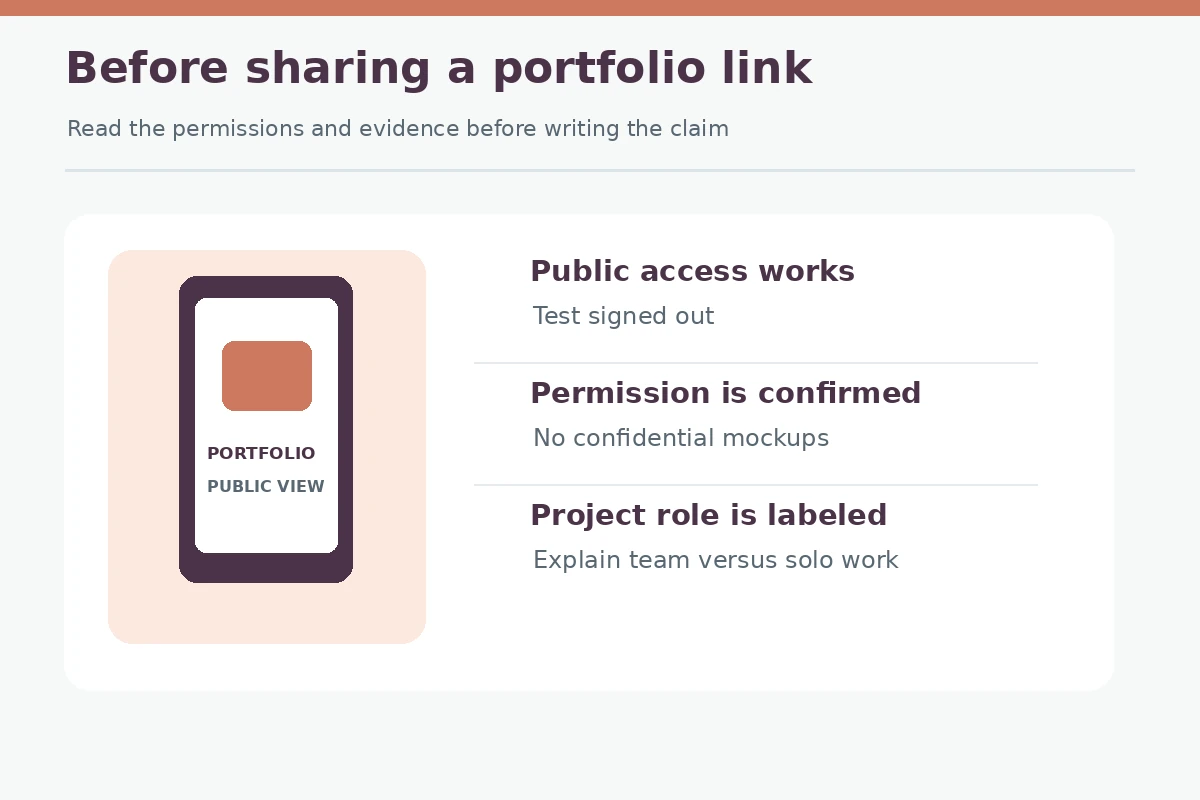
Perform the link, permission, and authorship audit
Open the portfolio on a phone and in a private browsing window. Check links, captions, and each file’s ownership. Is the sample public by permission? Does the caption identify the brief and your part? Are unfinished or speculative designs labeled clearly? Does the objective match the sample rather than claiming full art direction over a collaborative project? Remove any brand mark used in a misleading way and do not claim a client’s endorsement without approval.
Then proofread the resume itself as a document: a beautiful layout is not helpful if the text is hard to select or the exported PDF is cut off. Maintain a readable plain-text version when the application form needs one. Your objective should identify the target, your honest design contribution, and a clear proof path. None of those elements requires exaggeration about awards, clients, or marketing outcomes.
How We Research and Verify Resume Claims
We reviewed the O*NET occupation description for the tasks and role boundaries discussed above. For resume opening guidance, we checked CareerOneStop’s special resume tips for recent graduates and top-of-resume guidance. These resources do not confirm individual employers’ requirements or establish a candidate’s credentials. Compare the actual posting and your own documents before deciding what to claim.
All proposed resume lines and work scenarios in this guide are illustrative, not descriptions of real applicants or guaranteed hiring outcomes. We do not verify your credentials or imply employer endorsement. Source descriptions are paraphrased. Review the site’s affiliate disclosure; this article does not claim any paid employer placement or affiliate partnership.
More Resume and Cover Letter Guides
Yes. State that the projects were completed in coursework and make the original work available if you have permission.
No. Describe which concepts, layouts, revisions, or exports you personally handled and credit collaborators.
Seek permission or use a newly created demonstration piece instead. Do not expose restricted drafts.
No. Include only verifiable results you can reasonably attribute to your contribution; useful artifacts and workflow proof are often enough.
A summary may better foreground real professional scope and specialties. An objective is helpful for first roles or a clear change in design direction.