
For a law firm support interview, show how you organize documents, confirm deadlines, handle confidential information, and refer legal decisions to the responsible attorney. The most useful stories show an actual check or handoff. Do not imply that a receptionist, legal assistant, or paralegal can independently accept a client, give legal advice, or approve filings.
Prepare evidence for the duties actually advertised
Start by opening the employer’s own announcement and separating must-have requirements from responsibilities described as trainable. For this law firm support applicant role, relevant activities include index documents, flag a due date, route for review, secure client details. Mark the skills you have actually practiced, the ones you have only studied, and the ones that would require workplace instruction. A clear interview preparation sheet prevents you from borrowing impressive language from a posting without having examples to support it.
Make a small evidence table with the task, one past situation, your exact contribution, and what you would ask your supervisor to review. For instance, A project involving organized records, deadline checklists, or confidential office communications may demonstrate relevant habits. Where a project was shared, do not claim the entire result as your own. Where you had no permission to complete a decision, describe your verification, notes, or referral instead. This is useful preparation because interviewers can ask you to unpack a specific action.
Read the posting for the actual support lane
Law firms hire receptionists, legal assistants, paralegals, billing staff, intake staff, and records coordinators. The work may overlap, but titles do not confer the same authority. Start by identifying whether this posting emphasizes phone calls, calendaring, organizing evidence, preparing drafts, or supporting a particular practice. Build your answers from those tasks and the experience you can substantiate.
The BLS lists document organization, research, draft preparation, and attorney support among paralegal and legal assistant duties. A firm may expect some tasks to be performed by licensed or trained staff only. Avoid assuming that seeing a pleading once means you can draft or file it independently. If you are new to legal work, describe your existing administrative skills and ask how the firm trains new hires.

Use a deadline example with a clear handoff
A useful question may involve an incomplete document arriving just before a deadline. The answer should distinguish recording the receipt, checking the correct calendar, alerting the assigned team, and seeking instructions from the person authorized to act. Do not claim that you would unilaterally change a court date or submit an unreviewed filing. A hypothetical example is fine for practice, but use a real story of accurate scheduling when presenting your past experience.
You might explain how you tracked deadlines for a school project, event, or office team, checked the latest instruction, and communicated a missing item early. Tell the interviewer how you distinguished urgent from merely loud requests. A strong response uses careful documentation and a named responsible role rather than an invented miracle about preventing litigation loss.
Turn one work situation into a clear answer
Consider this hypothetical practice scenario: A document arrives with an unfamiliar due date and a missing attachment. A strong rehearsal answer is: Record receipt, compare with assigned instructions, notify the supervising team, and seek authorized review before acting. Replace it with a real event before using it as proof of experience. State what the request was, what you checked, what you could decide yourself, and how you communicated the next step. Never add a fabricated employer result just to make the story feel complete.
Compare an overclaim with an accountable statement. Too broad: “I made every legal decision and approved filings myself.” Better as a hypothetical process example: “I logged the received documents, flagged the incomplete attachment, and sent the issue to the assigned reviewer before the deadline.” A concrete action lets the listener understand your limits and strengths. Practice the answer once aloud, then remove unnecessary details, unexplained acronyms, and any personal information you do not have permission to share. A good interview example is a short explanation of judgment, not a performance of confidence.

Protect confidentiality in every example
Legal support workers may be exposed to client information, case materials, financial records, or privileged communications. In an interview, describe processes without identifying clients or showing a confidential file. You can say that you limited sharing to authorized staff, used the designated system, and sought guidance when a requester’s authority was uncertain. Do not give details that another person could use to reconstruct a private matter.
An employer may ask what you would do if someone calls requesting a case update. A suitable answer is to verify identity and authorization according to firm policy, take an appropriate message, and route substantive legal questions to the responsible lawyer. The key is helpfulness without pretending that every requester is entitled to every detail.
| Practice focus | Evidence to bring | Authority check |
|---|---|---|
| FILE | Index documents | Confirm required permission |
| CALENDAR | Flag a due date | Confirm required permission |
| REVIEW | Route for review | Confirm required permission |
| CONFIDENTIAL | Secure client details | Confirm required permission |
Separate document support from practicing law
The ABA emphasizes attorney supervision and identifies legal opinions, fee setting, and client acceptance as functions that may not simply be delegated to a paralegal. Legal rules vary by state and by permitted nonlawyer roles, so the safest interview framing is to describe your assigned support work and confirm who reviews and approves decisions. Do not volunteer legal advice as a demonstration of confidence.
If an interviewer asks about a possible drafting assignment, explain how you would gather instructions, prepare a document within approved scope, and request attorney review before it is sent or filed as required. This also applies to ambiguous instructions: seek clarification instead of guessing the requested legal effect. The employer should hear that you work carefully and do not confuse speed with authorization.
Prepare questions about workflow and supervision
Ask who oversees incoming documents, who checks calendars, where confidentiality training fits, and how urgent handoffs are documented. If the role includes client intake, clarify what intake staff may discuss and what must be reserved for a lawyer. Avoid asking to see confidential case files as an interview exercise. Public practice descriptions and the job announcement are enough for initial research.
Finish your preparation by testing one story aloud. Can you explain the problem, the steps you personally completed, the people you informed, and the documented result without revealing sensitive details? If not, choose a safer example. Strong legal support candidates show they can protect a process and raise questions promptly without claiming attorney-level authority.
Run an interview rehearsal that tests your boundaries
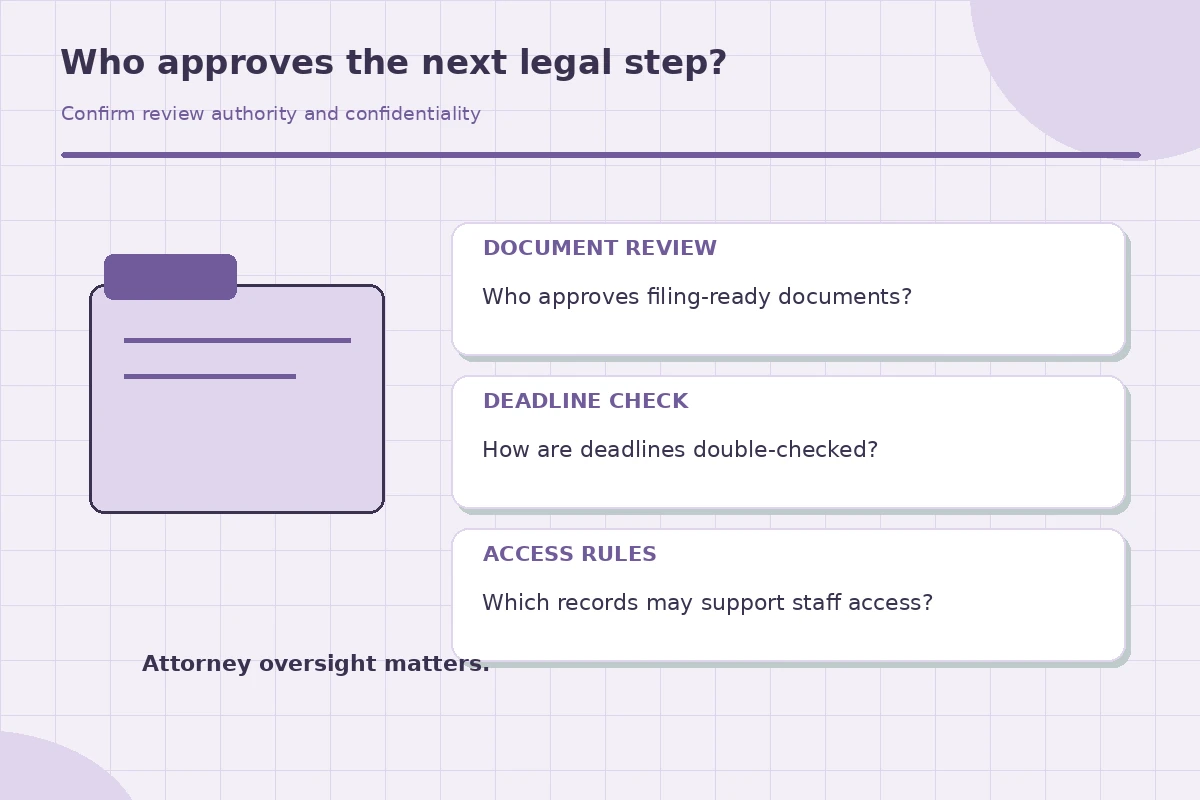
Read these three employer questions aloud and prepare short follow-ups: Who approves filing-ready documents? How are deadlines double-checked? Which records may support staff access? Practice a positive answer and an honest limitation. For this occupation, check the following boundaries: attorney controls legal advice; protect privileged information; confirm filing authorization. These are not obstacles to hide; they help you learn what the organization actually expects. A good rehearsal partner should ask what you personally did and what you would verify before acting.
End each example with a truthful result or a clearly stated unresolved handoff. Do not reveal private patient, client, patron, financial or emergency information. Ask whether the interviewer can follow the sequence without knowing your old employer’s internal system. If the answer depends on an assumption, change the wording: “I would check the written procedure or ask the authorized staff member.” That is particularly important when applying for a law firm support applicant position where trust is part of the job.
Review your notes before interview day
Prepare the job posting, interview location or call instructions, a clean copy of your resume, and a few concise questions. Identify which experience examples have documentation you can safely discuss. Do not carry proprietary screenshots or sensitive logs into the meeting. If the interviewer asks you to solve an unfamiliar procedure, explain how you would verify the rules before responding. Keep the first answer short enough that you can pause and invite a follow-up question.
After practicing, test your final explanation against three questions: Is every experience real? Does it show law firm support applicant duties rather than a different profession’s authority? Could you repeat it without violating confidentiality? If one answer is no, simplify the story. You can be motivated, skilled, and teachable while acknowledging that the employer provides essential procedures and onboarding. Interview preparation should help you assess fit, not just impress the interviewer.
How We Research Job-Specific Interview Preparation
JobAsk compared this topic with the supplied WordPress title inventory, the existing content plan, and previous locally prepared batches. We reviewed occupation-specific public guidance and primary sources on November 7, 2026. Example answers in this article are hypothetical unless explicitly described as personal examples to adapt; no candidate, employer outcome, credential, or hiring success is asserted. Local policy and training requirements take priority over broad occupational summaries. See our affiliate disclosure.
Source: cloudfront.careeronestop.org — CareerOneStop recommends researching employers, practicing aloud with real examples, and using the interview to assess fit.
Source: www.opm.gov — OPM describes competency-based questions that seek a situation, the applicant’s actions, and the result.
Source: www.bls.gov — BLS describes paralegal and legal assistant work involving organization, research, drafting and lawyer support.
Source: www.americanbar.org — ABA states that lawyers supervise delegated paralegal work and nonlawyers may not independently give legal advice or take reserved actions.
Source: www.americanbar.org — ABA explains the risk of nonlawyer staff exceeding attorney-only functions and the need for supervision.
More Interview Preparation Guides
Prepare examples of accurate filing, scheduling, confidentiality, handoffs and instructions followed.
Generally no. Nonlawyer work is subject to the applicable jurisdiction’s rules and lawyer supervision.
Describe the process and controls without revealing client names, case details or privileged documents.
Research public information about the firm and ask what matters most for the advertised support role.
Ask who checks drafts, who authorizes filings, and how deadlines and secure documents are tracked.