
A library assistant resume summary should quickly show how you help patrons and keep materials organized. Choose specific activities such as checking items in and out, shelving by the library system, helping people find the catalog, or maintaining accurate circulation records. Name the setting—public, school, college, or specialty library—when it matters. A volunteer at a book sale can describe the event honestly without claiming to be a librarian, cataloging professional, or reference specialist.
Distinguish assistant work from librarian duties
In a public library, an assistant may check in returned books, help visitors use the catalog, or organize materials. A librarian can have additional professional reference and program responsibilities; technicians may also handle more specialized technical services. Read the vacancy before choosing your first line. If you assisted at a service desk, do not call yourself the person who developed the collection policy. Describe the patron-facing or clerical functions you completed and the staff member to whom complex questions were referred. Specificity is more persuasive than a senior title that the experience section contradicts.
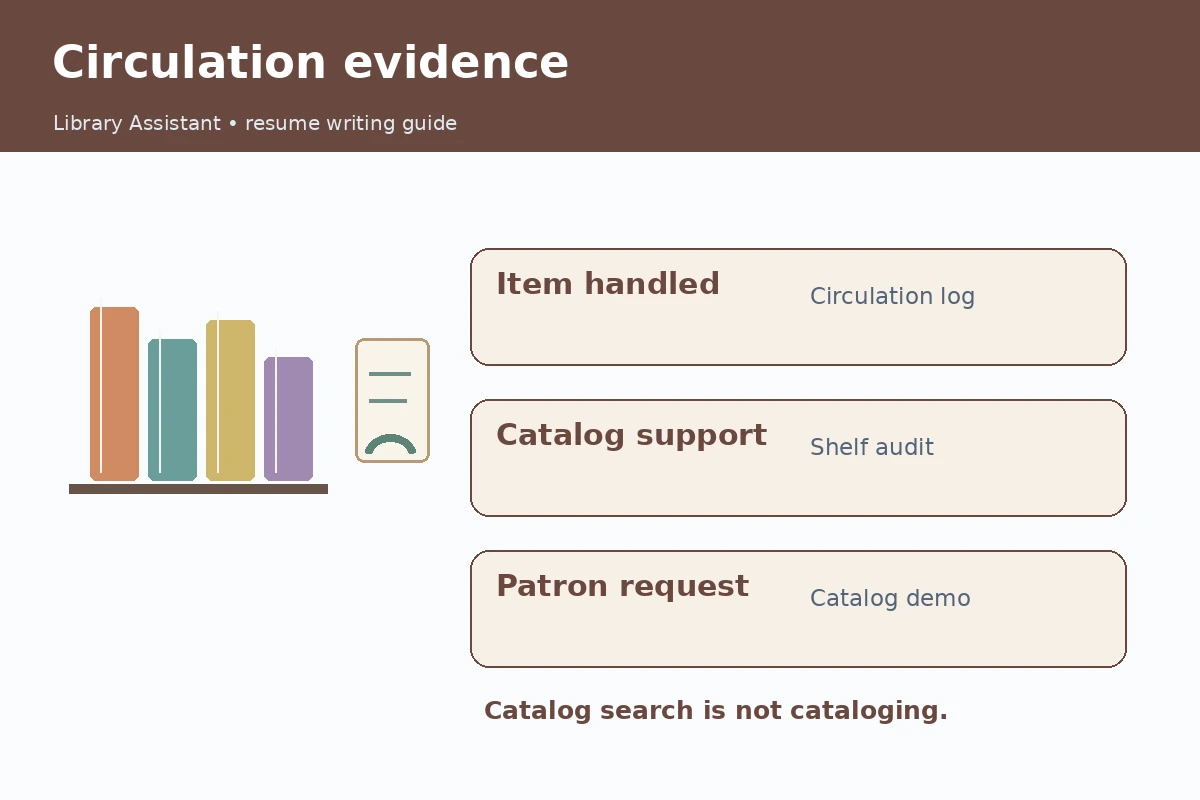
Choose the most relevant circulation tasks
A circulation summary can highlight transaction accuracy without revealing anyone’s borrowing history. Think about checking materials in or out, sorting returns, placing holds under instructions, or keeping carts organized. Pick the activities you actually handled and connect them to the setting. If you only volunteered to shelve books, do not describe independent management of the integrated library system. The main paragraph can say “assisted with shelving and material retrieval”; the bullets below can show how you verified locations or asked staff about ambiguous labels.
Use a summary that makes limits visible
A hypothetical applicant might write: “Library assistant with experience supporting circulation, shelving returned materials, and helping patrons navigate the public catalog. Maintains careful records and refers complex requests to library staff.” This is not a claim that the person held a librarian credential. Replace it with your own duties and work or volunteer status. An applicant who has only organized a school collection can still describe that experience accurately. Never invent an institutional affiliation, a circulation count, or a program outcome to make a short opening sound impressive.
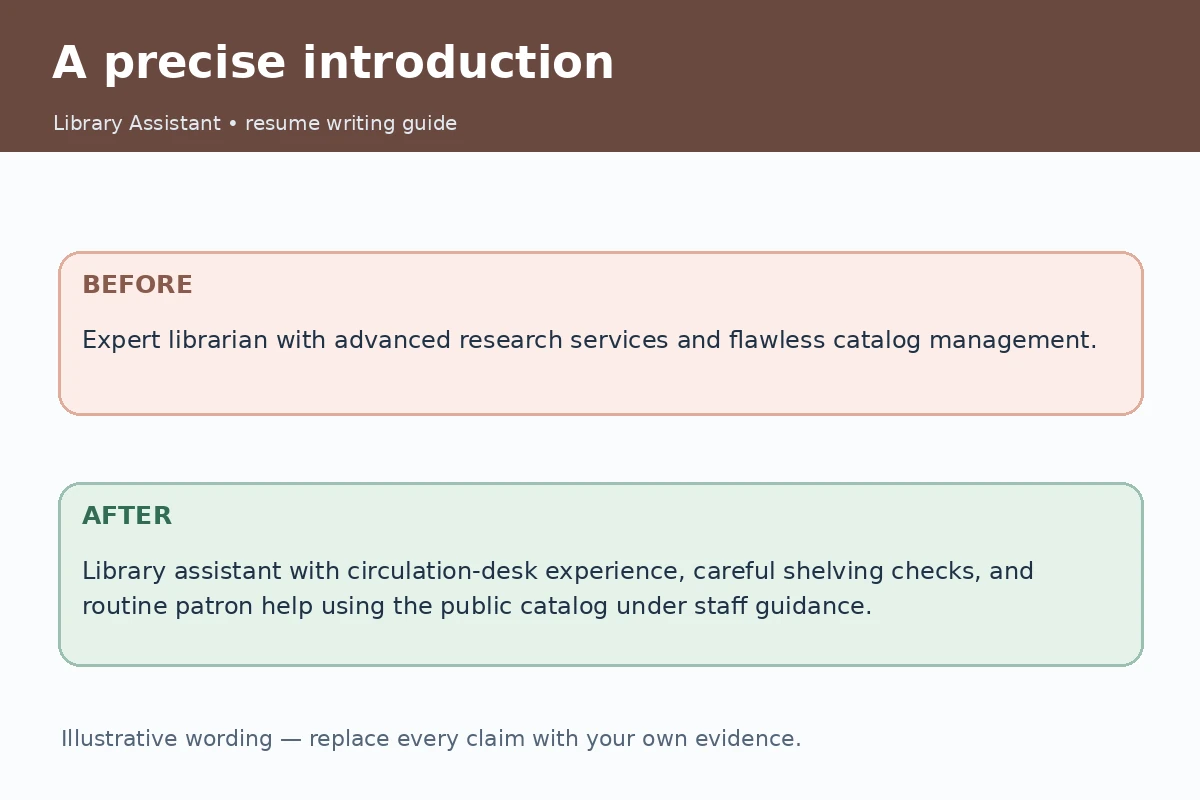
The example is deliberately limited to circulation, shelves, and catalog navigation. A candidate should be able to describe how materials were organized and how a patron received routine help, while recognizing that complex questions went to trained staff. If you have only school volunteer experience, change ‘circulation-desk experience’ to the honest setting. If you used a library self-service kiosk but never worked in the catalog database, say ‘helped patrons use the kiosk’ instead. This revised precision matters because a library assistant, a library technician, and a librarian may have materially different duties. The example is fictional.
Prove accurate shelving and materials handling
Shelving by call number or another classification scheme requires careful matching, not a vague statement about being organized. A relevant experience bullet might explain that you checked labels against a shelf sequence and placed uncertain items aside for verification. If the collection uses different systems, avoid claiming you know them all. Your summary can name “shelving and catalog support” when you have real examples. Save individual record types or procedures for the detailed section so the opening remains readable. Use only figures you actually recorded, and do not present a classroom exercise as library employment.
Demonstrate help without offering unauthorized advice
Routine patron assistance may involve showing someone where the catalog search box is, explaining a reservation process, or directing them to a workstation. A complex academic, legal, or medical reference question may need a trained librarian or an approved resource. Describe when you asked for help rather than pretending to know every answer. If you volunteered at a school library, your summary could mention basic resource orientation while acknowledging staff supervision. The distinction matters: respectful service means knowing both how to help and when another staff member should take over.
Protect patron privacy in examples and interviews
Borrowing histories, contact details, and library accounts can be sensitive. Do not create a resume portfolio from real user records or name a visitor to demonstrate a difficult interaction. A fictional circulation flowchart with invented titles and IDs can show that you understand the sequence without exposing records. If you handled patron data, describe your approved responsibilities rather than broad legal conclusions. Your summary might mention “confidential handling of circulation information” only if your actual practice supports it. A privacy-conscious candidate does not need to prove discretion by disclosing the very data they were trusted to protect.
Bring related retail or school experience into focus
Customer-service experience can transfer to a library desk when you have managed requests, organized stock, or explained basic tools. State the source role honestly: “retail associate transitioning to circulation support” may be appropriate, but do not relabel a store inventory system as a library database. A student who maintained a classroom reading corner can describe the project and the supervision. Tailor the summary to a position seeking reliability, public service, record care, or materials organization. The closer your examples match the posting, the less you need broad adjectives about passion or knowledge.

Perform a catalog and credential wording check
Before submission, make sure every specialized term is accurate. Catalog navigation is not the same as creating authority records. Shelving is not identical to collection development. Helping a patron find resources does not make you a professional research librarian. Check the exact title in your employment record and any certificate you list. If the posting expects a library technician qualification, read that requirement carefully rather than assuming assistant experience is equivalent. A well-written summary gives a truthful preview of the underlying duties and points the interviewer toward examples you can explain.
How We Research Professional Resume Summaries
We reviewed BLS occupational guidance; BLS occupational guidance; Penn Career Services resume guidance; Berkeley Career Engagement resume guidance to separate the tasks typical of this field from what any particular applicant actually did. Occupational descriptions inform which terms to explain, but they are not proof that a named person has the listed credentials. The resume resources emphasize targeted, specific evidence. Examples on this page are hypothetical; they must be rewritten to match your records, permissions, and the job posting. We do not invent employment, project outcomes, certifications, test scores, salary, or hiring assurances. Check your current employer requirements and refer to our affiliate disclosure before relying on any linked recommendations.
More Resume and Cover Letter Guides
Yes. Name the setting and volunteer capacity, and describe the shelving or organizing work you actually did.
No. Library assistants and technicians may support librarians, but titles, training, and authority differ.
Not unless you actually created or maintained catalog records. Catalog searching and cataloging are different tasks.
No. Use anonymized or fictional situations and protect library account and borrowing information.
Accurate organization, routine patron support, learning procedures, and appropriate staff referrals, backed by genuine examples.