
Preschool teacher interview questions usually make more sense when you prepare examples of how you support children’s learning, maintain predictable routines, communicate with families, and respond calmly to classroom changes. Avoid treating preschool as either babysitting or a miniature elementary school. Your examples should show age-appropriate activities and observed behavior, with no identifying stories about real children. Responsibilities and qualification rules depend on the school, program and state.
Role tasks were checked against official occupational information and interview techniques against the University of Michigan Career Center.
What This Role Actually Requires Before You Answer
The Bureau of Labor Statistics describes planning activities, observing children, and communicating with parents among the work of preschool teachers. O*NET also identifies adapting instruction, supporting social growth, planning experiential learning and maintaining classroom procedures. These are useful anchors for interview preparation, but they do not establish one curriculum, one discipline policy or one set of state licensing rules for every preschool.
Find out whether the opening is a lead teacher, assistant teacher or another early-childhood position. Study the program’s public philosophy and the job posting’s expectations; do not assert familiarity with a particular curriculum you have never practiced. Select examples from legitimate classroom placements, childcare employment, volunteer work or supervised learning. Protect children’s identities by changing nonessential details and never sharing records or family information. For the fuller picture, see our medical assistant interview questions guide.
Use Questions to Demonstrate Decisions and Evidence
The prompts below are practice scenarios about routines, safety, and families, not a real school’s question list. You can use a true past example with Situation, Task, Action, and Result, a structure explained by the University of Michigan. If you are asked what you would do about a child’s behavior or safety, clearly mark the reply as a proposed approach. Our office manager interview questions guide goes into more detail.
How would you plan a play-based learning activity?
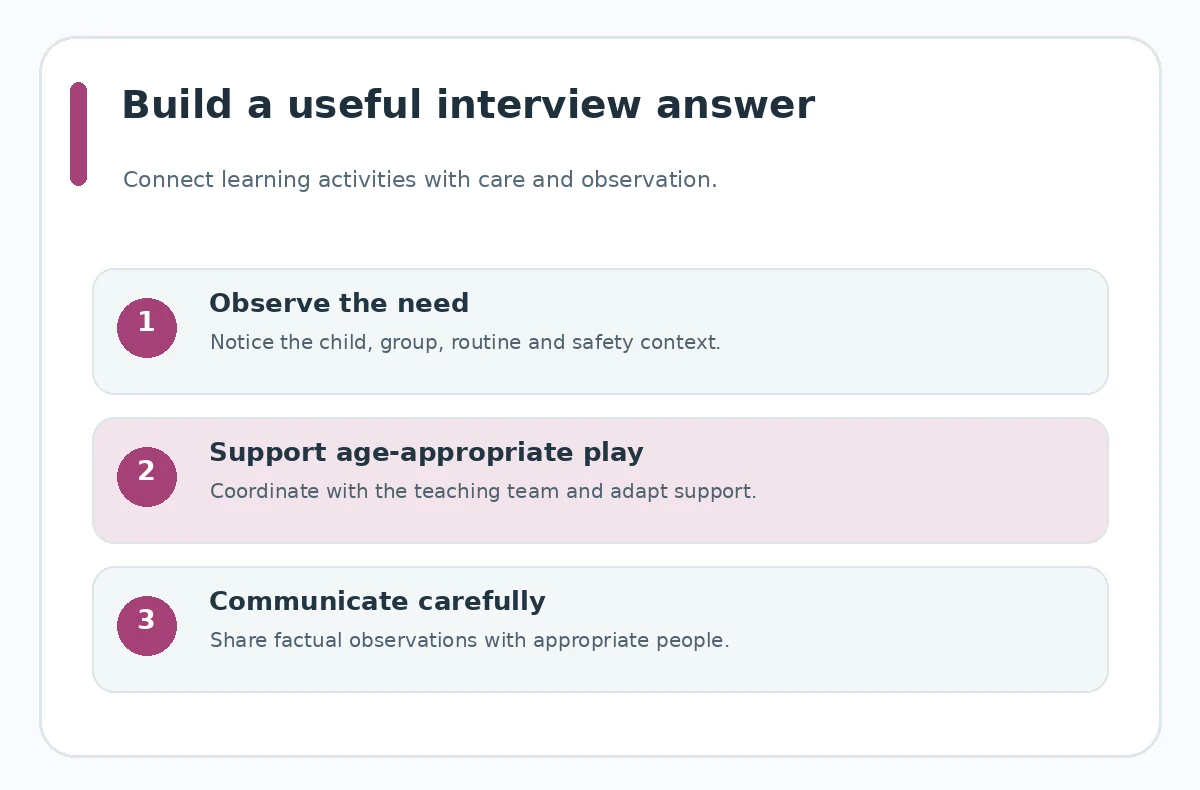
The question connects developmental aims with achievable classroom routines. A useful way to respond is to explain the learning goal, materials, adult guidance, room safety and how you would notice participation or adjust an activity. Hypothetical answer: In a hypothetical four-year-old classroom, you set up sorting and counting stations with age-appropriate materials. You observe how children approach the task and offer alternative ways to participate, then note what you would adjust with the lead teacher. Accuracy boundary: Do not promise that every child learns a skill on a fixed timetable or claim an unobserved outcome. After practicing, replace the sample classroom with your own childcare experience, or say you are describing what you would do. A good answer shows how you keep children safe and when you involve the lead teacher or director.
What do you do when children have difficulty with a transition?
Transitions can affect both emotional regulation and the rest of the group. A useful way to respond is to describe calm cues, simple choices, predictable steps, partner support and following the center’s behavior and safety policies. Hypothetical answer: In a hypothetical room, cleanup becomes difficult for several children. You give a clear warning before the transition, model a brief next step and involve a co-teacher according to the room plan. Afterward, you reflect on whether the routine needs adjustment. Accuracy boundary: Avoid punitive prescriptions that may conflict with program policy or a child’s needs.
How would you communicate a concern to a family?
Teacher-family conversations require factual observations and discretion. A useful way to respond is to use specific nonjudgmental observations, invite the caregiver’s perspective, and consult the lead teacher or director when the issue exceeds your role. Hypothetical answer: In a hypothetical conversation, you describe that a child needed extra support joining group activities on several occasions. You share the steps used, ask what has been helpful elsewhere and agree on a proper follow-up channel. Accuracy boundary: Do not diagnose a child, speculate about family circumstances or discuss other children.
How do you adapt for different learning needs?
Young children develop at different paces and may require differentiated ways to participate. A useful way to respond is to explain how you observe the learning goal, offer multiple ways to engage, and coordinate with the program’s approved support process. Hypothetical answer: In a hypothetical art activity, some children prefer large shapes while others use smaller pieces. You offer choices with suitable materials and observe participation without labeling the children as more or less capable. Accuracy boundary: Do not claim specialist training or services that you have not actually provided.

How would you respond to an unexpected safety concern?
Preschool environments need dependable supervision and clear communication. A useful way to respond is to describe securing the group in accordance with training, notifying the designated lead, following the center’s procedures and documenting necessary facts. Hypothetical answer: In a hypothetical playground scenario, you notice a damaged piece of equipment before a group activity. You keep the group away from it, notify the responsible staff member and use an approved alternative area. Accuracy boundary: Do not invent universal incident rules or reveal a real child’s private information.
| Evidence to prepare | What it proves | Accuracy check |
|---|---|---|
| Activity plan | Explain the age-appropriate goal, materials, support and observation. | Only describe tasks you really performed or would propose. |
| Family conversation | Use a respectful anonymized example with clear boundaries. | Only describe tasks you really performed or would propose. |
| Classroom routine | Show how you coordinated transitions, supervision and co-teacher support. | Only describe tasks you really performed or would propose. |
Prepare Stories Without Borrowing Someone Else’s Results
Write three short evidence cards about working with young children: the situation, your action, and the result. Childcare, camp, tutoring, or a practicum placement can count if it shows work with young children. Say where it happened and who supervised the group. If you have no reliable figure, describe how the child or group responded. Our hotel front desk interview questions guide goes into more detail.
Then practice one case where you had to involve the lead teacher or a parent. Explain what you observed, who you told, how you documented it, and what happened next. This matters because preschool staff are responsible for the safety and wellbeing of young children. Prepare one example about a daily routine and another about an unexpected incident.
Questions to Ask About the Actual Job
Use the last minutes to ask about class size, routines, and communication with families. Three useful questions for this role are: What curriculum or early-learning approach guides your classrooms?; How do lead and assistant teachers coordinate support and observations?; How does the center communicate routines and concerns to families?. These are suggestions, not requirements. If the interviewer already explained the daily schedule, thank them and ask about something else. Our electrician interview questions guide goes into more detail.
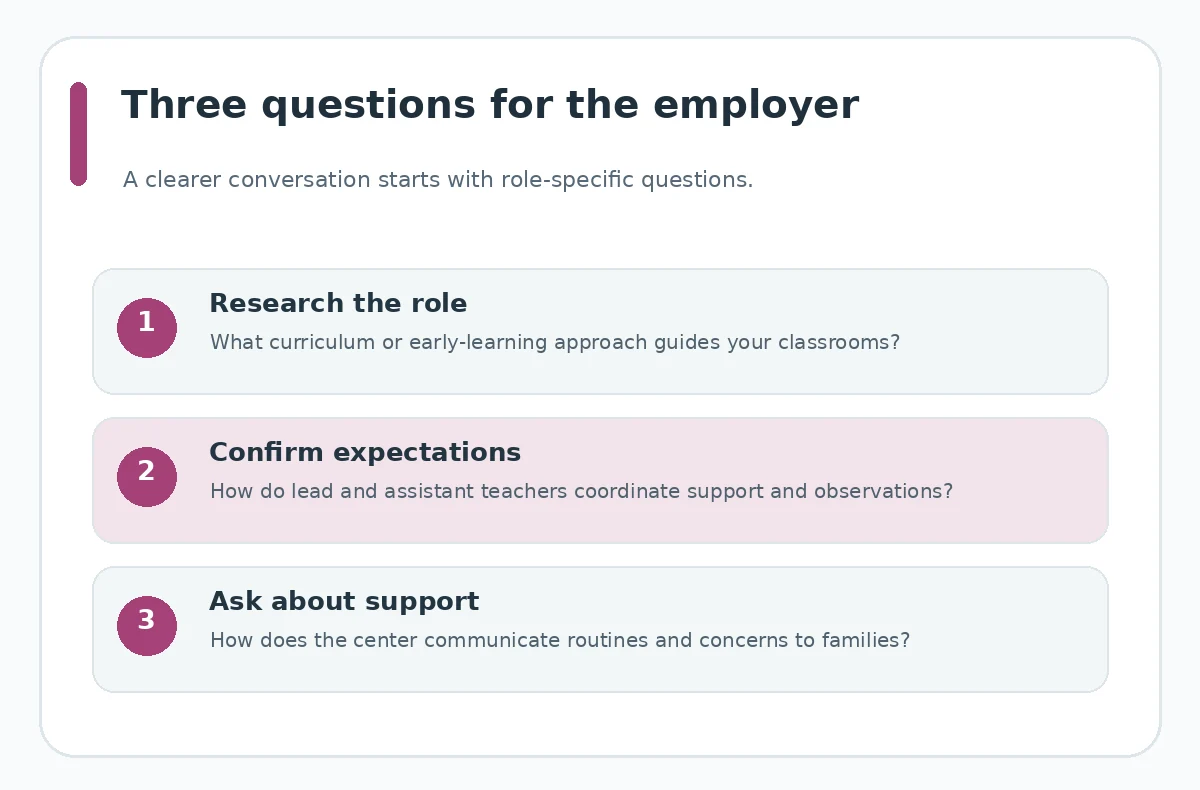
Listen for which tasks you would lead and which the lead teacher handles. The title “preschool teacher” does not tell you the age group, ratios, or curriculum. After the interview, note the duties discussed and any next steps, without details about children. In your follow-up, mention a real part of the conversation, such as the classroom routine you discussed.
How We Research These Interview Questions
University of Michigan career guidance informed the evidence-based answer structure.
Sources, Boundaries, and Affiliate Disclosure
Source checks completed October 21, 2026: O*NET occupational profile supports O*NET describes preschool instruction, adapting activities, classroom routines and social development. BLS occupational guide supports BLS identifies early-childhood planning, parent communication and variations in requirements. University of Michigan interviewing guidance supports University of Michigan explains research preparation and situation-task-action-result examples.
This guide contains no affiliate links. For the site-wide policy see the affiliate disclosure.
More Interview Preparation Guides
- Elementary Teacher Interview Questions: Lessons and Classroom Decisions
- Tell Me About Yourself in a Teacher Interview: Classroom Evidence First
- Questions to Ask in a Teacher Interview: Curriculum, Mentoring, and Support
- Teaching Assistant Interview Questions: Show Classroom Support and Boundaries
- Teacher Interview Strengths and Weaknesses: Lesson Evidence and Reflection
Yes. Label a practicum or supervised placement honestly and describe your own part of the activity.
Avoid names, identifying circumstances and private records. Use anonymized, appropriate examples and follow confidentiality rules.
Be truthful about your experience and describe how you would learn and apply the program’s approach with guidance.
No. Requirements vary by state, setting and specific role; review the job posting and official state guidance.
Specific observations, respectful listening, documented next steps and staying within your responsibility.