
Quick answer: A plausible remote dispatcher job should specify the service type, territory, coverage hours, communication tools, and who authorizes routing changes. Focus here on nonemergency service and logistics dispatch—not 911 or other public-safety positions, which have different duties and hiring requirements. Verify the employer and the shift before applying.
Confirm the Dispatch Type and Geographic Coverage
A dispatcher may assign field technicians, coordinate deliveries, schedule transportation, or relay work orders. These are not interchangeable with public-safety telecommunicator roles. O*NET describes non-police, non-fire, non-ambulance dispatch as scheduling personnel or equipment and maintaining service records. Read the advertisement for the actual operational setting, who receives calls, what constitutes a completed assignment, and what territory the worker supports.
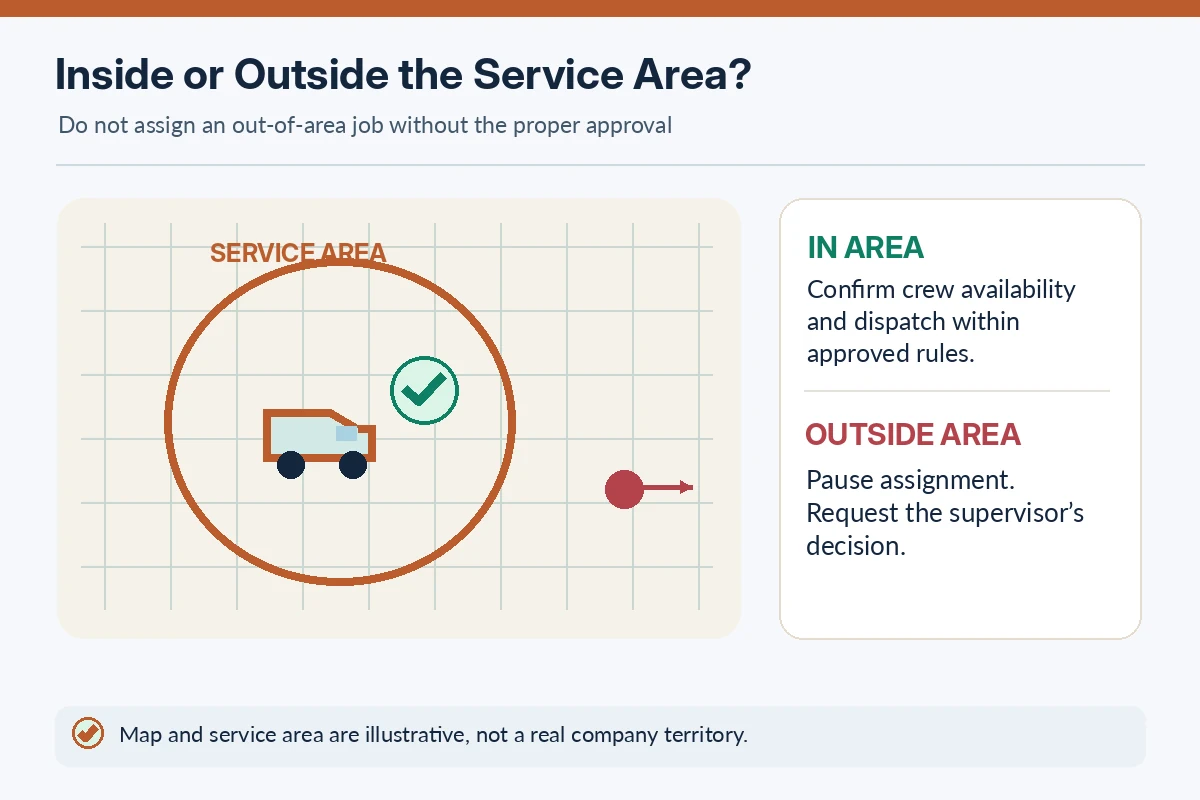
Location matters even when the operator works from a spare bedroom. An employer may require knowledge of a regional service area, permission to access local systems, or coverage during specific hours. Ask whether you must live within a state or region, whether routing maps and training are provided, and whether on-site orientation is required. Do not advertise yourself as an emergency dispatcher on the basis of a nonemergency practice project.
Trace One Work Order From Intake to Closure
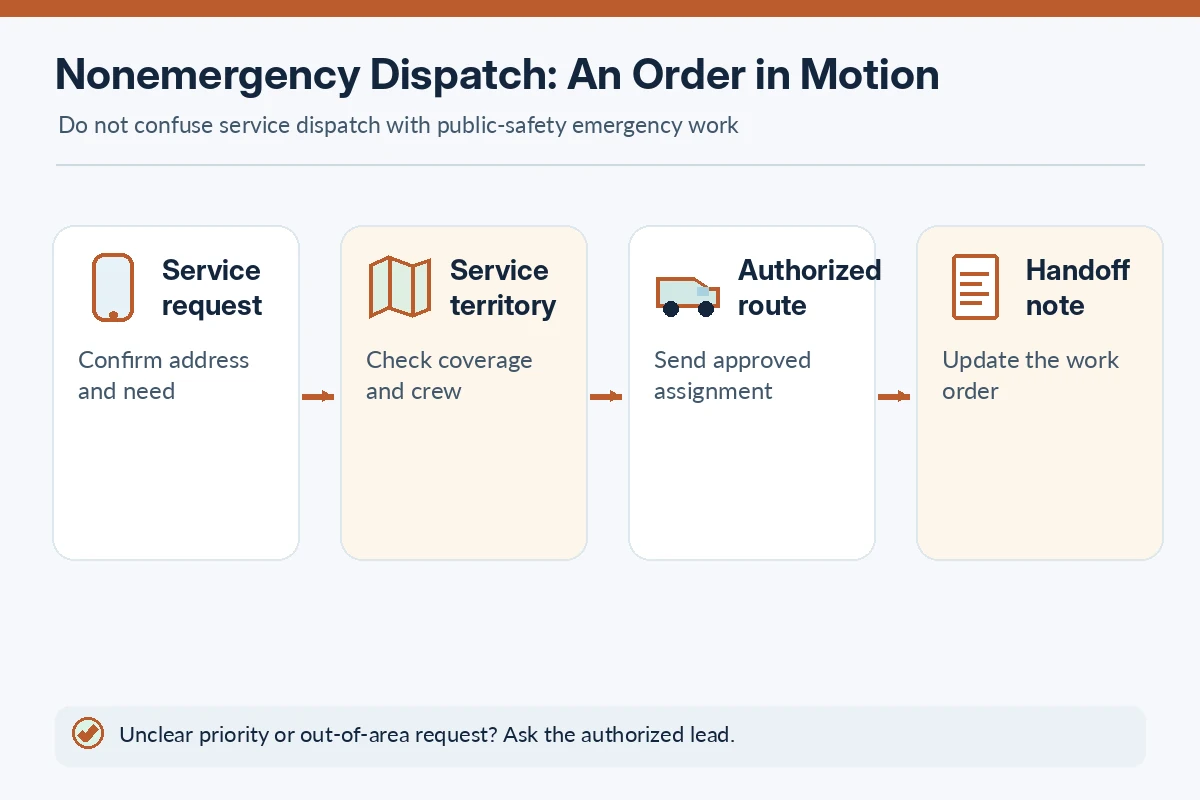
For a hypothetical plumbing-service request, the dispatcher records the address through an approved system, confirms the type of request, checks available technicians, and routes the work order within authorized limits. If the service address lies outside the employer’s coverage or the job is urgent, the next step is the designated escalation path, not an improvised promise to the customer. The dispatcher then records status and sends a handoff as instructed.
Ask what software tracks open work orders, driver or crew availability, customer updates, and exceptions. Routing is not simply choosing the closest icon on a map; priority, service commitments, vehicle suitability, and supervisor direction can change the decision. If the employer expects workers to authorize repairs, prices, refunds, or emergency responses, ask who approves each action. A job seeker should never assume operational authority from a broad job title.
Check Tools, Security, and Backup Procedures
A home-based dispatcher usually needs reliable voice or data communication because field teams may be waiting for instructions. Confirm whether the employer supplies a headset, a secure login, access to a map or service platform, and an approved way to handle outages. Ask who takes over a queue if the internet fails. Do not buy equipment using a recruiter-sent check or pay a third party to unlock the company system; the FTC specifically warns about fake check and equipment schemes.
Find out whether work orders contain addresses, phone numbers, or other sensitive information. Verify permitted storage and communication channels before handling records. Avoid copying live dispatch screens or customer identities into a public portfolio. You can instead create a fictional routing worksheet with generalized sites, clearly marked as practice, showing how you track status and escalate cases without disclosing anything about an actual business.
Understand Shift Handoffs and Real-Time Pressure
A dispatch desk may operate in shifts, with the next worker taking over unresolved service calls and delayed crews. Ask how open tasks are assigned to a new owner, whether a shift log is mandatory, and who receives the final status. A clear handoff contains the request reference, last confirmed action, responsible person, next check time, and escalation level. The values must come from the system, not invented estimates.
Some advertised “flexible” work still requires continuous coverage during a fixed block. Confirm start and end times, time zone, weekends, on-call expectations, and breaks in writing. If you are a nonexempt employee, accurate records of hours worked matter even from home, as Worker.gov explains. This article does not determine your employment classification or any overtime entitlement; review the actual agreement and applicable rules.
Describe Transferable Skills With Honest Scope
Candidates with administrative, front-desk, transportation, customer service, or scheduling experience may already have relevant skills. Choose evidence that mirrors a dispatch task: documenting an incoming request, coordinating several schedules, checking an address, communicating a delay, or maintaining an accurate handoff. Explain the software only if you used it. A role involving calendars does not automatically mean you have operated a specialized dispatch platform.
A hypothetical resume example is: “Logged incoming service requests, confirmed availability with field staff, and updated records for team handoff.” Use it only if each verb matches your real duties. If your practice is independent, label it as a simulation rather than employment. A hiring manager should be able to determine whether your experience was live operations, supervised training, or self-study.

Make the Hiring Decision Using Verifiable Facts
Use a single-page screen: business identity, dispatch type, service territory, typical calls, routing authority, technology, shifts, and compensation terms. Unanswered questions are not automatic evidence of fraud, but they should be resolved before sharing sensitive information. Confirm the posting on the organization’s official career site or through a separately verified contact, especially when an unfamiliar recruiter sends an urgent offer.
If the ad mixes emergency response language with general remote customer support, request clarification rather than assuming the tasks are the same. If it demands that you send money to ship equipment or to claim a position, stop. The final decision should come from actual operating duties and written terms, not the appeal of avoiding a commute. Preserve the job description and any answers you receive.
How We Research and Check Remote Job Claims
How We Research: We checked the primary occupational, institutional and government guidance linked here on October 29, 2026, then compared the article intent with existing JobAsk coverage and the original production plan. These sources explain duties or safeguards; none verifies that a particular vacancy is live, that a third-party recruiter is legitimate, or that a reader will be hired. Illustrative situations in this article are hypothetical. Source 1: www.onetonline.org. Source 2: consumer.ftc.gov. Source 3: www.worker.gov. Read our affiliate disclosure for transparency; no paid product recommendation or affiliate partnership is represented here.
Related Job Search Guides
- Medical Billing and Coding Jobs From Home: Check Credentials and Record Access
- Online Jobs From Home: How to Verify Real Work Before You Apply
- Online Proofreading Jobs From Home: Build Samples and Check the Assignment
- Online Tutoring Jobs From Home: Prove Subject Fit and Protect Students
- Part-Time Work From Home: Check Hours, Tasks, and Job Legitimacy
Some roles can be conducted through approved remote communications systems; the employer determines location, security and coverage requirements.
No. This guide concerns service and logistics routing. Emergency public-safety positions have different duties and selection requirements.
Ask about the approved phone or headset, dispatch software, network backup, secure access, and who supplies or maintains the equipment.
Record actual open work orders, current owner, confirmed status, next action, and escalation contact using the employer’s process.
Only within assigned authority. Supervisors or other authorized staff may need to approve exceptions, cost changes, or out-of-area requests.