
Legitimate online proofreading work requires checking a defined kind of proof, marking clear errors, respecting edit boundaries, and reviewing corrected text. Match the job to your sample and tool skills, then verify the client and payment terms; do not pay to unlock supposed assignments.
The decision framework below uses official occupational descriptions and consumer-protection guidance. Any scenarios described as hypothetical are instructional, not verified job listings, placement claims, or promises of earnings.
Know What a Proofreader Is Paid to Check
Proofreading is not a synonym for writing, developmental editing, fact-checking every claim, or redesigning an entire publication. O*NET’s proofreaders and copy markers profile emphasizes detecting grammatical, typographical, compositional, and layout errors and checking the corrected proof. A job description may also request more, but you need to identify those additions instead of assuming that a “proofreader” has unlimited editing authority.
Inspect the deliverable: a PDF proof, a word-processing file with tracked changes, a web page, or typeset pages. Each format changes how corrections are marked and how you confirm they were implemented. Ask whether you should preserve style choices, query ambiguous material, or make direct edits. Editorial quality depends on respecting scope. A proofreader who rewrites entire paragraphs without approval may cause more problems than a careful professional who flags a question.
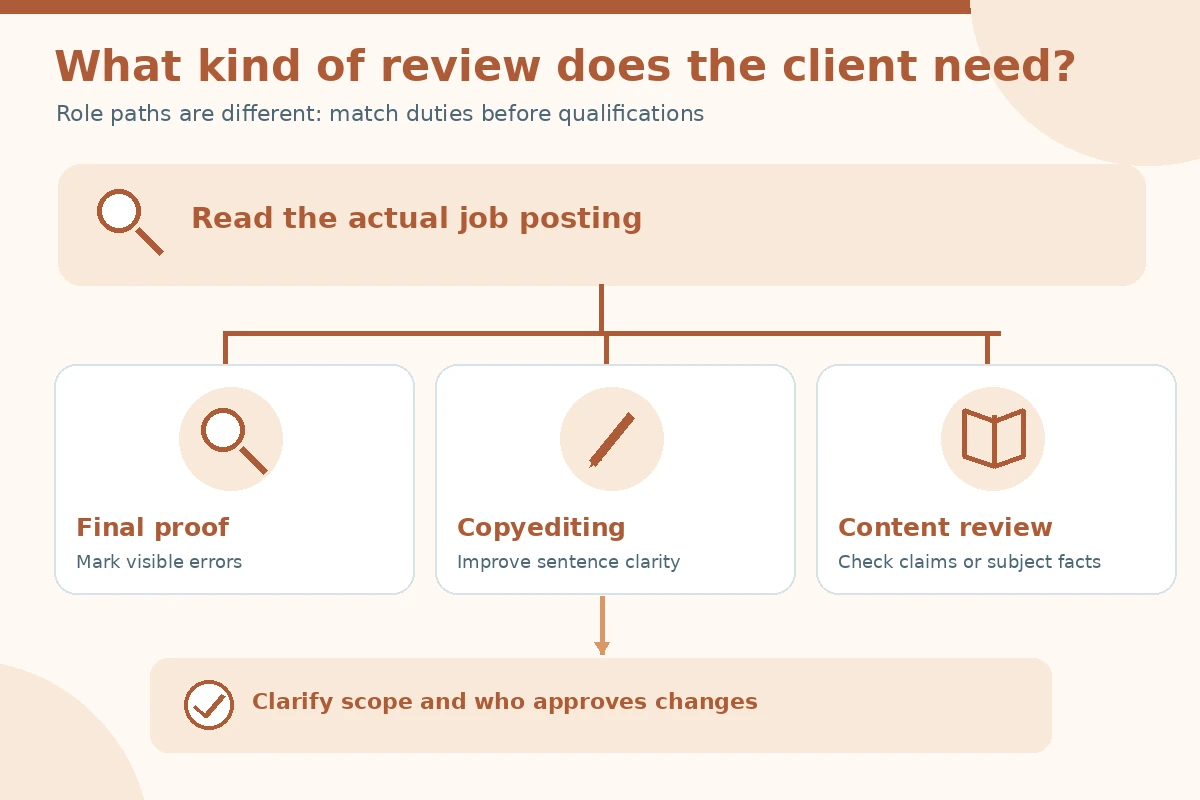
Compare Proofreading, Copyediting, and Content Review
A proof pass focuses on errors in a near-final document and consistency with a provided style guide. Copyediting may address sentence clarity, usage, and internal consistency earlier in production. Content review may require research or specialist subject judgment. A single contract can legitimately combine duties, but then time and responsibility should reflect that broader scope. Avoid a posting that calls for “simple spelling checks” yet expects heavy rewriting with no described approval process.
Ask who owns author queries, what style guide applies, and whether you must make or merely flag corrections. On confidential documents, clarify whether work can be saved locally or included in a portfolio. You should never publish a client’s unpublished pages to advertise your proofreading services without permission. Reaching for a more impressive sample does not override confidentiality or rights to the original material.
Create a Sample With Visible, Useful Corrections
A good proof sample shows both the original line and a corrected version, with brief annotations for the kinds of errors found. You can write your own deliberately flawed practice paragraph. Label it “hypothetical practice exercise”; do not present it as a real paid assignment or imply that a publisher hired you. Include errors of spacing, punctuation, duplicated words, reference consistency, and heading formatting rather than inventing a dramatic fake production failure.
Hypothetical example: “The team reviewed the report, and sent it on Friday.” A proof pass might remove the duplicate space and adjust the comma according to the agreed style. It would not invent a business outcome or replace the sentence with a different claim. Show a second clean pass over the corrected copy. O*NET explicitly lists checking revised proofs, which is different from stopping immediately after the first marked-up version.

Use a Repeatable Two-Pass Review
First compare the document against the approved source or style guide: names, headings, numbers, spacing, punctuation, captions, and cross-references. Mark clear errors, then flag uncertain cases rather than silently changing technical meaning. Second, inspect the corrected version to see whether the intended changes were applied without introducing new errors. If a layout shift causes an orphaned heading or broken link, send it back through the designated review route.
A check may be performed on screen, in a PDF annotation tool, or in an approved document editor. Describe the actual method you used, not a universal software requirement. Automated spell-checking helps spot some errors but does not establish that all references, figures, or names are correct. If the job is in a regulated field or another language, ask for the necessary subject knowledge and review authority before accepting it.
Check Rates, Revisions, and Deliverable Boundaries
Compare whether the offer is per word, page, document, project, or worker hour, and what the term “page” means. Long tables, scanned text, and complex layouts can change the time spent reviewing. Ask whether revisions are included, how many review rounds are expected, who resolves disputed changes, and what happens if the source document changes mid-project. Do not infer an hourly result from a per-page figure without estimating your own realistic review time.
For an employee role, also check location requirements, scheduled hours, collaboration and access expectations. For contract work, ask about agreed scope, payment milestones, handling of proprietary text, and the process for changes. Do not promise to proofread every topic expertly. Specialized medical, legal, mathematical, or technical content can require additional subject knowledge, and a general language review is not a substitute for expert approval.
Verify the Employer and Protect Your Samples
Online proofreader advertising attracts both genuine opportunities and misleading work-from-home promises. The FTC’s February 2026 guidance warns against unsolicited job offers with urgent promises, large rewards for minimal effort, or upfront payments. Check the organization’s own site and the real application route. A supposed employer that requests a “document access charge” before providing any real contract is a reason to stop and verify.
An unpaid screening exercise can vary in length and legitimacy. Ask how the submission will be used and avoid giving away substantial client-ready work without a clear process. The FTC’s broader work-at-home guidance also warns about fake checks. Never accept a check and then return money to a supposed equipment vendor. Privacy matters in both directions: protect your own details and do not circulate someone else’s unpublished material.

Target Postings That Match Your Best Evidence
If you have experience reading tables and cross-references, search for proofing of manuals, catalogs, or reports. If you have worked with newsletters, search for editorial proof production. Match the listing’s document type and correction method rather than applying to every “writing job.” The strongest application includes a concise explanation of what you checked, a redacted or original sample, and the tools you actually know.
Prepare a simple screening message: “Does this role focus on final proof corrections, copyediting, or both? Which file format and style guide are used, and who approves author queries?” Ask about remote eligibility and revision deadlines as well. Proofreading credibility rests on showing consistent care, not on unsupported claims that you can guarantee zero errors or instant turnaround on every document.
How We Research These Remote Work Choices
We checked O*NET, FTC, FTC on October 27, 2026 to distinguish occupational duties, qualifications, remote-work limitations, and job-scam warnings. The illustrations are original explanatory diagrams; sample tasks are hypothetical, not actual employer policies or reported client outcomes. Requirements may change, so verify the current job listing and the organization’s official instructions.
JobAsk does not claim an employer affiliation, an available vacancy, or a guaranteed hiring result from this information. If you follow commercial links elsewhere on the site, read our affiliate disclosure; no paid referral or affiliate relationship is asserted in this guide.
Related Job Search Guides
- Medical Billing and Coding Jobs From Home: Check Credentials and Record Access
- Remote Dispatcher Jobs From Home: Check Routing and Coverage Duties
- Online Jobs From Home: How to Verify Real Work Before You Apply
- Online Tutoring Jobs From Home: Prove Subject Fit and Protect Students
- Bilingual Work-From-Home Jobs: Compare Interpretation and Translation Roles
They can overlap, but a proof pass usually checks near-final errors while copyediting may change sentences earlier.
Only with permission and appropriate protection of confidential or copyrighted content.
No. Tools may help, but a human still needs to check names, meaning, layout and corrected proofs.
Create an original hypothetical before-and-after sample with clear annotations and a second proof pass.
Be wary of any fee for the promise of a job; verify the organization and terms independently.