
A musician resume template should reflect the opportunity: an orchestral audition, ensemble performance, studio-teaching role or ordinary non-performance job may require different evidence. A performance resume usually prioritizes instrument or voice type, ensembles, roles and selected performances, while a teaching resume emphasizes students, instruction and learning activities. Do not make one sprawling master document carry every detail into every application. Maintain a complete private record and tailor a shorter reader-facing version to the specific request.
Eastman’s musician resume guidance distinguishes a focused performance resume from a more general professional resume; Lawrence University also treats the repertoire list and musician biography as separate documents. That distinction matters: performing a piece in a student recital does not establish an employment credential, and knowing a work does not mean you performed it publicly. Choose sections that state where, when and in what capacity you actually participated.
Decide Which Music Resume the Recipient Needs
For an ensemble or audition, open with name, instrument or voice category and relevant performance experience. Use clear categories such as Orchestral Experience, Chamber Music, Solo Performance and Selected Honors as appropriate. For a studio-teaching application, put teaching roles, ages or learner groups if relevant, instruction methods and actual responsibilities first. For arts administration or an unrelated part-time job, a standard work resume may communicate transferable planning, scheduling and collaboration better than a long list of concert titles.
This is a choice about audience, not about which version makes you look most accomplished. A student who has performed in a campus ensemble may have a credible performance entry, but should not label that work as a professional orchestra appointment. An instructor who has led group rehearsals can describe preparation and supervision without claiming licensed classroom-teacher status where it does not apply. Confirm the requested length and file type; auditions may have specific instructions.

Record Ensemble Credits Without Inflating Roles
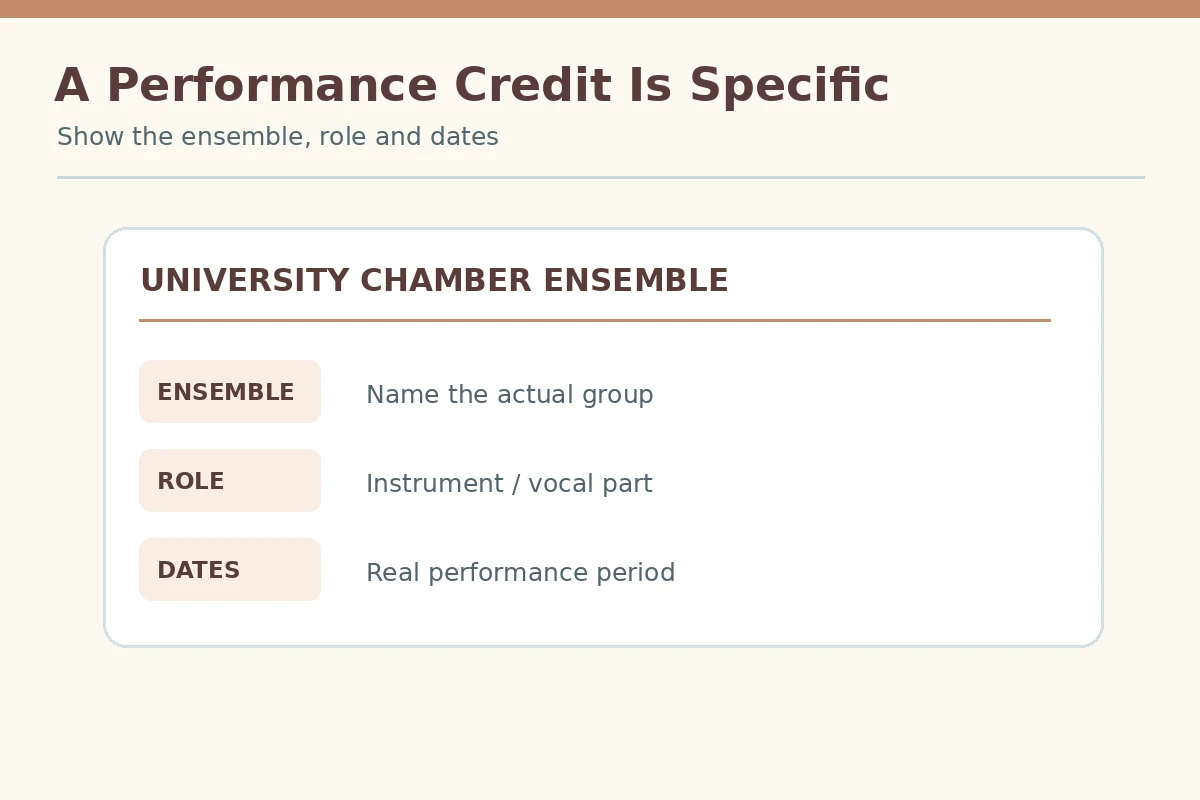
An accurate performance entry gives the ensemble, your actual role or instrument, institution or venue when relevant and dates. Distinguish permanent or recurring ensemble membership from a guest project, one concert, workshop or school ensemble. “Principal,” “section leader” and “soloist” communicate specific responsibilities; use them only if that is the role you were assigned. A hypothetical example: “Viola, University Chamber Orchestra — fall and spring terms; rehearsed and performed scheduled campus concerts.” It is clear without guessing at audience counts.
If a performance was collaborative, say which part you played. Awards and festival participation belong in their own section when relevant, with accurate selection status. A finalist is not a winner, and a masterclass participant is not necessarily its instructor. Program archives and confirmed event materials are useful evidence, but check whether you have permission to reuse photographs, recordings or programs in a public portfolio.
Keep the Repertoire List and Biography Separate
A repertoire list documents specific works studied or performed, often organized by composer, genre or performance context. A biography is normally narrative and audience-oriented. A performance resume instead gives a quick account of relevant roles and experience. Sending all three when only a resume was requested can create clutter. Use the names and spellings of works correctly; do not include entire repertoires as a way to fill blank space. Where an audition requests excerpts or a prescribed list, follow that instruction rather than inventing a standard.
For example, a clarinetist who performed a concerto with a student orchestra might list the performance in an appropriate resume section and give the detailed work information in a separate repertoire file if requested. A piece merely rehearsed privately may belong in a study repertoire list, not the same category as a public performance. Keep digital links authorized: a recording of an ensemble may require permission from other performers and organizers before public sharing.
| Evidence or document | What to show | Claim to avoid |
|---|---|---|
| Orchestra or audition | Ensembles and performance roles | Only actual positions and dates |
| Teaching studio | Teaching settings and methods | No invented student results |
| General workplace role | Relevant employment and teamwork | No lengthy unrequested repertoire |
Show Teaching Work With Learner-Specific Evidence
For teaching, state the organization, learner level where appropriate, format (individual or group) and curriculum or rehearsal responsibilities. An honest hypothetical bullet might say: “Planned weekly beginner piano exercises and documented practice goals for instructor review.” It does not invent pupil improvement percentages or imply credentials. If you taught independently, name your actual service accurately; if you assisted a supervisor, record your support role. Avoid disclosing student names, ages tied to identities or family details.
Give weight to practical information: instrument range, lesson planning, accompaniment, ensemble coaching, scheduling and accessible communication, when true. Certificates or degrees should be described precisely and only if awarded. If an application requires background checks, child safeguarding procedures or special credentials, verify the actual requirements with the employer; a resume cannot substitute for those conditions.

Proof the Layout Like a Program Editor
Use readable headings, consistent venue and ensemble names, dates and role labels. Put the most relevant credits near the top rather than assuming the newest performance is always the most useful. Keep typography restrained: music symbols and decorative staff lines should not interfere with text extraction or contact details. Build a separate teaching version from the same verified master list instead of rewriting dates from memory each time.
Before submitting, verify event titles, repertoire spelling, affiliations, honors and hyperlinks. Do not include private contact information for conductors, coaches or students without permission. Make sure the final PDF opens cleanly and that your actual instrument and contact method are visible. An accurate, selectively organized resume gives the audition committee or employer a better basis for deciding what to ask next.
Two Illustrative Cases and What They Prove
Hypothetical case: A student saxophonist has university jazz ensemble experience and one invited local performance. The performance resume separates recurring ensemble work from the one guest appearance. It identifies their instrument and dates, without presenting the performance as a touring residency or a competitive award.
Hypothetical case: A pianist teaches beginner lessons under a studio director and accompanies a campus choir. For a teaching application, the student leads with supervised lesson planning and correct dates; for a performance audition, they prioritize accompaniment and recital credits. Neither version claims awards, professional contracts or independent authority that did not exist.
How We Research and Verify Resume Advice
This article was prepared using primary occupational, documentation, and university career resources checked on 2026-11-14. The iml.esm.rochester.edu source supports eastman Institute for Music Leadership distinguishes regular resumes from focused performance resumes. The blogs.lawrence.edu source supports lawrence University Career Center differentiates the musician resume from the repertoire list and biography. The www.music.mahidol.ac.th source supports mahidol College of Music offers professional-development resources specifically for musician resumes and performance materials. Examples above are hypothetical and must be replaced with your own verifiable dates, duties, permissions, and results. Our editorial purpose is to explain format choices rather than promise a hiring outcome or automated screening acceptance. Read the JobAsk affiliate disclosure for editorial transparency.
More Resume and Cover Letter Guides
Often yes. The same verified master record can support different versions emphasizing the experience relevant to each opportunity.
Usually maintain a separate repertoire list unless the audition instructions request specific works on the resume.
Yes, when honestly labeled as student or university experience and relevant to the opportunity.
Only when the appointment or credited role truly supports that title. Otherwise describe the rehearsal task precisely.
Only when you have the necessary permission to share recordings and the link is relevant and functional.