
A strong nonprofit thank-you mentions a concrete program responsibility and genuine evidence, not broad praise for a mission or invented community outcomes. This guide provides a situation-specific decision process, an original hypothetical message, and checks to avoid false claims. An interview thank-you is a courtesy, not a guarantee of a job, referral, or response. Adapt every example to the conversation that actually took place.
Write about the position, not only the mission
Nonprofit interview thank-you emails work best when they connect the organization’s mission to the specific duties of the position. A generic sentence such as ‘I have always wanted to change the world’ may express enthusiasm but tells the interviewer little about how you would work. After discussing an outreach coordinator role, you might reference appointment scheduling, community referrals, reporting requirements, or volunteer support if those topics actually arose. The mission matters, but a selection committee also needs people who can complete accurate, supervised tasks on ordinary workdays.
Before writing, separate three things in your notes: the publicly stated organizational mission, the program goals described by the interviewer, and the responsibilities of the advertised job. Those are related but not identical. An applicant for a donor-records position should not claim to deliver direct services to clients; a front-desk candidate should not claim to set program policy. Use the role language from the actual conversation and only an example from your own experience. This creates a more credible note than repeatedly restating the organization’s website headline.
Reference one concrete program challenge
An interviewer might explain that the team needs consistent outreach logs, volunteer schedules, referral tracking, or more accurate donation acknowledgments. Thank them for explaining that operational challenge, and connect it to evidence from your prior work. You could say: ‘Your explanation of how volunteers record completed visits helped me understand the importance of consistent handoffs. In my campus program, I maintained sign-up lists and communicated schedule changes.’ That statement describes transferable organizational work; it does not claim the applicant ran a nonprofit program or measured an increase in community well-being.
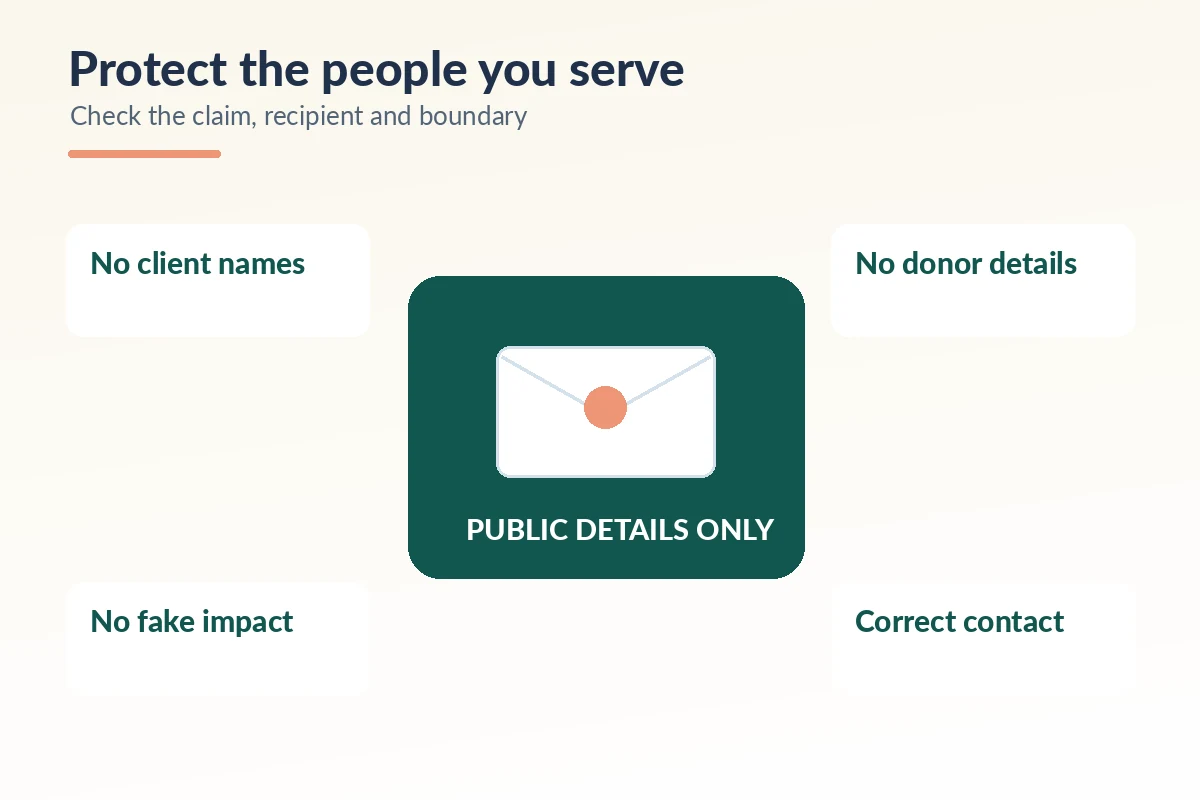
Avoid quoting client stories, donor identities, participant contact details, or confidential cases from the interview. Even when an interviewer tells an anonymized anecdote, your thank-you can refer to the professional process instead: ‘the importance of privacy-aware referral tracking.’ Do not reproduce names or amounts from a private fundraiser. If the organization discussed a program outcome, do not attribute that outcome to your past work. Hiring follow-up is no place to repeat personal data or suggest you were authorized to use restricted material.

Show realistic values through specific behavior
Your own values can appear in the note, but they should be anchored in an action. ‘I value dependable community service’ becomes stronger when followed by a true example: ‘I organized sign-in materials and ensured participants received accurate event directions.’ Do not overpromise that you can transform a community, solve an underlying social problem, or guarantee a funding increase. A reliable candidate respects policies, works with colleagues, and escalates decisions outside their assigned authority. Those details demonstrate care for the mission without marketing exaggeration.
For some roles, the interviewer may emphasize culturally responsive communication, accessible services, or trauma-aware client interactions. If you have relevant training, mention it accurately. If you are new to that area, say you appreciated learning about the organization’s processes and would follow its training. Avoid claiming professional qualifications or clinical competencies you do not hold. A thank-you email is not an assessment of a client’s needs, and applicants should not offer advice about individual cases. Keep your focus on work responsibilities and the respectful practices described during the interview.
| Situation or detail | Practical approach |
|---|---|
| Mission statement | Use as context; avoid broad praise without proof. |
| Program challenge | Mention one actual duty explained in the interview. |
| Your experience | Give a truthful scheduling, records, or service example. |
| Privacy boundary | Never quote client or donor identities. |
Read a hypothetical nonprofit interview note
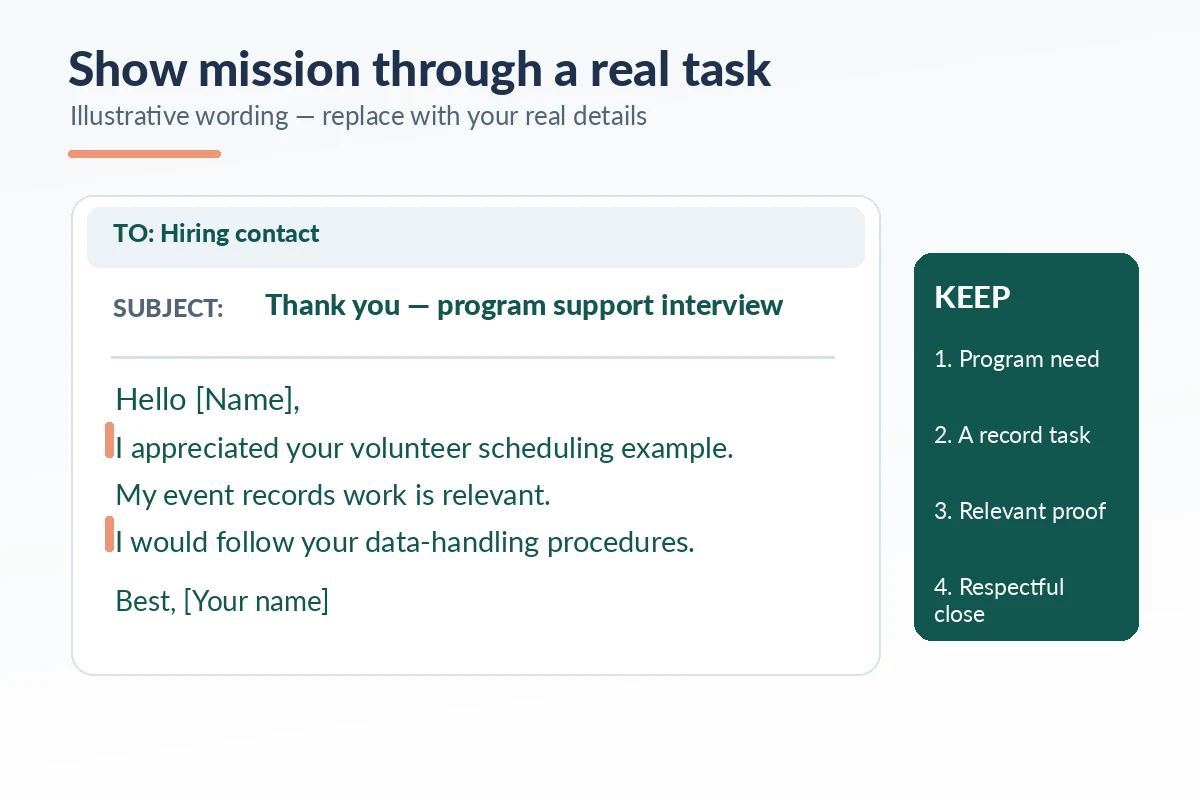
Illustrative subject: ‘Thank you — Program Support Assistant interview.’ Illustrative message: ‘Hello Morgan, Thank you for meeting with me to discuss the program support assistant position. I appreciated learning how the team checks referral records and prepares volunteer schedules. In my previous community-event role, I kept sign-up information organized and informed team leads when plans changed. I would welcome the chance to bring that careful coordination to your program, following your data-handling procedures. Thank you again for your time. Best, Alex.’ The names and experiences are hypothetical; edit each claim to match your own interview.
This example does not assume that the nonprofit has a specific program, database, or hiring process. The details are illustrative prompts, not facts about a named organization. If your conversation focused instead on fundraising operations, replace the referral example with confirmed duties, such as matching gifts to records for review, but do not claim authority to approve financial adjustments. If it was a volunteer position rather than paid employment, identify that distinction as well. The core structure remains brief gratitude, one real conversation detail, relevant evidence, and a courteous close.
Choose a contact route and follow-up boundary
Send the message to the interviewer or the hiring contact identified during the recruitment process. If the organization routes applicant correspondence through a coordinator, respect that instruction. Avoid forwarding the email to board members, donors, client contacts, or public program inboxes just to increase visibility. University career-center guidance favors prompt, tailored notes, often within about a day. The relevant measure is whether the recipient will recognize the conversation, not whether your message includes the largest possible list of enthusiastic adjectives.
If a job interview included several staff members, you can send brief individualized notes where their contact information was offered; do not copy an identical claim to everyone. When later checking on the status, use the timeline the organization provided. Do not ask for updates on client cases or fundraising plans. Keep your own record of the posting and interview date, proofread the job title, and keep attachments limited to requested, non-confidential materials. The nonprofit’s mission is a reason to pay attention, not permission to bypass its hiring or privacy procedures.
Final review before you send your note
Read your draft once as the intended recipient would. Check that the name, position, and conversation detail are accurate; remove invented numbers, private information, unrequested attachments, and claims that anyone promised a hiring outcome. Confirm the communication channel is appropriate, and keep the note easy to read on a mobile screen. If the situation is not a formal hiring interview, identify it honestly. A timely, sincere note is useful, but hiring processes vary and a reply is never guaranteed.
How We Research Interview Follow-Up Advice
We compared published university career-center guidance on timing, specificity and message tone with the distinct context covered in this article. UC Davis Career Center. USC Career Center. University of Alabama Career Center. These resources support general communication practices; the fictional examples, decision tools, and role-specific wording are editorial illustrations, not a record of an actual employer discussion. Follow the hiring organization’s instructions when provided. Visit our affiliate disclosure to understand site relationships.
More Interview Preparation Guides
Yes, but link it to a specific role duty and your genuine interest rather than repeating slogans.
Avoid private details or identifying information. Refer to the program process instead.
Use true examples of schedules, records, outreach, or teamwork, without exaggerating your authority.
Send it to your interviewer or instructed hiring contact, not senior leaders who were uninvolved.
No. Describe your actual tasks and observations; do not invent outcomes or attribute program results to yourself.