
A research assistant thank-you should mention a genuine methods discussion and your support skills while keeping participant information and study approvals confidential. This guide provides a situation-specific decision process, an original hypothetical message, and checks to avoid false claims. An interview thank-you is a courtesy, not a guarantee of a job, referral, or response. Adapt every example to the conversation that actually took place.
Mention the real research role and methods discussed
Research assistant positions vary widely: one group may hire for literature screening and citation management, another for laboratory sample tracking, field observations, data entry, or supervised interviews. Your thank-you should not assume that every assistant collects human-subject data or operates laboratory equipment. Start with the methods the interviewer actually described and connect them to your own verified coursework, project, or work task. A note about accurate spreadsheet labeling can be useful for an entry-level assistant role; it does not need to claim that you designed a study or led an analysis.
The job title alone does not define authority. Research teams often distinguish the principal investigator, study coordinator, and assistants who perform assigned tasks. If you discussed reviewing records for missing fields, phrase that as checking and flagging data, not approving the final dataset. If you completed an undergraduate lab, mention the assigned portion of the project and the supervision involved. Accuracy about who owns the research decisions is a more meaningful professional signal than listing techniques you have only read about.
Connect an interview insight to one verifiable skill
Write down the interviewer’s explanation of the team workflow while it is fresh. Perhaps they described version control of survey instruments, comparing coding decisions, maintaining a sample log, or documenting exceptions for a supervisor. Choose one point that matches something you actually did. An example: ‘Your description of how the team documents coding disagreements stood out to me because I used a shared checklist to flag uncertain classifications in a course project.’ This says what the applicant did, without claiming independent authority to resolve research conflicts or guarantee data quality.
A single accurate detail can be stronger than a long inventory of software names. If you have worked with spreadsheets but not the named study database, describe spreadsheet cleaning and openness to training. If you have taken a statistics course, do not turn that into a claim that you have independently conducted complex analyses. If you worked on a confidential team project, discuss the process without revealing client names, unreleased findings, or raw datasets. The thank-you should demonstrate judgment about research methods and information handling.
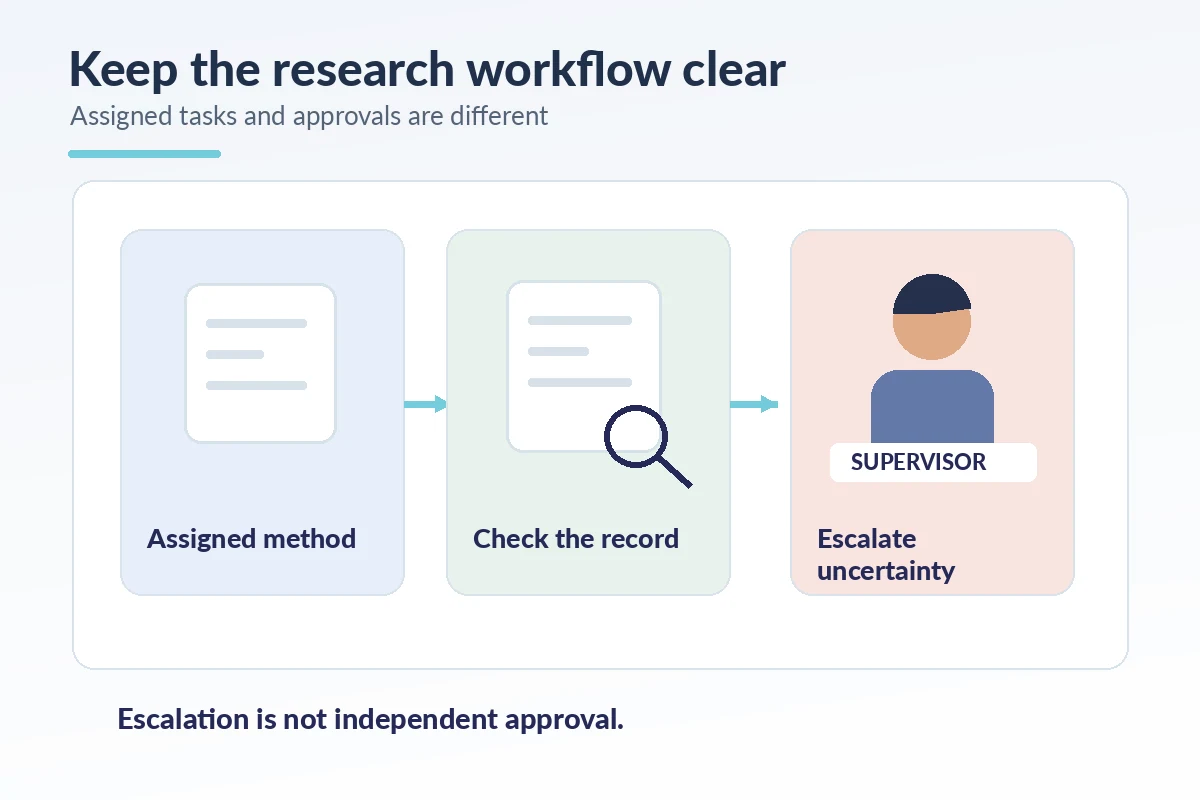
Keep participant and study information out of email
Research interviews may touch on restricted datasets, unpublished hypotheses, participant recruitment, or institutional approval processes. A thank-you email is usually not an authorized record-transfer channel. Do not repeat names, enrollment information, health details, identifying anecdotes, or confidential document excerpts. HHS explains that identifiable private information can be relevant to whether research involves human subjects, and research institutions have their own procedures for handling protected material. Your safest wording focuses on the method or responsibility: ‘the team’s participant-contact procedures’ rather than details about a particular participant.
Do not claim that you can obtain informed consent, approve protocols, make clinical decisions, or release research findings unless you are specifically authorized and qualified for those functions. If an interviewer referred to institutional review or ethics training, you can say you appreciate the importance of supervised training. Never attach a project screenshot containing identifiers to make yourself look prepared. If you were asked to provide a permitted portfolio example, confirm that it is public or sanitized and send it only through the stated application channel.
| Situation or detail | Practical approach |
|---|---|
| Method discussed | Describe the real workflow at the right level. |
| Your evidence | Use actual class or job tasks, with supervision. |
| Sensitive detail | Exclude participant and unpublished data. |
| Approval scope | Never imply investigator authority you do not have. |
Use a hypothetical research assistant thank-you
Illustrative subject: ‘Thank you — Research Assistant interview.’ Illustrative message: ‘Hello Dr. Lee, Thank you for speaking with me about the research assistant role. I appreciated hearing how the team verifies entries and documents questions for supervisor review. In a course research project, I maintained a shared coding log and flagged uncertain records for our instructor rather than changing classifications alone. I would welcome the chance to apply that careful approach while learning your approved procedures. Thank you for your consideration. Best, Sam.’ The names, project and interview are hypothetical.
The example does not assert that the lab uses a particular database, performs clinical research, or guarantees an apprenticeship. If your interview was for a biology lab, replace the coding example with a genuine sample-label or instrument-log task you performed under supervision, without inventing a safety certification. If the principal investigator did not offer training, avoid implying that formal training was guaranteed. Keep the tone professional and the message short enough to read between other team duties. A specific thank-you is better than re-sending the entire research proposal.

Select the right recipient and next action
If you met a principal investigator and a project coordinator, check who actually handled the interview invitation. Address individualized notes only to people with official contact details provided in the process; do not pull private staff email addresses from unrelated documents. If a coordinator asked you to send references or a work sample, follow that request separately and verify permission to share the materials. A brief email within roughly a day matches many university career-center recommendations, but an institution’s stated applicant-communication instructions take precedence. Do not invent deadlines or ask the team to reveal confidential findings.
Before sending, proofread the study or role title, your methods terminology, and the distinction between your individual contribution and team oversight. Do not assume a lab has human-subject participants merely because it is called research, and avoid adding regulations that do not apply to the work. If you later follow up on hiring status, use the date the team provided. Research work relies on accurate records and careful handling of uncertainty; the same habits should be visible in a modest, truthful thank-you rather than an inflated list of claimed accomplishments.
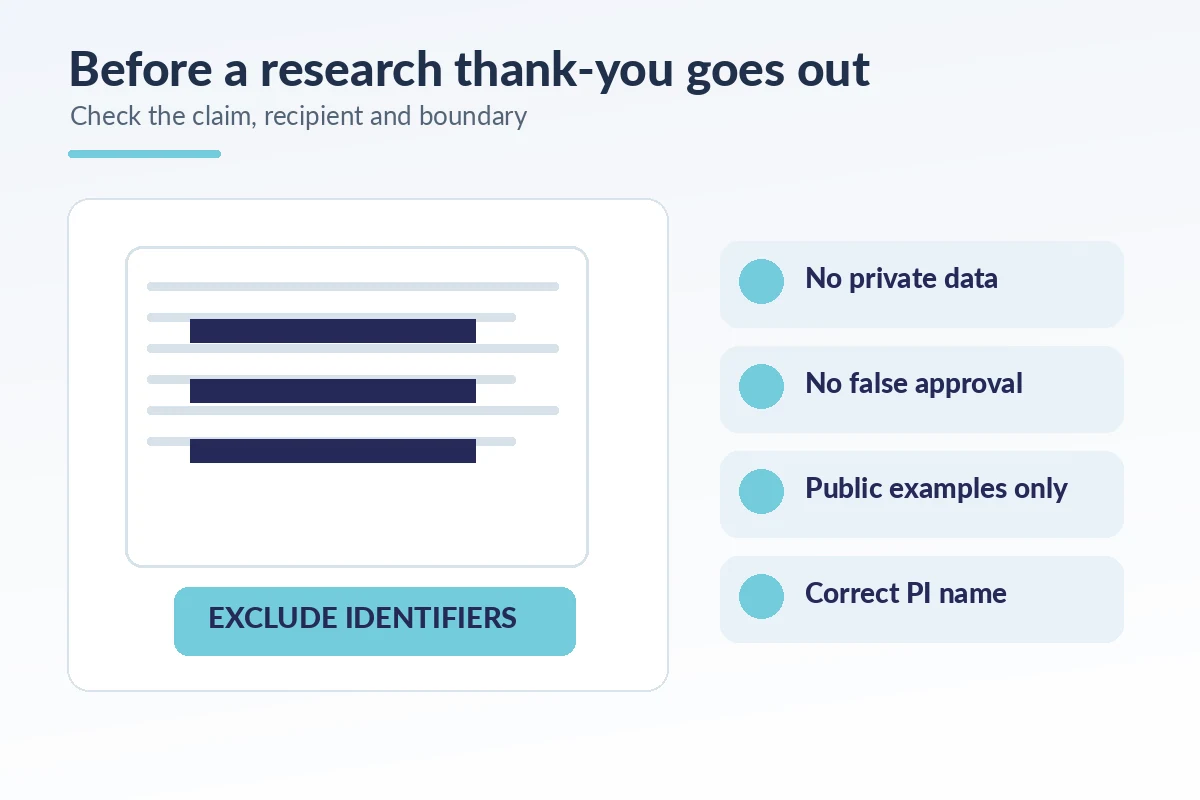
Final review before you send your note
Read your draft once as the intended recipient would. Check that the name, position, and conversation detail are accurate; remove invented numbers, private information, unrequested attachments, and claims that anyone promised a hiring outcome. Confirm the communication channel is appropriate, and keep the note easy to read on a mobile screen. If the situation is not a formal hiring interview, identify it honestly. A timely, sincere note is useful, but hiring processes vary and a reply is never guaranteed.
How We Research Interview Follow-Up Advice
We compared published university career-center guidance on timing, specificity and message tone with the distinct context covered in this article. UC Davis Career Center. USC Career Center. UCSF Career Development. HHS Human Research Protections. HHS Research Consent Guidance. These resources support general communication practices; the fictional examples, decision tools, and role-specific wording are editorial illustrations, not a record of an actual employer discussion. Follow the hiring organization’s instructions when provided. Visit our affiliate disclosure to understand site relationships.
More Interview Preparation Guides
Use public, non-confidential context; do not reveal unpublished methods or participant details.
Only if you truly had that formal responsibility. Most assistant tasks are performed under approved oversight.
Only if permitted, relevant, and cleared of confidential or restricted content; follow requested submission procedures.
Use the title and name the person uses professionally, and proofread them carefully.
State the coursework and supervised work honestly; it can show care without suggesting independent research authority.