
When two openings at the same company both look relevant, do not email a recruiter saying you will take either one without explaining why. Compare the actual responsibilities, nonnegotiable requirements and work arrangements, then identify a primary role. You can mention a second genuinely relevant position in one short note, using the exact job titles and requisition numbers. Apply for each position through the employer’s stated process if you decide to pursue both; the email itself is not an application. This approach is different from emailing multiple unrelated recruiters or spraying the same resume across every vacancy.
Confirm both postings are real and currently relevant
Read the two complete job descriptions on the company’s own careers site. Record each title, reference number, team or department, location, required qualifications and application deadline. A staffing board may rename positions or display an older listing that no longer accepts applications. Confirm both are still open, and note if they use separate hiring teams or locations. If one opening is clearly closed, do not describe it as an active application just because the webpage still appears in search results.
Think about employment type as well as title. An assistant role on one team might be full-time while another similarly named role is temporary or based at another office. Separate facts from assumptions in a short comparison. The University of Georgia Career Center recommends a job-search record containing positions, application dates and recruiting contacts; this becomes particularly important when one employer has several parallel processes.

Rank the roles using truthful experience evidence
For each opening, identify two or three tasks you have actually completed that relate to its responsibilities. If one job emphasizes vendor records and the other emphasizes event scheduling, compare your documented work with those activities instead of counting shared keywords. A candidate could have handled both kinds of work, but the strongest application will show a reason for choosing one. Also check genuine constraints such as worksite, availability and required credentials; no message can substitute for meeting a nonnegotiable eligibility condition.
The Indeed Career Guide cautions against mass-applying to loosely related roles and recommends considering qualifications and genuine interest before applying to several jobs at one company. Do not treat a numerical fit score as an employer rule or guarantee. A simple ‘strong evidence,’ ‘possible match,’ or ‘not supported’ note is more honest than claiming that you meet an arbitrary percentage of qualifications. If the second opening has too little real overlap, focus on the first and leave the other out of the email.
Decide what a recruiting note should accomplish
The email should clarify your primary interest and, if needed, ask whether the same recruiting contact handles both openings. It should not ask the team to select a job for you or to consider you for all future vacancies. If the company explicitly routes all candidates to a portal, follow that direction without inventing an alternative. A specific subject line including the primary role or reference number helps the recipient understand what is being discussed before opening the message.
You may write before submitting applications to clarify the correct route, or after submitting to explain that you applied to two jobs with distinct relevance. Be accurate about which stage you are in. ‘I am considering these roles’ is not the same as ‘I have submitted both applications.’ An HR team may already see separate entries in its system, but you should not assume they are linked or that one recruiter owns both.
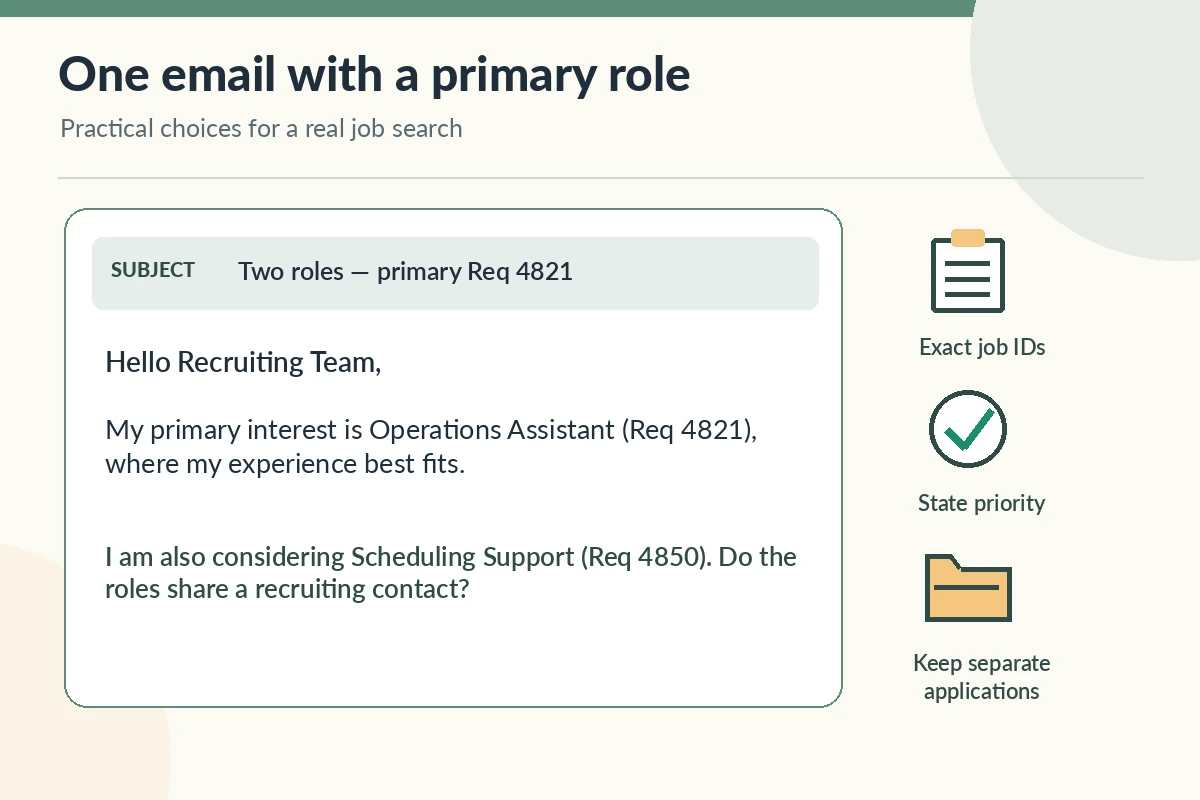
Use one honest email that names the primary opening
An illustrative message: ‘Subject: Two operations openings — primary interest in Req 4821. Hello Recruiting Team, I am applying for Operations Assistant (Req 4821), where my experience with shift records and inventory checks is the strongest match. I am also considering Scheduling Support (Req 4850) because I have maintained team calendars. Do these positions share a recruiting contact, or should questions go through each posting’s portal? I will follow the required application steps for each. Thank you, Jordan Lee.’ All details in the example are invented.
If you have already applied, replace ‘I am applying’ with the truthful submission dates. Do not attach two generic resumes without being asked. Where two applications are allowed, tailor the evidence for each role rather than uploading identical material with different titles. If the employer has specific instructions on duplicate submissions, follow those instructions first. The point of the note is clarity, not a claim to receive preferential routing.
Keep each application and response separate in your records
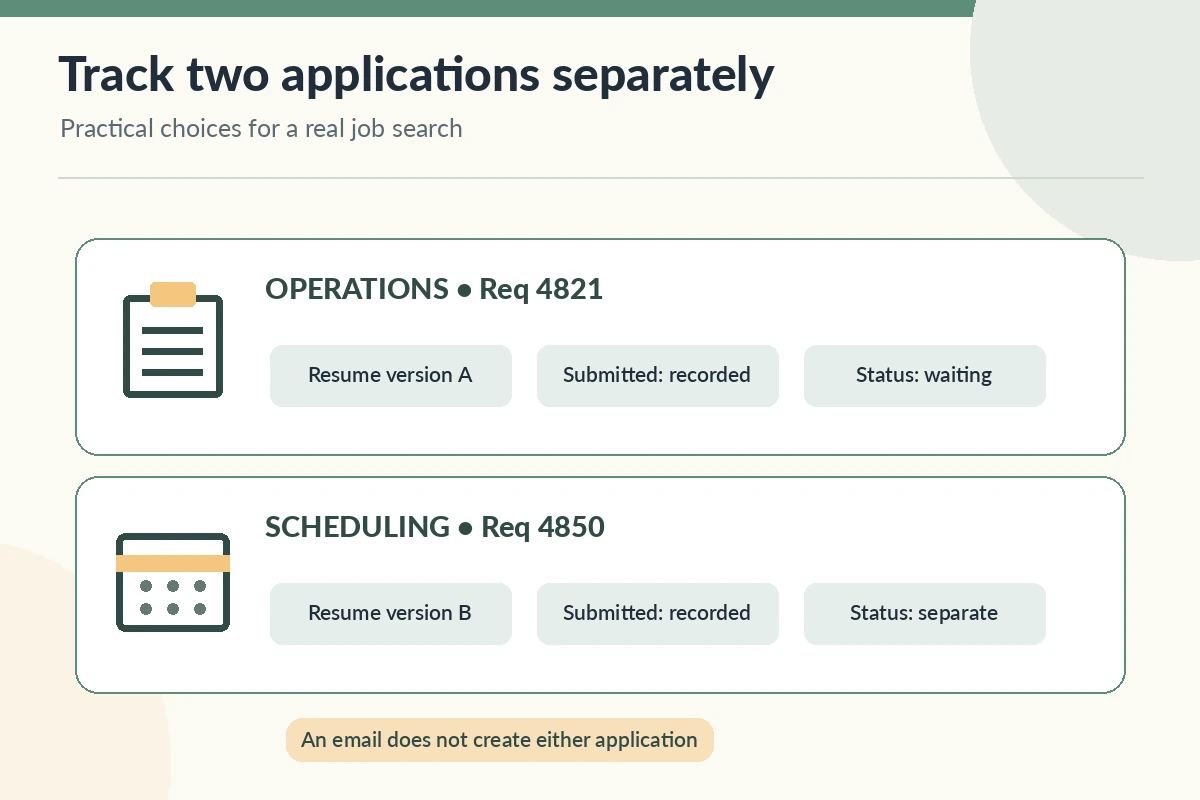
Create two entries even though the employer is the same. Record each requisition number, title, specific resume version, submission date, status, email recipient, and next-step date if given. If a recruiter says one team is handling both, record that fact without merging the applications themselves. A single reply thread can be convenient for questions, but one job may advance while the other closes or moves to a different manager.
Be especially careful when a staffing agency is involved. Verify whether it represents the same requisition you already applied to directly, and do not authorize duplicate submissions without understanding the process. A candidate may want both roles, but the employer’s instructions—not your enthusiasm—determine the actual application path. You can mark ‘not applied’ in your private tracker until the appropriate system confirms submission.
Handle a recruiter response without widening the pitch
If the recruiter recommends one opening, compare that guidance with the written descriptions and your genuine interests. You can thank them and state which job you will pursue; do not pretend to prefer a role that does not fit. If the recruiter says separate teams handle the openings, complete each process as directed without copying a broad message to both managers. If no reply arrives, respect the application deadlines and keep the formal submissions moving.
The value of contacting a recruiter is to reduce confusion about two real opportunities, not to create an extra approval step. Continue other applications as appropriate, and avoid following up repeatedly just to restate interest. If one application is rejected, the other is not automatically accepted or rejected; check its actual status. Keep correspondence and job descriptions private so you can answer accurately if an employer asks which opening you are discussing.
How We Research Recruiter Outreach Guidance
We compared career-center and recruiting-industry guidance with current FTC consumer-protection information where relevant, and wrote practical decision rules for this distinct outreach situation. Sources reviewed: Indeed multiple-openings guide; UGA Career Center application tracking; USC Career Center job-search guide; Harvard FAS networking email guidance. People, dates, job titles and reference numbers in example messages are hypothetical and do not represent current vacancies. This content is general job-search guidance, not a legal guarantee or a promise of employer response. For commercial relationships and links see the JobAsk affiliate disclosure.
Related Job Search Guides
It can be reasonable when you genuinely match both and the employer permits separate applications. Compare each posting and tailor materials rather than applying indiscriminately.
If it helps route a question or explain your two relevant applications, mention exact titles and numbers while identifying a primary interest. Do not imply that an email replaces applying.
Each role should be supported by relevant, truthful evidence. If their requirements differ, tailor the emphasis while keeping factual dates, roles and credentials consistent.
Follow each listing’s official channel and maintain separate application records. Avoid copying unrelated hiring teams merely to increase exposure.
Do not miss application deadlines while waiting for routing advice. Follow the official process for roles you genuinely want and track submissions separately.