
A reliable nonprofit program manager resume begins with verified qualifications, relevant experience and readable evidence, not a decorative template. A nonprofit program manager resume should identify the program setting, level of responsibility and work you personally directed. A program coordinator, manager, grant administrator and executive director may all touch the same initiative but have very different authority. Put contact details and a clear professional heading first, then a concise summary if it connects your experience to the vacancy. The most relevant work history, selected program accomplishments, skills and education should follow in a familiar order.
Organize the page around the program you actually managed
The Bureau of Labor Statistics describes social and community service managers as overseeing programs and responding to staffing, budget and outreach needs. It also notes that some managers implement programs designed by senior administrators or other stakeholders. A truthful resume should reflect this division of decisions. If you scheduled services and kept monitoring reports but did not set the organization’s strategy, describe strong implementation work rather than claiming that you founded or approved the entire program.
Separate program delivery from funding decisions
Grant-funded programs often have multiple stakeholders: a funder, board, finance staff, program lead and service team. If you coordinated reporting, tracked expenditure categories or maintained supporting evidence, those are substantial accomplishments. They are not automatically proof that you secured the award, approved restricted spending or signed financial certifications. Use separate bullets to make delivery and funding-related duties understandable without confusing them.
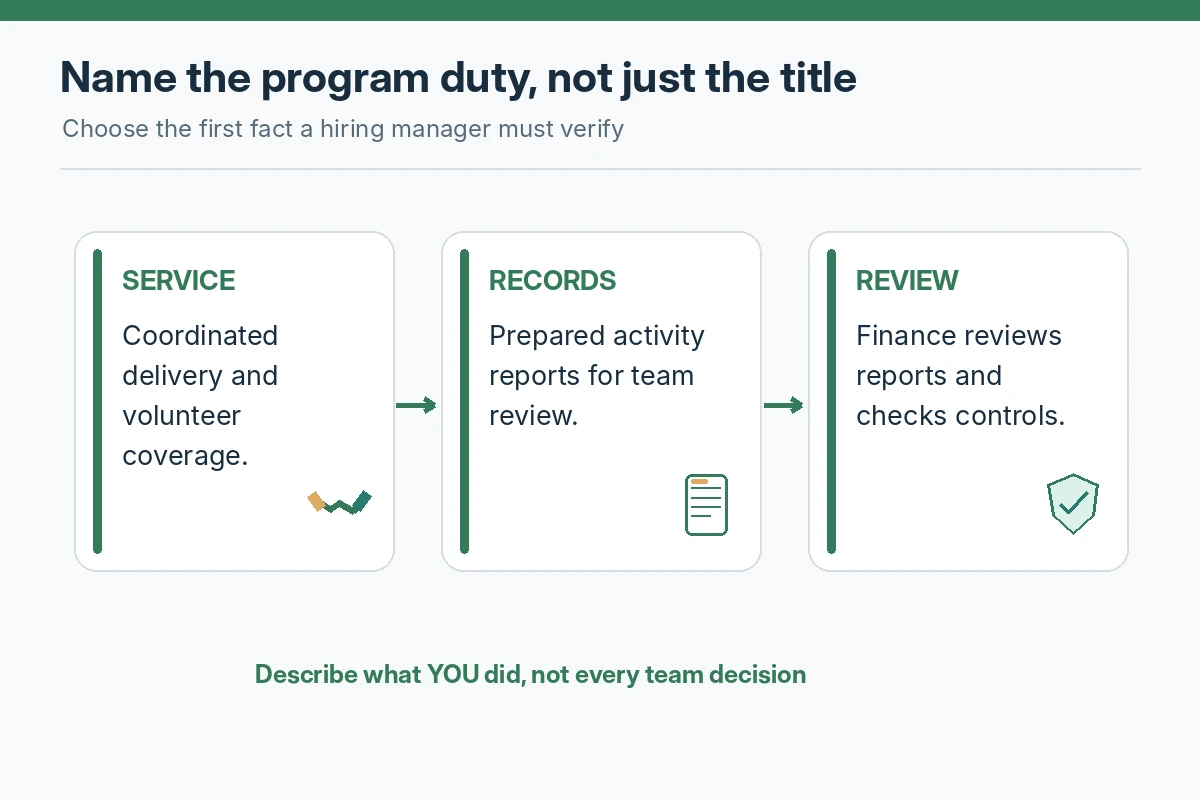
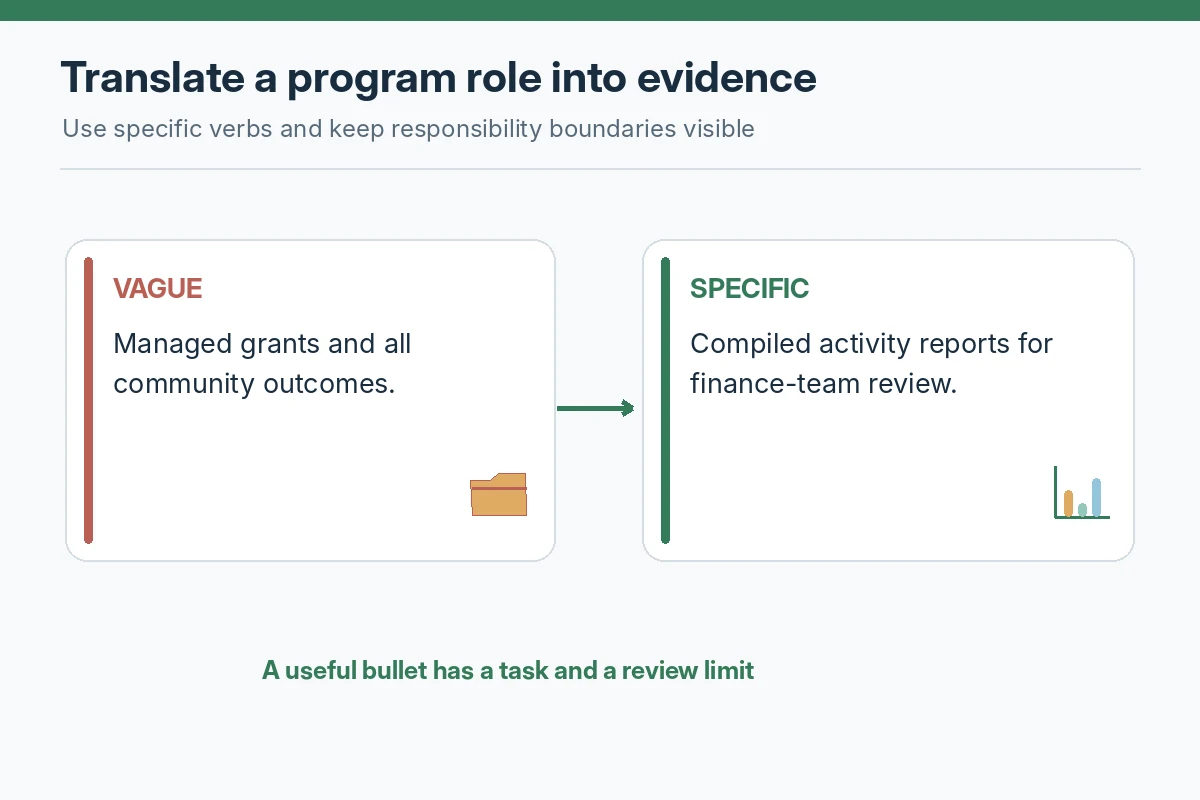
For instance, a fictional applicant could write: “Compiled monthly service-activity summaries and reconciled program records for finance-team review.” If that was the actual task, it is stronger than “Owned the organization’s grants.” A second bullet might describe coordinating attendance, training volunteers or following up with partner organizations. Show the review or authorization point where necessary. Employers need people who respect internal controls, and clear language is a professional signal rather than an admission of weak authority.
Give each major program a useful evidence line
A long list of program names is not enough. Identify the purpose, audience at a broad level, the delivery workflow and your individual contribution. For a community education project, the resume might describe scheduling facilitators, revising resource materials, tracking attendance responsibly and presenting recurring issues to leadership. Do not reveal an individual beneficiary’s circumstances or use a small-count demographic breakdown that could make someone identifiable.
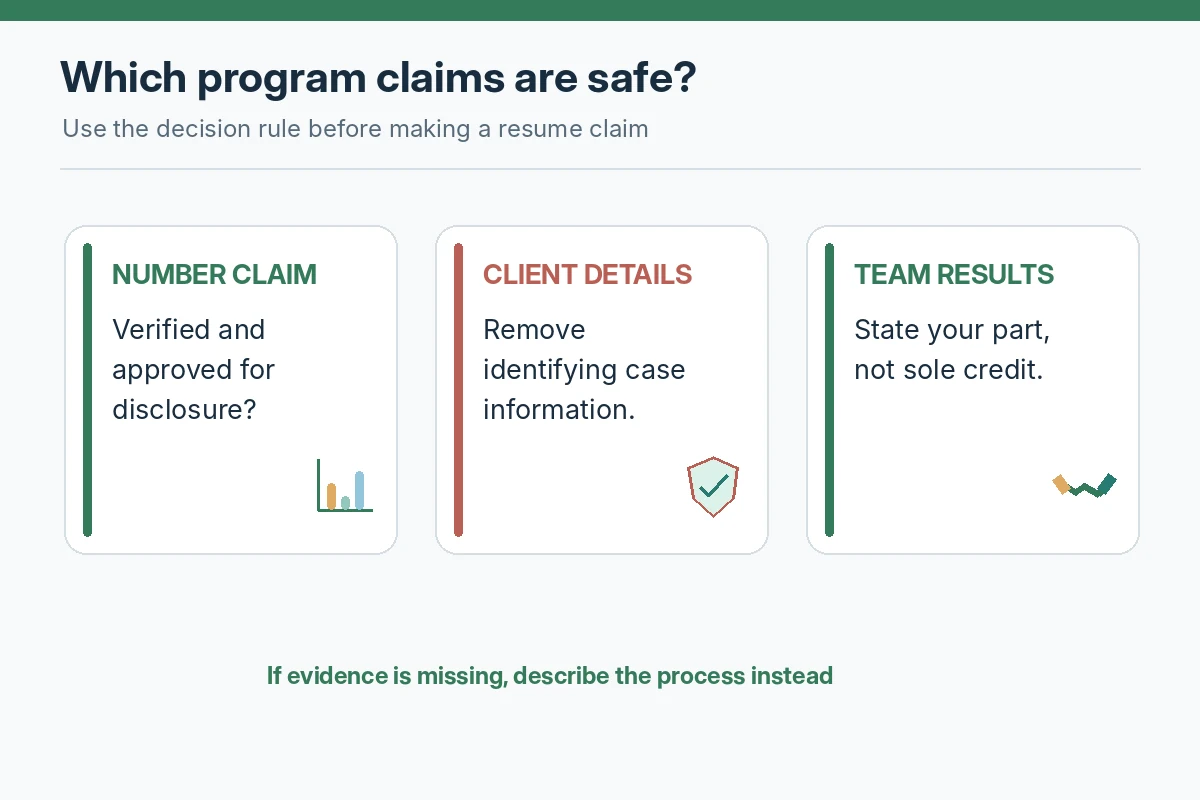
Evidence can be operational rather than numerical. Documented referral handoffs, an improved intake checklist, a published public resource guide or a reviewed reporting procedure can demonstrate reliable management. If a program achieved an independently documented outcome, use figures only with permission, consistent denominators and defensible attribution. Avoid phrases such as “transformed the community” or “doubled impact” when you cannot explain how the effect was measured and what other partners contributed.
Describe leadership using decision rights
Titles can obscure the difference between directing staff, coordinating volunteers, coaching peers and approving formal employment decisions. Explain who you supervised and what authority you actually had. For example, a candidate who managed volunteer shift assignments can state that. A person who facilitated team check-ins but did not handle personnel matters should not imply hiring, disciplinary or payroll authority. Decision rights help a hiring organization understand how quickly you could step into the role.
A useful leadership bullet can combine duty, context and follow-up: “Coordinated weekly volunteer coverage and escalated service gaps to the program director.” That is more informative than “Outstanding team leader.” If you trained a substitute coordinator or developed a process guide, describe the material and handoff. Be careful with sensitive HR cases and internal disputes. An applicant can discuss escalation practices without publishing confidential staff information.
Present budgets and grant reporting without inflated ownership
Budget monitoring, tracking receipts, requesting purchases and approving expenditures are different tasks. State which ones you performed and whether your work required finance or director approval. A grant writer who drafted narrative sections may deserve credit for those contributions without presenting themselves as the award’s principal investigator or authorized official. If the job opening emphasizes compliance, show how you kept records consistent, prepared documentation and referred unclear restrictions for review.
You can include the dollar size of a program or a grant only when the figure is accurate, approved for disclosure and relevant to your actual responsibility. Do not put donor names, confidential gift terms or account details on a public resume. A precise explanation of controls and scope often demonstrates more judgment than a large unsupported number. Use a separate Selected Programs section only if it makes complicated cross-program work clearer than conventional chronological entries.
Use a simple hierarchy for complex program histories
Some nonprofit professionals move across several initiatives while keeping the same employer. Group the employer’s name once, then list dated roles or named programs underneath if that is accurate and readable. If you worked for several funded partners, distinguish your actual employer, contract relationship and project. Overlapping program periods are normal, but dates must remain true. Make sure a reviewer does not confuse a six-month pilot with a full-time multi-year management position.
CareerOneStop recommends clean formatting and recognizable headings. Put program operations, partnerships and reporting under experience rather than scattering each one into colored cards. Keep a skills list focused on systems and processes you can demonstrate. For work that spans two pages, page two should contain real relevant achievements rather than a large decoration or an isolated line. Test the exported text and the application portal’s parsing of employer names and dates.
Tailor your application to the program's governance model
A small community nonprofit may need a person who coordinates volunteers, maintains schedules and supports fundraising events. A large institution may have specialized finance, evaluation, safeguarding and HR teams. Read who supervises the job, what budget authority it includes, and whether outcomes are set by program leadership or an external funder. Then move the most relevant accomplishments upward. Do not invent formal authority to match an advertisement asking for it.
A good final check is to ask whether each bullet can survive two follow-up questions: “What exactly did you do?” and “Who approved the decision?” If you cannot answer both, revise the language. Confirm that all cited program outcomes can be disclosed and understood without exposing beneficiaries. Your resume should help an employer see your operational strengths and professional judgment, not require an interview to untangle exaggerations.
How We Research nonprofit management resume structure
BLS describes the varied duties of social and community service managers. CareerOneStop and Penn career guidance offer general advice on layout, experience and relevance. These sources do not determine the governance rules of any individual nonprofit or grant. Compare BLS manager responsibilities, CareerOneStop resume formatting, and Penn career advice with your employer’s actual procedures and the vacancy.
The examples are fictional and not evidence of a specific organization’s results. Protect donor and beneficiary information. Read the JobAsk affiliate disclosure for the site’s recommendation policy.
More Resume and Cover Letter Guides
Show your role focus and the most relevant verified program experience. Make it clear whether you supervised staff, monitored budgets, coordinated delivery, or supported reports, rather than assuming the title conveys every responsibility.
Only if that wording accurately describes your personal contribution and authority. Drafting a section, assembling evidence, or tracking spending is different from being the lead fundraiser or authorized signatory.
Use approved aggregate or process descriptions that are accurate and nonidentifying. Avoid beneficiary stories, images, case numbers, or demographic slices that could expose individuals.
Yes, when relevant and accurately described. Distinguish scheduling or coaching volunteers from formal employee supervision, hiring authority and performance decisions.
Say what the team achieved and what your own role was, separately. Where metrics are approved and reliable, attribute them carefully; otherwise document processes and deliverables rather than taking sole credit for broad community change.