
A home-based captioning job can involve reviewing machine-generated subtitles for recorded content, placing time-coded captions, or creating text in real time during live broadcasts and accessible meetings. These are different production problems. The Bureau of Labor Statistics notes that simultaneous captioners may work at home or in an office; this does not mean every captioning vacancy is home-based. The first question is whether you can pause and replay the source. If not, live listening, speed, equipment, and uninterrupted coverage become central requirements.
Separate recorded video from live broadcast and CART
Recorded-video captioning generally permits a review pass for names, punctuation, speaker identification, and time alignment. Live broadcast captioning needs timely output while speech continues; communication access real-time translation, or CART, supports accessibility in classes, events, meetings, and similar settings. NCRA describes specialized captioning careers and related realtime skills. Do not claim the two are interchangeable. An applicant skilled at cleaning edited subtitles should not call that a real-time stenographic qualification unless it truly is one.
Search verified employers by workflow, not by hype
Use terms such as ‘offline caption editor,’ ‘subtitle quality reviewer,’ ‘broadcast captioner,’ or ‘remote CART provider’ together with the relevant industry and qualification. Check the employer’s own recruitment pages or the established organizations that serve that field. A credible vacancy explains whether assignments are live, prerecorded, on-call, evening or time-zone dependent. Avoid pages that simply promise a large daily earning for watching videos without specifying media rights, deliverables, accuracy standards, or a supervisor.

Study the four caption quality checks
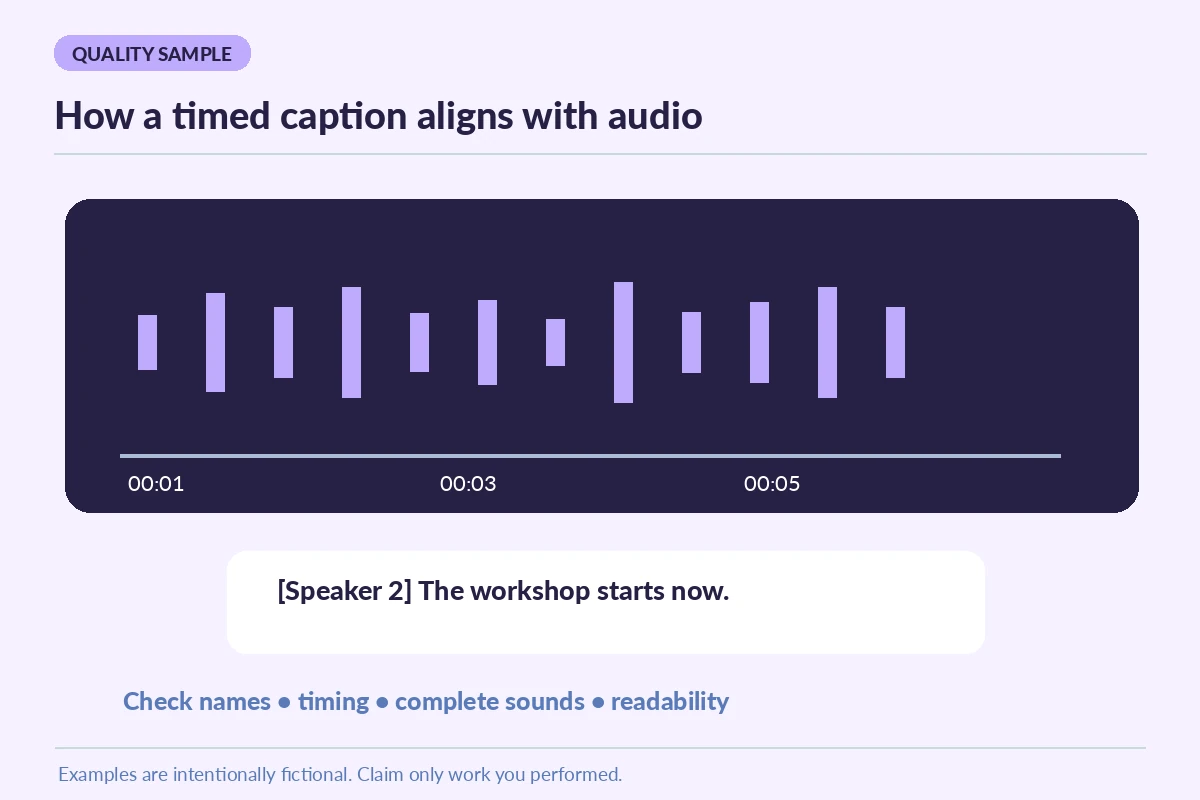
For applicable television programming, federal captioning rules address accuracy, synchronization, completeness, and placement. In practical terms, verify words and meaningful non-speech sounds; align captions closely with audio; include required content rather than omitting difficult passages; and keep text legible without blocking key visuals. A job test may emphasize some criteria more than others. Do not claim that every website video automatically follows the same television rule; use the published client specification and the relevant accessibility framework for the actual assignment.
Choose a demonstration appropriate to your level
For recorded work, create your own short video or obtain explicit permission to use one, and prepare a brief caption file with timing and speaker cues. Keep a before-and-after change list showing corrected words and repositioned captions. For live captioning, follow the hiring organization’s actual skills assessment and equipment instructions instead of presenting a prerecorded sample as proof of realtime capability. Use nonconfidential source content and avoid uploading copyrighted client video to public services without approval.
Understand certification and training claims
NCRA’s Certified Realtime Captioner is an established qualification for certain stenographic broadcast and CART careers. Its existence does not mean all offline caption editors must hold it. Ask whether the vacancy specifies stenotype, voice writing, a recognized credential, particular software, or a performance assessment. If you are training, say so and identify completed coursework or practice accurately. Do not add CRC letters to a résumé before earning the certification. Check current requirements with NCRA rather than trusting a recruitment page that quotes outdated thresholds.
Clarify how a live assignment is staffed
If the job is realtime, ask how advance speaker names and terminology are provided, what happens when audio drops, whether backup captioners cover long events, and who alerts the organizer about access failures. Live access work can affect people’s ability to participate; a speculative availability promise is not enough. Confirm the handoff between event staff, captioner, and technical support. Never represent yourself as a qualified live-access provider just because you can type quickly in ordinary office software.
Review confidentiality and the right to record
Recorded webinars, classes, company meetings, and legal or medical discussions can contain personal information or confidential business details. Ask whether you may retain source files, who can view the generated captions, how corrections are approved, and when recordings must be deleted. For CART or other real-time access assignments, discuss transcript retention and distribution instructions before the event. NCRA’s professional guidance emphasizes clear understandings about the service and the handling of electronic files.
Read an assessment brief line by line
A credible captioning assessment should state the permitted tools, the clip or event duration, format, speed or accuracy measures, deadline, and evaluation process. Recorded-work tests may ask you to deliver an SRT or another caption format, while live tests can require specialized equipment. Clarify the scope of unpaid samples and do not assume that every assessment is legitimate. A sender requesting a deposit before providing a real project or equipment could be exploiting the demand for work-from-home jobs rather than hiring.
Build a quality checklist from a practice excerpt
Illustrative example: a self-recorded community-announcement clip includes two speakers, a difficult street name, laughter, and a slide title. Review the captions for speaker labels, proper spelling, audio alignment, complete spoken content, and whether the slide remains visible. Record what you corrected in a short audit. That proves attention to caption quality without inventing a client or a certification. When describing the result, label the sample as a practice exercise and specify the caption format used.

Evaluate compensation and schedule realistically
Captioning pay and workflow differ among employment, contracting, recorded projects, and live assignments. Ask whether rates include preparation, quality review, edits, training, difficult audio, or event setup. Realtime events may require reliable connectivity at fixed times, even if the worker is at home. Verify that the payment entity and employer identity match the written contract; never deposit money to release supposedly earned captions income. Do not use a broad occupational wage figure as a guarantee for a particular remote captioning role.
Choose the next sensible application step
If you have language, timing, and media-editing skills, begin with appropriately scoped recorded-caption assessments. If the goal is broadcast or CART, research specialized training, equipment, and any posted credential requirement first. Apply when the employer’s live-versus-recorded distinction is clear, the quality expectations are written, and you can protect the content. Ask for clarification if the vacancy uses ‘transcription,’ ‘subtitles,’ and ‘realtime captioning’ as though they are identical; that ambiguity affects both accessibility and job fit.
How We Research Remote Job Guidance
We reviewed the role-specific occupational, professional, or government guidance linked below and compared it with practical questions that a real applicant can ask. The examples in this article are fictional, not employer testimonials or live openings. A job title and its remote eligibility can vary by organization; the official advertisement and written access rules should control the decision. No source promises a job, a particular salary, an interview, or automatic qualification.
Sources checked on November 4, 2026: www.bls.gov (BLS describes simultaneous captioners, broadcast captioners, CART providers, training, and possible home-based settings.); www.ncra.org (NCRA describes broadcast and CART captioning, including remote real-time services.); www.ncra.org (NCRA explains its Certified Realtime Captioner credential for stenographic broadcast and CART work; a credential is not assumed for all caption jobs.); www.law.cornell.edu (47 CFR 79.1 identifies accuracy, synchronicity, completeness, and placement standards for applicable televised video captions.). Review our affiliate disclosure; this article does not claim any paid partnership. NCRA captioner ethics guidance provides additional expectations for the handling of electronic files.
Related Job Search Guides
No. Some simultaneous captioners work remotely, but availability, equipment, licensing, event coverage, and client rules depend on the vacancy.
No. Captioning adds screen timing, display and accessibility considerations; live captioning may also require specialized real-time methods.
No. NCRA credentials apply to particular skills and roles. Confirm the exact requirements of a posting.
Use footage you created or have permission to use. Do not publish or submit protected client content without authorization.
Confirm preparation materials, system access, backup coverage, privacy expectations, and how technical failures are reported.