
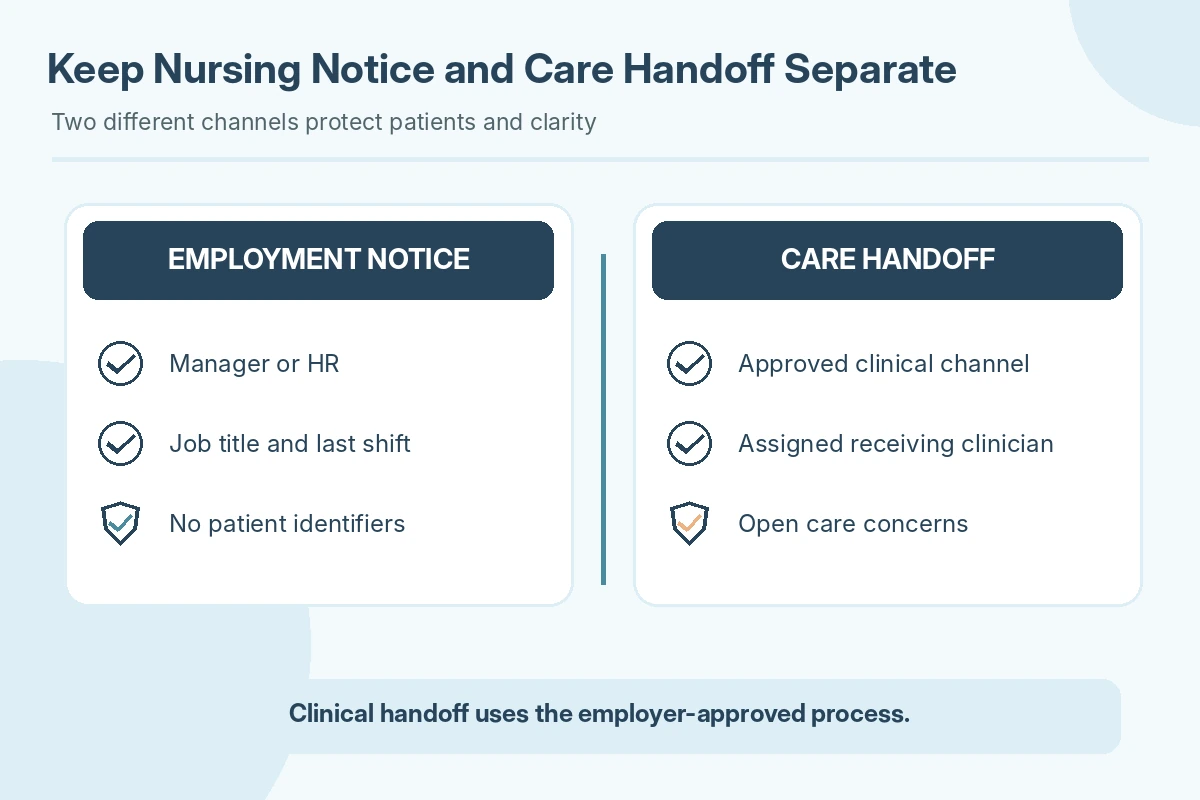
A nurse resignation letter is an employment notice, not a clinical handoff record. State the nursing position, your intended last working shift, appreciation if genuine, and willingness to use approved transition processes. Then manage patient assignments, open issues, records and coverage through the facility’s clinical channels rather than putting protected patient information in the letter itself.
The American Nurses Association Code of Ethics describes accountability for competent practice, and The Joint Commission discusses structured hand-off communication in accredited hospitals. Neither source establishes a universal resignation notice period for every nurse, facility or state. Contracts, facility policy, union provisions and applicable state board requirements may affect what you must check before leaving.
Separate Your Employment Decision From Patient Safety
A resignation notice belongs with the appropriate manager or HR recipient and records employment facts: role, last shift and contact for employment administration. A clinical handoff belongs in an approved patient-care workflow and may contain sensitive information accessible only to authorized staff. Combining them is risky. Do not attach a patient list, record numbers, clinical notes or family contact details to a personal resignation email.
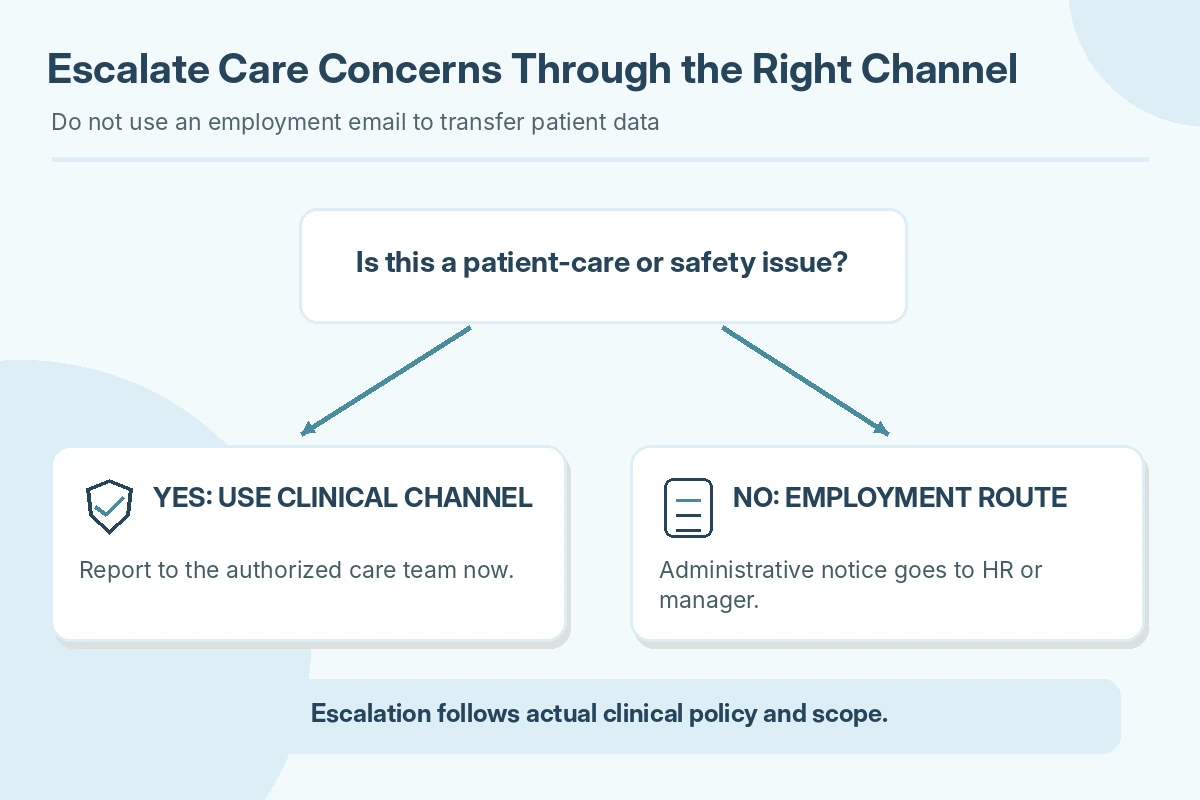
This separation also avoids implying that a polite letter itself discharges nursing responsibilities. During the period you continue working, you still follow safe care practices and approved reporting processes. If a patient condition or assignment concern needs immediate escalation, use the care team’s established chain of communication at the time; do not wait for a final exit meeting or put the issue in a farewell paragraph.
Confirm Notice Requirements and the Last Shift
Check your written employment terms, facility policy, collective agreement if applicable, and the schedule currently assigned to you. If a final shift crosses midnight, ask the manager which date should appear on the letter. Do not assert that a particular number of weeks is legally required for every RN or LPN; local rules and employment circumstances differ. Where a credential or licensing concern is raised, contact an appropriate board, representative or licensed adviser.
For the notice itself, plain language is enough: “I am resigning from my position as [Role] on [Unit]. My final scheduled shift will end on [Month Day, Year, if relevant to your schedule].” You need not discuss a diagnosis, pregnancy, a disagreement with management or a future employer. Keep these personal details out unless you specifically choose to discuss them through an appropriate channel.
Use a Short, Role-Accurate Sample Letter
Hypothetical sample: “Dear [Nurse Manager], please accept this letter as my resignation from my [RN/LPN/other accurate role] position. My last scheduled shift is [exact shift and date]. Thank you for the clinical learning and collaboration I have experienced here. During my remaining shifts, I will follow our unit’s approved handoff and documentation procedures and raise outstanding care or assignment concerns through the appropriate team channels. Sincerely, [Name].”
This fictional message does not imply that the nurse controls scheduling, certifies staffing adequacy or can unilaterally reassign patients. If you do not supervise staff, do not volunteer to approve a replacement or “sign off” on competence. ANA’s assignment and delegation guidance focuses on competence and organizational policy; a resignation letter should not be used to make unsupported representations about who has accepted responsibility for future care.

Build a Clinical Handoff in the Approved System
For each active assignment, follow your unit’s actual end-of-shift handoff procedure: communicate changes in condition, pending tests or alerts, required follow-up and any unresolved urgent concern to an appropriate receiving clinician. The exact format and approved communication tool depend on the institution. The public infographic on this page illustrates responsibility boundaries rather than giving mandatory clinical instructions or a substitute for facility protocols.
If you have administrative duties, identify where approved rosters or shared task records live and who is responsible after departure. Do not export clinical data, retain screenshots, or use a personal messaging account for patient details. Confirm unusual questions with your supervisor or privacy team. The Joint Commission’s patient safety guidance supports the importance of a hand-off process, but does not authorize a particular employee to transfer care outside their scope.
Handle Last-Day Logistics Without Disrupting Care
Ask HR or your manager which steps concern badges, uniforms, equipment, final access removal, credentialing, leave balances and employment verification. These are administrative issues; they should not be folded into patient notes. If your final-day logistics conflict with an assigned shift, raise the schedule issue early rather than simply assuming someone else will cover it.
Some nurses leave because working conditions concern them. The existence of a resignation does not erase a safety concern, nor does it mean every issue must be described to HR in the letter. Continue to use appropriate incident, risk management, supervisory or regulatory reporting channels when warranted. This guide cannot determine the legal or licensing significance of a particular set of facts.
Check the Draft for Privacy and Authority Errors
Reread the letter for correct credentials, unit terminology, actual last shift, and tone. Remove patient information and claims such as “all of my patients are fully covered” unless the appropriate personnel have independently confirmed the staffing plan. Do not imply your nursing license ends on your final employment date; licensing and employment are separate matters.
The safe final check is two questions: does the notice clearly communicate the employment decision, and have the patient-care responsibilities been addressed through the right live clinical process? ANA professional accountability and Joint Commission handoff standards help frame the second question. They do not certify that a hypothetical example complies with every state’s nursing practice requirements.
How We Research Professional Resignation Guidance
This guide draws on ANA professional ethics, ANA assignment standards, The Joint Commission, UNLV Career Services. These sources support practical communication, notice structure or, where applicable, clinical responsibility. They do not confirm an individual contract, a legal notice period, a facility policy or an invented candidate’s experience. Public source pages were checked on October 26, 2026.
All templates and scenarios are explicitly hypothetical and must be rewritten with your actual dates, duties and recipients. Treat the original diagrams as decision aids, not legal or clinical directives. This site makes no claim of a paid referral or affiliated employer. Review the affiliate disclosure.
Explore Related Career Guides
- Resignation Letter Due to Relocation: Explain the Move Without Oversharing
- Retirement Resignation Letter: Last Day, Handoff, and Benefits
- Resignation Letter for Personal Reasons: Privacy, Dates, and Examples
- Resignation Letter for Personal Reasons: A Decision Matrix and Example
- Formal Resignation Letter Format: Write, Sign, and Deliver It Clearly
Review the relevant agreement, employer policy and any applicable professional requirements; there is no universal period stated by this article.
No. Patient details belong only in approved clinical documentation and handoff channels, not a general employment notice.
Only within their role, available time and organizational rules; do not claim authority to approve assignments or competence.
State the exact scheduled shift or confirm with the manager how the final working date should be recorded.
Use the appropriate immediate clinical and escalation channels; do not rely on the resignation letter as the safety report.