
An office manager resume summary should explain the operation you kept organized, the people and processes you supported, and the decisions you were actually authorized to make. “Office manager” can describe a broad supervisory role in one workplace and a small-office coordinator in another. Without concrete boundaries, a summary may accidentally suggest control over budgets, personnel policy or vendor contracts that belonged to another employee.
Start with work you can document: calendar coordination, supply ordering within limits, visitor procedures, office records, facilities requests and handoffs to decision-makers. If you supervised staff, say so only when that was a genuine responsibility. O*NET’s profile of administrative support supervisors includes work quality, deadlines and guidance for complex problems, but it is an occupational reference, not permission to adopt every listed duty as your own.
Define the Office Operations You Actually Managed
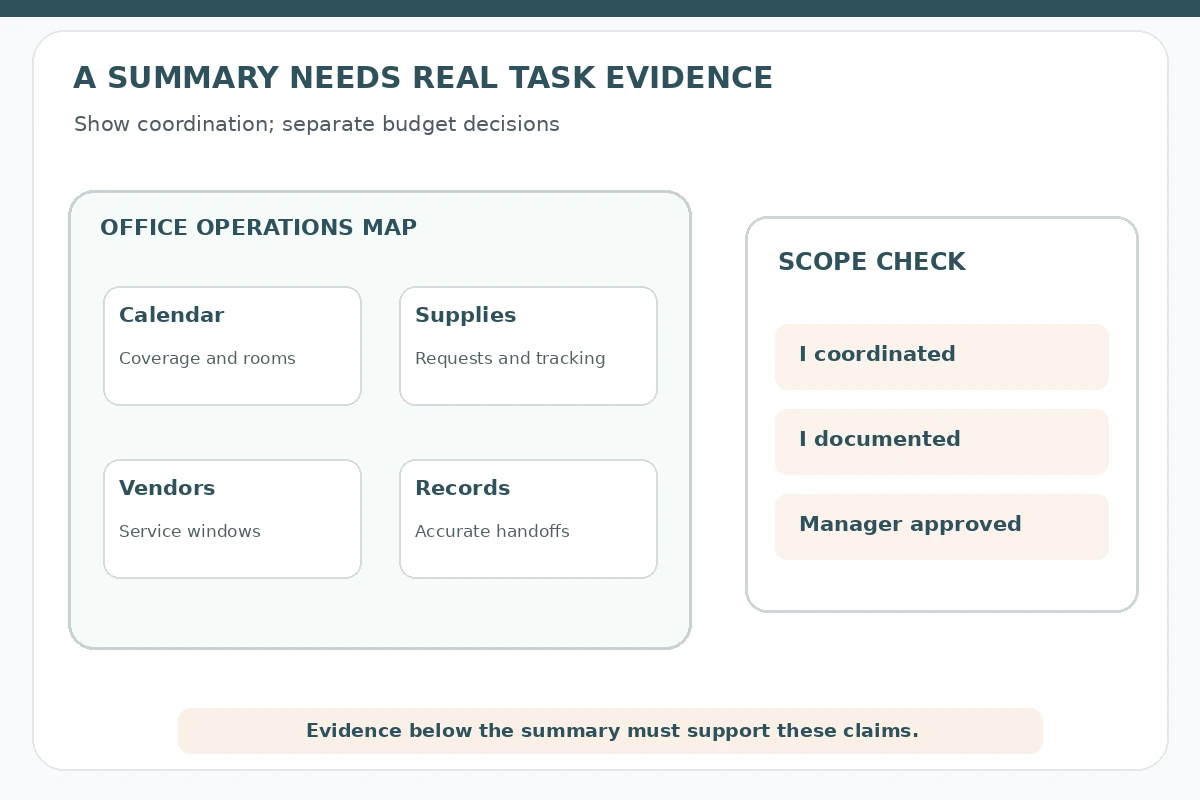
Draw a simple map of the office: scheduling and space, records and communications, supplies and vendors, and staff coordination. Under each area write whether you performed the work, organized others, checked a result or approved an action. For example, coordinating a contractor visit is not necessarily negotiating a contract; collecting timesheets is not the same as authorizing payroll; assigning a shared calendar slot is not automatically staff management.
Evidence may include an anonymized service-request log, a scheduling procedure, a stock reorder checklist or a handoff template. Avoid publishing workplace visitor details, personnel records, confidential vendor rates or door-access instructions. A credible summary can refer to “coordinated facilities service requests and maintained a reviewed supply ordering process” without exposing private records.

Turn Busy Office Work Into a Specific Opening
Consider this hypothetical summary for an experienced coordinator: “Office operations professional with experience coordinating shared calendars, vendor service requests and administrative records. Supported front-desk coverage, documented exceptions and routed budget approvals to designated managers.” It shows the kind of work, the dependencies and the boundary between coordination and approval.
“Dynamic leader of every office process and all budgets” is less useful. Even if you handled many daily tasks, employers need to know which ones required your judgment and which required escalation. If your true title was office assistant, use that title in experience and describe the transferable coordination skills rather than changing your history to “office manager.”
Distinguish Supervision From Collaboration
An office can function through shared responsibility. A person who assembled a coverage schedule, trained a new receptionist or checked an inventory count contributed real operational value. However, those actions do not by themselves prove authority to evaluate employees, issue disciplinary action or approve spending. Show the distinction in the summary or in a supporting bullet: “coordinated schedules with supervisor approval,” or “maintained supply requests within approved purchasing procedures.”
For measurable results, use a real record. You may be able to state the number of sites or teams served if it is accurate and disclosable, but do not invent cost savings or customer satisfaction increases. A process you introduced is easier to defend when you can show a dated checklist revision, a documented problem and the steps used to verify the change.
| Office function | Show evidence | Authority check |
|---|---|---|
| Schedule / space | Shared calendar changes | Confirm who set priorities |
| Vendor requests | Service tickets and follow-ups | Contract approval may differ |
| Supply orders | Reorder checklist | Observe spending limit |
Adjust the Summary to a Small Office or Large Team
For a small workplace, emphasize practical range, service continuity, scheduling and accurate records. For a larger office, highlight coordination across people or locations, request-tracking tools and documented escalations. For a facilities-heavy role, prioritize vendor communication and service requests over general receptionist duties. The best opening depends on the employer’s actual operational problem, not on a generic collection of leadership adjectives.
Pay attention to job descriptions that combine office manager with HR, bookkeeping or IT administration. Include experience in those areas only if you did it. Checking a vendor invoice is not full accounting ownership; helping onboard an employee is not necessarily HR policy authority; collecting a device request is not administering network access. A useful summary makes those interfaces clear.

Perform a Final Scope and Evidence Check
Check each action verb. “Coordinated” should be supported by a sequence you arranged; “supervised” should be supported by staff oversight duties; “approved” requires actual delegated authority. If a bullet below says that management approved the purchase, do not make the summary claim you personally managed a purchasing budget. Conflicting assertions can distract a recruiter even when the underlying work was valuable.
Proofread department names, job dates and software tools. If an office coordination achievement required a team effort, use wording that identifies your contribution. Save a version of the summary matched to each role and confirm that it agrees with the rest of the document. The result should explain the specific type of office operation you can support from day one.
Worked Example: A Disrupted Vendor Appointment
In a hypothetical small office, a repair contractor changes the planned service window while the front desk needs uninterrupted coverage. The office coordinator checks the shared calendar, identifies the rooms affected, contacts the contractor using the approved route and offers two alternate time slots to the facilities manager. The manager chooses the final option and confirms any cost change. The coordinator documents the agreed schedule and informs affected employees. The story shows a real coordination sequence while keeping contracting and budget decisions separate.
An accurate top-of-resume claim from such experience would be “coordinated vendor service windows and office coverage with manager approval.” An inflated claim would be “negotiated facilities contracts and controlled operational budgets” when the candidate merely relayed choices. To support the statement, the experience section could mention anonymized tracking practices and the handoff procedure. The lesson generalizes to supply orders and workspace requests: the résumé should recognize proactive coordination without suggesting unlimited purchasing or supervisory rights. A posting that mentions staff supervision requires separate evidence such as assigned oversight duties or documented training responsibilities; coordinating visitors and meeting rooms alone does not establish that level of authority. The candidate should keep those distinctions visible in the chronological bullets.
How We Research and Verify the Examples
This U.S.-focused article was checked on 2026-11-14 against the following reference materials: Career Center resume guide (UC San Diego recommends concise experience-based, role-specific summary content). Occupational or technical source (O*NET identifies oversight, records, problem-solving and supervisory responsibilities). Occupational or technical source (BLS explains administrative management, recordkeeping and coordination responsibilities). All sample summaries are hypothetical demonstrations, not records of real applicants, employers, projects or employment outcomes. Practices vary by employer; verify actual role definitions, confidentiality rules and approval rights. No salary, applicant tracking score or hiring outcome is guaranteed. See our affiliate disclosure.
More Resume and Cover Letter Guides
Keep the formal employment title accurate. You may describe office-management functions you performed without changing the recorded title.
Say you coordinated coverage or maintained the shared schedule, and identify the supervisor’s approval when relevant.
Only when reliable documentation supports the calculation and your contribution; otherwise state the vendor coordination activity.
Add software when it directly supports a requirement such as calendar management, service-ticket routing or document control.
Explain requests, order tracking and the approval step honestly; never claim spending authority you did not possess.