
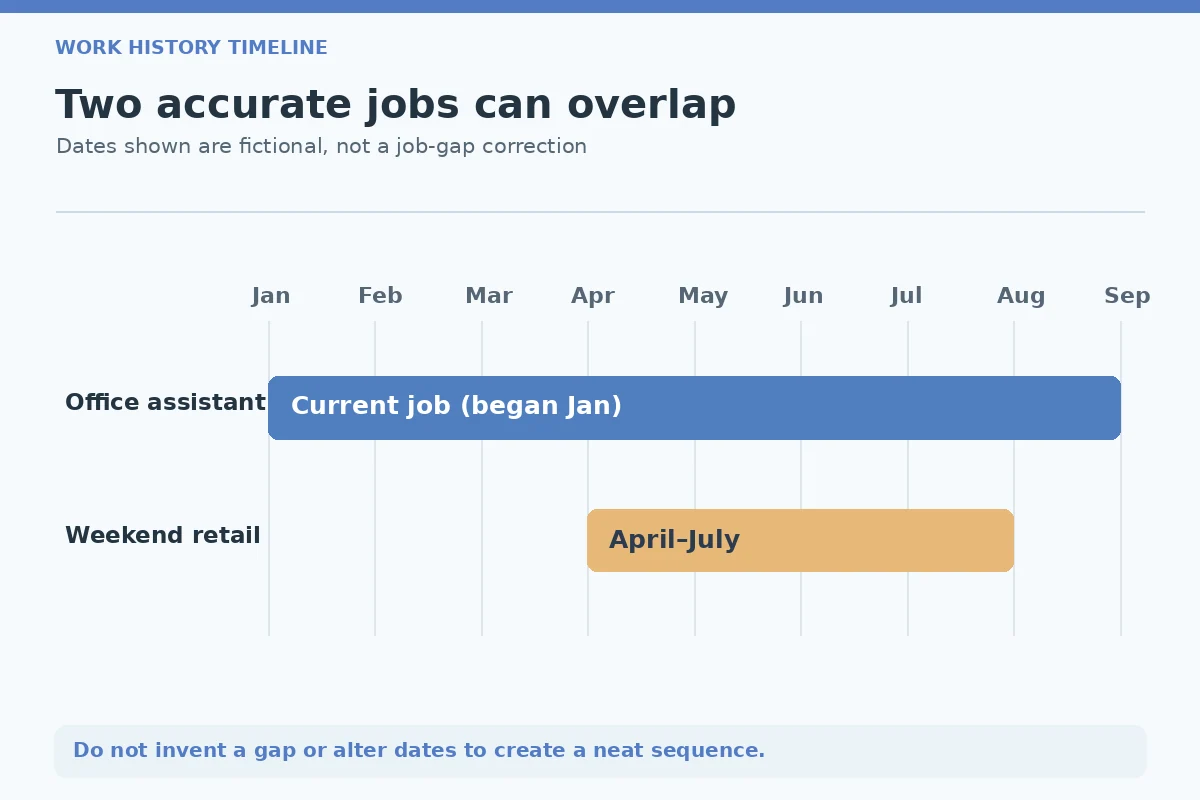
Two jobs can appear on a resume with dates that overlap. List each real employer, title, and accurate dates; you do not need to invent a gap or change one job to make the timeline look sequential. Use a brief status note such as “part-time” or “weekends” when it helps explain availability, and give each role a different set of relevant examples. Job application forms may separately request hours per week, which should be reported as actual hours rather than assumed full-time work.
Separate overlapping jobs from duplicate entries
Start by confirming that you truly held both positions during the same period. A paid weekend role alongside weekday work, a campus job during an internship, and an evening teaching assignment alongside self-employment are all possible. A resume normally presents work in reverse chronological order; the start or end dates can overlap without violating that structure. The key is making each line easy to interpret, not smoothing the dates into a fictional sequence.
For instance, an illustrative applicant worked as an Office Assistant at Cedar House from January 2024 to the present and as a Weekend Retail Associate at Park Lane Store from September 2024 through May 2025. These are hypothetical names and dates. Put the Office Assistant first if it remains current. Add “Part-time, weekends” to the second job if the clarification matters. Do not describe an overlap as a full-time workload at both employers unless that is actually what occurred.
Present both employer records in plain text
Use separate entries: employer, title, city/state if useful, dates, and relevant duties. Clear month/year ranges reduce confusion; the resume does not need to explain every change in weekly hours. If your schedule changed halfway through a job and that distinction is material, add a truthful short notation or explain it in the application form. CareerOneStop emphasizes readable employment history, and USAJOBS explicitly requests hours per week for relevant federal work experience. Those federal requirements do not automatically apply to every private-sector resume.
A sample entry could read: “Cedar House — Office Assistant | January 2024–Present” with a bullet about maintaining a meeting calendar and checking incoming forms. A second entry could read: “Park Lane Store — Retail Associate (weekends) | September 2024–May 2025” with a bullet about restocking and flagging pricing mismatches to a shift lead. Both are examples of discrete work. Neither claims the applicant managed both organizations or owned the performance of entire teams.
Decide whether both jobs deserve equal space
Overlapping jobs are not a reason to allocate identical space to each. Give more attention to the experience that best answers the new vacancy. A candidate for office administration may need two precise bullets about scheduling and records while the retail job needs one line showing customer service. For a customer-facing position, the ordering of accomplishments may differ even though the timeline stays the same. The purpose of editing is relevance, not changing what happened.
If one role was very brief and unrelated, you can consider whether to include it on a targeted resume. However, leaving a job off an optional resume does not authorize leaving it off an application that asks for complete work history. Save a private master chronology with all genuine employment periods so you can answer accurately and consistently. This separation is useful when employers request different forms or detail levels.
Clarify employment type without oversharing schedules
Status labels can be helpful: “part-time,” “seasonal,” “contract,” or “weekends”. Select only a label that is factually correct for the specific role and period. You generally do not have to put detailed weekly shifts, pay, personal circumstances, or the reason you needed two jobs on a resume. For schedule-dependent roles, the employer may ask about availability during an application or interview; answer based on your current commitments, not an invented guarantee.
Some candidates worry that an overlap looks like a mistake or conflict. The simple fix is readability: align the date ranges, place titles next to employers, and avoid hiding either role inside a shared paragraph. If a recruiter asks about time allocation, give a truthful explanation such as, “The office assignment ran on weekdays, and I worked the retail role on scheduled weekends during that period.” Use this only when it matches your actual experience.

Handle concurrent freelance, study, and volunteering carefully
Not all activity in the same month is employment. A class project, volunteer shift, freelance assignment, and payroll position can overlap without belonging under one “Employment” heading. Put paid jobs in Experience and place coursework or volunteering in their appropriate sections when that prevents category confusion. For independent contracting, identify the work arrangement accurately instead of inventing a single client as a permanent employer. Avoid implying that a training or certification period was paid professional work.
A second illustrative layout is: “Office Assistant — Cedar House | January 2024–Present” and “Volunteer Event Scheduler — Neighborhood Arts Council | March–November 2024” under a separate Volunteer Experience section. The dates overlap, but the section label signals the difference. If the work you performed used confidential customer information, describe your tasks without reproducing any real records or names in the resume.
Double-check dates before submitting a federal application
Federal applications deserve special care because the current USAJOBS guidance asks relevant experience entries to include employer, job title, month/year dates, and hours per week. If your two roles overlapped, report the hours of each rather than summing them into a single job or assuming a 40-hour schedule. Read the particular announcement for specialized requirements. This is a format and evidence issue, not a claim about how any individual hiring manager will judge two jobs.
For other employers, follow the application instructions too. Use the same dates on the resume and application form to avoid accidental contradictions. If an online form refuses a legitimate overlapping period, contact the official help or recruitment channel rather than altering your chronology to bypass the form. Keep a clean PDF or DOCX as the employer requests and view the final document to make sure labels and dates remain legible.

How We Research Concurrent Work Histories
Our guidance builds on CareerOneStop’s recommendations for truthful work history and consistent formatting, the University of Pennsylvania’s advice about prioritizing relevant accomplishments, and USAJOBS instructions for federal applicants. These sources explain what information resumes and applications should convey; they do not establish a universal rule against date overlap. See CareerOneStop experience guidance, Penn resume guidance, and USAJOBS resume requirements. All sample employers, dates, and bullets are fictional. For website relationships, see our affiliate disclosure.
More Resume and Cover Letter Guides
Yes, when both jobs genuinely happened at the same time. Two accurate entries are clearer than adjusting dates to manufacture a sequential history.
Usually the duties and dates are more important than the personal reason. A truthful part-time or weekend label can clarify the arrangement when relevant.
Not for every private-sector resume. Current USAJOBS guidance requests hours per week for relevant federal work history, so follow the actual announcement.
Keep the distinction clear. A separate Volunteer Experience heading can show the overlap without misrepresenting unpaid activity as payroll employment.
Do not invent a different timeline. Use the employer’s official applicant support channel or instructions to clarify the form problem.