
Part-time delivery driver jobs are not all the same. An employee driving a company van on assigned shifts has a different expense and supervision picture from an app-based driver using a personal car. Start by identifying the actual employer or platform arrangement, the license and vehicle requirements, the delivery window, and who pays operating expenses. Then test whether a route fits your available hours without inventing income figures or assuming that advertised flexibility removes traffic, loading or safety demands.
This guide is about evaluating real US job descriptions, not a list of currently available vacancies or a promise of hiring. Examples labeled hypothetical are illustrations, never reported candidate achievements or actual employer outcomes. Keep licenses, financial claims, experience and hours accurate. For more role comparisons see JobAsk job search resources.
Start With a Verified Role and Schedule
Before applying, record the employer name and official listing URL, stated weekly hours, days required, workplace or service territory, qualifications, training offered and your own nonnegotiable availability. The U.S. Department of Labor explains that the FLSA does not define part-time with a single hours number. If the schedule is not disclosed, ask; do not silently infer it.
Choose Between Employer Routes and App-Based Deliveries
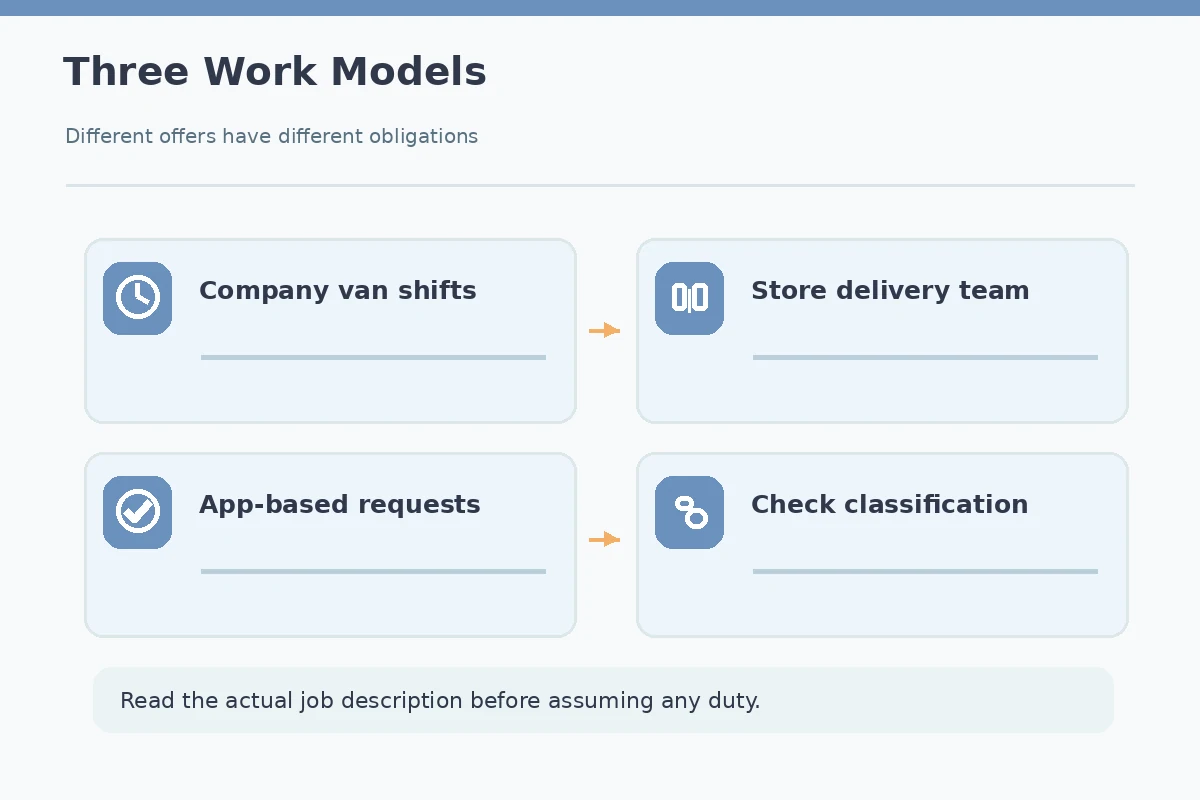
Compare at least three models: a scheduled employee delivery route, a retail store’s own delivery team and independent app-mediated requests. Company-based positions may assign a vehicle, dispatch instructions and fixed starts; platform arrangements may let drivers accept individual offers but can create costs and administrative work. The exact employment classification is a legal and factual question, not something to decide from a marketing slogan alone.
Use the BLS delivery driver profile to understand the core work of picking up, transporting and dropping off packages or products. Some roles involve physical lifting and customer contact. Do not assume that a car-delivery app and a job operating a light delivery truck have identical training, insurance or vehicle requirements. Open each listing and record who supplies equipment and who directs the work.
Read the Shift and Route Window Together
A four-hour advertised shift may include vehicle preparation, loading, dispatch or returns; ask when paid work begins and ends under the actual arrangement. For employees, check posted start time, assigned area, weekend coverage and location of the pickup point. For app delivery, distinguish the time you are available from the time you spend completing accepted deliveries. A short route can be a poor match if its dispatch window overlaps a required class or family commitment.
Map the practical route: departure point, pickup, service area, traffic-sensitive periods and return or drop-off location. Use real travel conditions when planning; do not invent a fixed number of deliveries per hour. Ask how delays, failed deliveries and customer cancellations are handled. If dispatch changes are common, decide what variation you can genuinely accommodate rather than labeling every unpredictable schedule flexible.
Audit License, Vehicle, Insurance, and Expenses
Check the required driver’s license, driving history criteria, vehicle age or type, insurance arrangements, fuel policy and any lifting requirements from the official listing. A general valid state license is relevant to delivery driving, but additional conditions depend on the work and location. Do not imply that a platform’s sign-up approval establishes insurance coverage for all commercial driving situations. Ask the responsible insurer or employer to explain the applicable use.
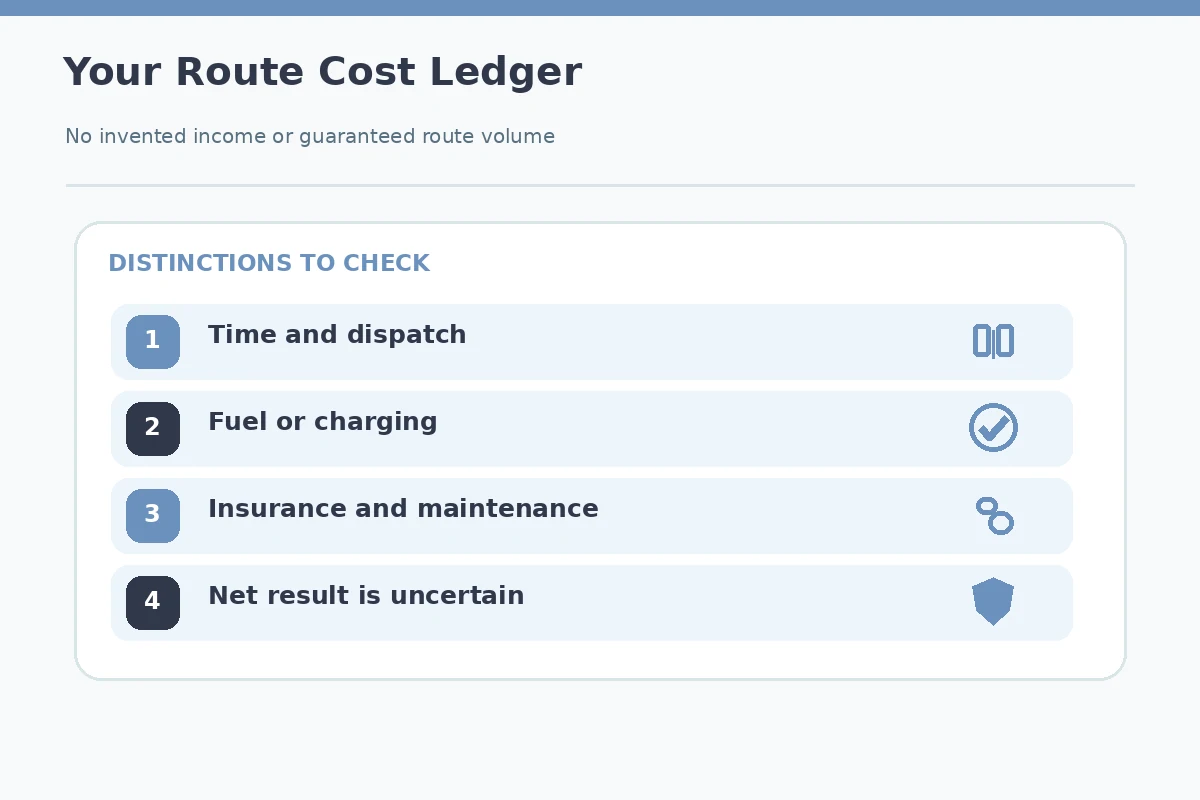
For personal-vehicle work, build a cost worksheet without assuming a tax deduction: fuel or charging, maintenance, tires, insurance and driving time. Keep receipts and mileage records where relevant. The IRS Gig Economy Tax Center notes that gig income is taxable even for part-time activity and explains worker-classification considerations. This article is not individualized tax or insurance advice; verify your actual circumstances.
Understand Safe Completion and Reporting
An effective driver records the pickup, destination, delivery attempt and any authorized proof of delivery accurately. Learn how the employer wants damage, an incorrect address or a customer complaint reported. Do not create your own rule for entering a locked building, leaving a package in an unsafe location or sharing a customer’s private information. The dispatcher, supervisor or official platform workflow determines the permitted next steps.
Practice a hypothetical case: the app marks a package delivered, but the customer reports that it is missing. A responsible candidate would check permitted records, avoid guessing where the package went and use the approved escalation channel. Do not claim a recovery outcome if you never performed it. In an interview, your real evidence might be accuracy, punctuality, route planning or safe customer communication from another role.
Compare the Real Offer, Not the Headline
Make a comparison row for each opportunity: employee or contractor status, confirmed pay basis, vehicle responsibility, accepted operating costs, shifts, training, driver screening and a verified contact. “Earn up to” language is not a guaranteed take-home result, and a single unusually productive shift does not establish typical earnings. Ask what the listing actually guarantees in writing, and keep any excluded expenses visible.
For a scheduled employee route, check whether shift hours are assigned in advance. For variable gig requests, ask what happens when work is unavailable and whether cancellations create charges. If the listing will not disclose the company identity, duties or payment method before demanding a fee, stop. Do not treat an unverified social media post as a contract, even if it carries familiar branding.
Verify Hiring and Payment Channels
Find the position through the employer’s real site or the platform’s official application channel. FTC guidance warns that fake jobs may demand advance payments, personal information or checks to cover equipment. Do not pay a stranger to unlock deliveries or transfer money from a purported employer check. Look up the organization independently rather than relying on a phone number supplied only in a recruiter message.
Retain the legitimate application receipt and any onboarding instructions. If a screening request appears inconsistent with an official offer, confirm it directly with the company through a trusted channel. A driver’s license, personal vehicle details and financial records are sensitive, so submit them only at the appropriate verified stage and through the approved process.
Make a Seven-Question Fit Decision
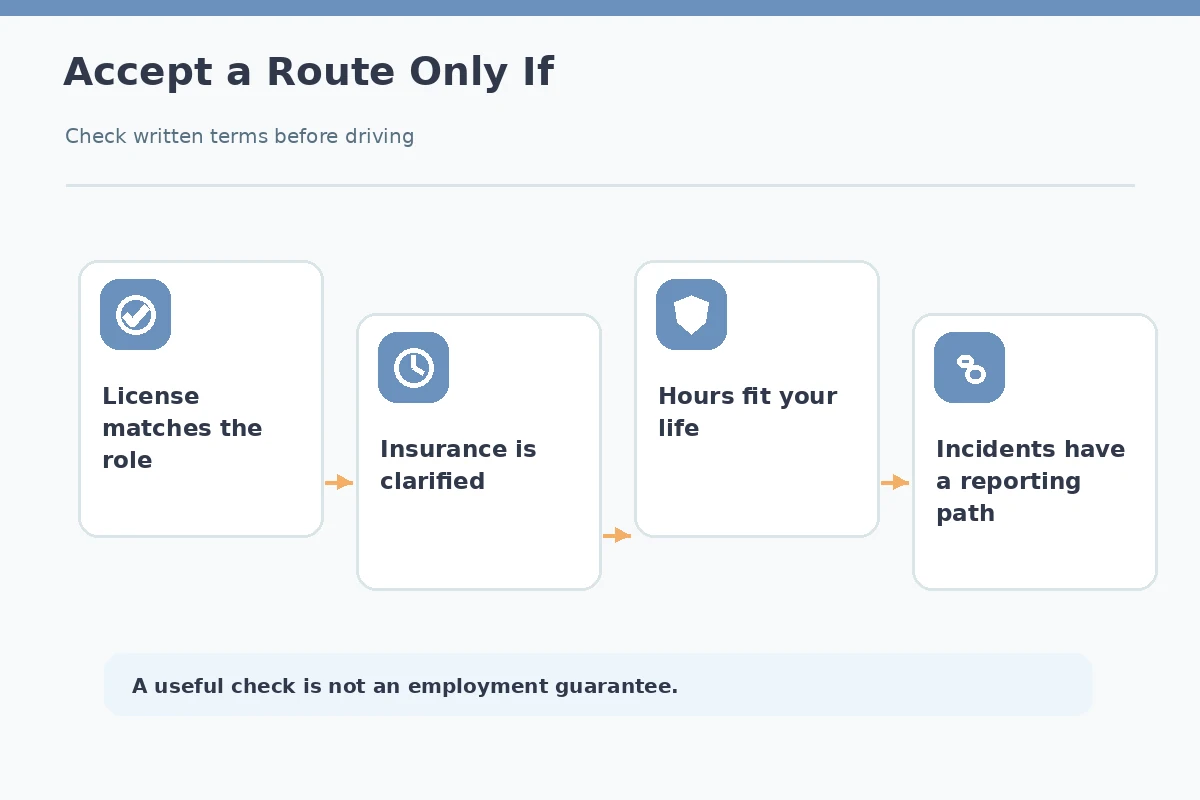
Before applying, answer: whose vehicle; which license; whose insurance; who controls the schedule; how are incidents reported; what expenses remain yours; and who pays you under what arrangement? Treat unknown answers as questions to resolve, not reassuring assumptions. If you cannot legally or safely meet a stated requirement, look for a different role rather than attempting to conceal it.
A hypothetical applicant might compare an evening grocery delivery shift against a weekend parcel route. If the second includes a fixed early dispatch conflicting with another commitment, its nominally shorter total hours may still be unsuitable. The right choice comes from verified terms and personal constraints, not from promises of easy money or a fabricated earnings comparison.
How We Research Part-Time Job Options
On 2026-10-27, we reviewed the linked primary US federal agency and professional occupational resources for work duties, hours, qualifications and hiring safety. These descriptions cannot confirm any private employer’s actual opening, rate, benefits, policies or hiring results. We checked the topic against the available JobAsk index, including B076, B090, B112, B120, B128 and adjacent clusters, to focus this page on a distinct decision. Hypothetical examples are not sourced real job outcomes.
Source reference: BLS describes delivery-driver duties, driving and loading demands, route variation and required state driver license.
Source reference: IRS explains that gig work through delivery apps can generate taxable income and that worker status affects reporting.
Source reference: DOL states the FLSA has no universal definition of part-time employment.
Source reference: FTC warns against upfront payments and fake work-from-home or gig offers.
The cited agencies and organizations do not endorse this article, and no hiring or affiliate relationship is claimed. Read JobAsk’s affiliate disclosure. Always follow the verified employer’s instructions and local requirements.
Related Guides
- Delivery Driver Resume Objective: Show Route Reliability and Safe Handoffs
- Part-Time Delivery Jobs With Your Own Car: Check Costs Before Applying
- Part-Time Delivery Jobs: Routes, Vehicle Costs, and Work Arrangements
- Part-Time Cleaning Jobs: Compare Worksites, Schedules, and Safety
- Part-Time Warehouse Jobs: Compare Shifts, Physical Tasks, and Entry Requirements
Not necessarily. Worker classification, control, equipment and tax treatment can differ; check the actual arrangement.
Do not assume that it does. Confirm the written policy and calculate your own relevant costs.
Delivery driving generally requires an appropriate valid driver’s license, with additional requirements varying by assignment.
Yes, depending on routes, employer schedules or available app requests. Confirm the details before accepting.
No. Do not treat illustrative or maximum advertised amounts as guaranteed income or take-home pay.