
Part-time work on a resume: Part-time jobs count as real work experience. List the employer, actual job title, location and dates, then explain the tasks you completed. You generally do not need to apologize for shorter hours or inflate a part-time role into full-time employment. Mention the schedule only when it clarifies overlapping positions, an application asks for hours, or the job requirement makes it relevant. The best entry shows what you did during the shifts you actually worked.
Give part-time work the same honest structure as other jobs
Use a normal experience line rather than isolating part-time work as a lesser category. A student cashier, weekend receptionist and evening library assistant can show transactions, records, service and teamwork. American University career guidance lists part-time employment among relevant experience categories. What matters is whether the tasks demonstrate a requirement in the target vacancy, not whether each shift lasted a standard eight hours.
A clear format is “Library Desk Assistant (Part-time) | [Organization] | [City, State] | [Month Year–Month Year].” Include the label if it helps explain the schedule, but do not add it to every entry automatically. Never stretch employment dates to fill a gap, and do not turn two unrelated weekend shifts into a continuous management role. Employers can ask about actual hours later; a resume should remain consistent with the application.
Decide whether hours belong in the entry
A resume often needs job title, dates and evidence more than a weekly-hours figure. If you worked while studying or held two simultaneous positions, “Part-time” may clarify why the jobs overlap. If an employer explicitly asks for hours per week or equivalent experience, answer in the application according to its instructions. Do not assume a particular recruiter will convert part-time years into full-time years in the way you prefer.
Hours can vary across semesters or seasonal periods. If the form asks for an average, calculate a defensible estimate from the applicable period and state any necessary qualification. Do not write that you handled a five-day closing cycle if you only worked Saturday and Sunday. A smaller true scope—closing the weekend register or covering evening check-ins—is enough for a useful accomplishment.

Choose skills that are visible in actual shift duties
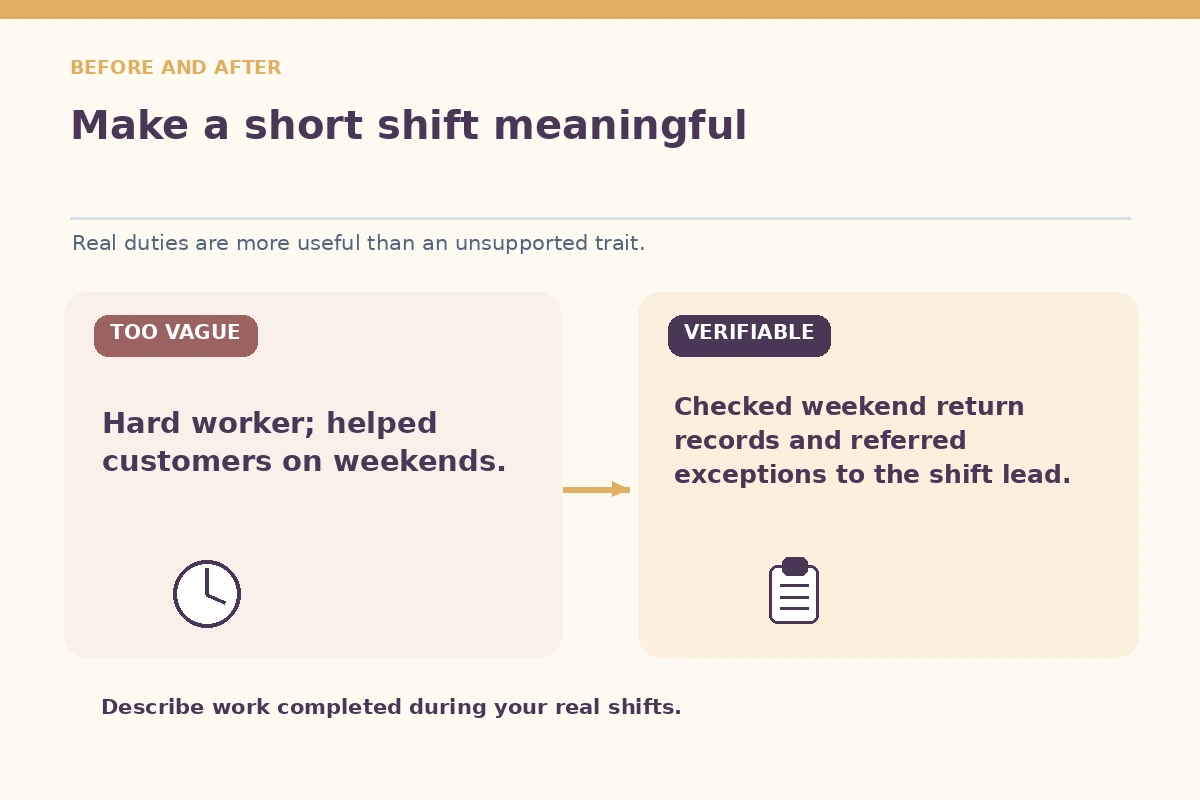
Instead of “Worked part-time at a store,” specify the action. One hypothetical resume bullet is, “Reconciled the weekend register checklist and referred any discrepancy to the shift lead.” This assumes the applicant actually followed that process; do not claim audit authority or cash totals that were never your responsibility. Another example for a campus worker might be “Updated room-booking notes and handed unresolved requests to the weekday desk.”
Tailor the bullet to the next job. If applying for administrative support, show records and communication. If applying for warehouse order processing, show accurate order checks where you actually performed them. Avoid using generic adjectives such as “hard-working,” “dedicated” or “excellent time management” in place of evidence. Employers can evaluate a concrete workflow more easily than a self-awarded personality score.
Show overlapping school, family duties, and employment clearly
If a part-time job ran alongside school, you do not need a paragraph proving how busy you were. Put school under Education and work under Experience with dates that truthfully overlap. When two jobs overlap, keep both if each is relevant; the presence of overlapping dates is not necessarily an error. The purpose of the parenthetical part-time label is to prevent a misleading impression, not to explain away every period.
For interrupted work, show the genuine start and end dates of an employment relationship. A restaurant may keep a student on payroll during a semester even when shifts pause; a series of separate temporary assignments may need separate entries. Use your actual records and employer terms. Resume formatting should not silently change what an employer would confirm if asked.
Use part-time experience strategically when space is limited
If this is your strongest work experience, give it two or three good bullets. If you have longer professional history, a less relevant weekend role may take one line or be omitted when the application does not require a complete record. CareerOneStop recommends emphasizing the jobs, responsibilities and accomplishments most related to the target goal. More bullets do not automatically improve credibility, and an unrelated job should not crowd out stronger evidence.
Group repeated duties without making them seem like a promotion. For example, staffing an information desk, checking sign-in lists and explaining appointment directions are different activities that may support one concise bullet. Do not list a system as a skill just because you watched a colleague use it. Keep consistent dates, capitalization and verbs, and make sure the job title and employer match the application form.
Use a final shift-to-bullet audit
Imagine a student who worked at a community center on weekends. A vague bullet says “Helped everyone and did administration.” A better hypothetical line could be: “Checked visitor sign-ins and updated room-use notes for the weekday coordinator.” The second line names the record and handoff, but it is appropriate only when those actions happened. It does not invent the size of the center, years of service or authority to approve bookings.
Before sending, ask: What did I do in a typical shift? What could a supervisor confirm? Was the work part-time throughout the stated dates? Which job requirement does each bullet address? If you cannot answer those questions, simplify. A concise and traceable part-time entry is more persuasive than pretending limited shifts were a different kind of work.

How We Research Resume Work Experience
JobAsk reviewed these public career and occupation references on November 4, 2026: CareerOneStop: Work Experience (CareerOneStop work-experience guidance on relevance, dates and job accomplishments). American University: Resume Guidance (American University guidance explicitly including part-time employment in relevant experience). CareerOneStop: Resume Formatting (CareerOneStop format and standardized date guidance). These explain typical resume practices and job duties; they do not establish any applicant’s real employment history, certifications, or hiring outcome.
Every example and diagram is illustrative. Replace sample actions, employers, months and duties with facts you can verify from your actual work, and recheck each job posting before tailoring an application. For editorial and commercial context, read our affiliate disclosure. This article does not claim a paid referral relationship or guaranteed resume screening result.
More Resume and Cover Letter Guides
You may when it clarifies the schedule or overlapping positions. It is not necessary on every resume unless requested by the employer.
Part-time jobs are real work, but how an employer evaluates duration or qualifying experience depends on its own job criteria.
Yes, when the dates are accurate. A part-time label may help explain simultaneous employment without changing the chronology.
Usually focus on the work and outcomes. Provide hours where specifically requested or where they materially clarify the scope; keep numbers accurate.
Describe the actual weekend duties, such as opening checks or shift handoffs. Do not imply that you managed weekday operations.