
International work experience on a resume: Work completed outside the United States can be listed in the work-experience section of a U.S. resume. State your actual employer, title, city and country, and employment dates; then explain the tasks and accomplishments that fit the target role. A readable English explanation of an unfamiliar title may help, but it must not upgrade your authority, professional license, degree, or job level. The goal is to help a U.S. hiring reader understand the work, not disguise its location.
Keep the real employer and country visible
Use the organization’s real name and a recognizable location such as “Lima, Peru” or “Pune, India” if those are the places where the work occurred. These are illustrative locations, not fictional employer records. If the organization uses a legal name in another script, consider its commonly used English rendering alongside the original form when space permits. Do not replace it with a well-known U.S. company or an invented abbreviation to appear familiar.
A standard entry might read “Operations Coordinator | [Actual Organization] | [City, Country] | [Month Year–Month Year].” Replace every bracketed item with your own verified facts. The location communicates context; it does not automatically mean the work was inferior, equivalent to a U.S. credential, or subject to a particular immigration status. If the online application separately asks for country or work authorization, answer that question accurately rather than hiding it in resume wording.
Explain titles without changing seniority or licensure
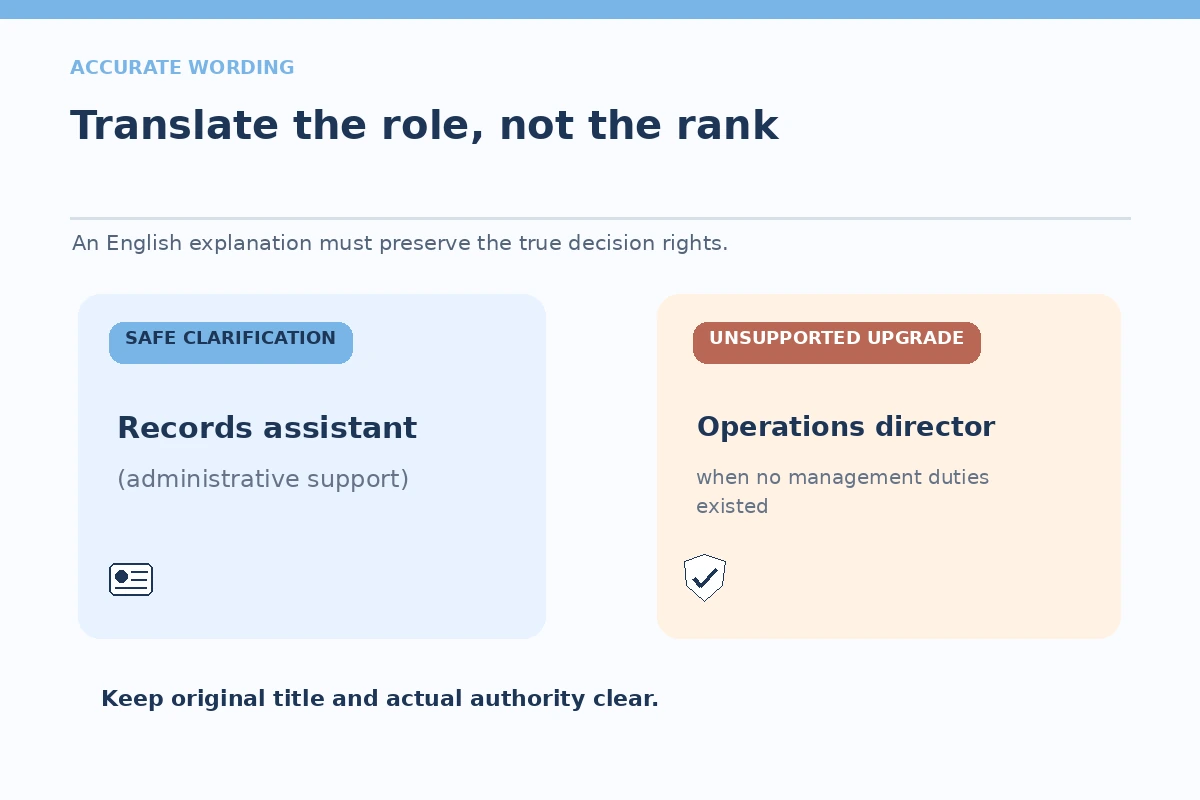
A literal title translated from another language may sound unusual to U.S. employers. You can retain the original title and add a short functional explanation, such as “Team Records Assistant (administrative support),” if that accurately reflects what you did. Do not translate a junior support job into “manager,” “engineer,” “registered nurse,” or another title with a different authority or licensing implication. Duties provide the context for titles that do not map neatly.
If the position was a government civil-service rank or occupation with a country-specific meaning, describe the work and reporting relationship plainly. Where licensing matters, report the issuing jurisdiction and actual status rather than claiming a U.S. license by analogy. The employer’s application and any regulated profession requirements determine whether independent credential review is needed; a resume word choice cannot establish recognition.

Write accomplishments for readers unfamiliar with the workplace
Country, employer name and dates alone do not show your contribution. Explain what you produced, checked, coordinated, maintained or handed over. Oregon State University career guidance on international experiences similarly emphasizes accomplishments and skills rather than merely the place. For example, a hypothetical candidate might write, “Maintained shipment exception logs and prepared handover notes for the next shift.” That is useful in many countries because the workflow is recognizable.
Avoid unsupported claims that unfamiliar operations were “world class” or that a translated department was a Fortune 500 subsidiary. Define an unfamiliar system by function, not by invented equivalence to a popular U.S. brand. When figures matter, state only verified units and dates. Do not silently convert currencies or measurement units in a way that changes what the original record meant; if conversion is genuinely necessary, state that it is approximate and identify its basis.
Separate employment from study and short programs
A paid job abroad belongs under employment history when it meets your normal work-experience standards. A study-abroad course, observational visit, volunteer program or classroom exercise may belong elsewhere, with a label that makes its nature clear. This avoids turning a field trip into employment or an academic assignment into client work. American University and other career services distinguish employment, internships, volunteer positions and education experiences.
If you completed a supervised international internship, identify it as an internship and describe what you personally did. A translator or editor can help make English readable, but you still need to check every action verb for accuracy. “Assisted,” “prepared under supervision” and “approved independently” are different claims. Retain the wording that matches the role you actually held.
Handle dates, references, and evidence consistently
Use month-year dates consistently throughout a U.S. resume unless an employer requests a different format. For overlapping jobs in different countries, do not hide overlaps; state part-time or concurrent work if that clarifies the timeline. Avoid importing the local convention for day-month order where a U.S. reader could interpret it ambiguously. Name the country separately from the employer so the hiring team can see the context immediately.
If a former employer is no longer operating, do not erase that history or invent a replacement. Keep legitimate personal records, references you have permission to list, and public employer details that may help explain the role. Never attach other employees’ private files or proprietary contracts. On a reference form, use accurate contact details and note time-zone differences only where useful; an international reference may have a different calling schedule.
Test the entry against the job posting
Read the required tasks for the U.S. role and select two or three genuine examples from the international position. A records coordinator may stress version checks and handoffs; a customer-facing candidate may stress explaining policies and documenting issues. Do not claim that foreign credentials automatically transfer or that the employer must count years abroad in a particular way. Requirements and recognition processes can vary by role and jurisdiction.
Read the final resume as if you have never heard of the previous employer. Can you identify where the job took place, what kind of organization it was, what your position meant, what you did, and what evidence supports the claim? If so, the entry can stand on its merits without a defensive paragraph about working abroad. Clarity, not concealment, is the practical target.

How We Research Resume Work Experience
JobAsk reviewed these public career and occupation references on November 4, 2026: CareerOneStop: Work Experience (CareerOneStop guidance on employer names, locations, dates and relevant achievements). American University: Resume Guidance (American University career guidance on experience entries, locations, dates and audience expectations). Oregon State: International Experiences (Oregon State University guidance on explaining international skills and accomplishments rather than merely listing a place). These explain typical resume practices and job duties; they do not establish any applicant’s real employment history, certifications, or hiring outcome.
Every example and diagram is illustrative. Replace sample actions, employers, months and duties with facts you can verify from your actual work, and recheck each job posting before tailoring an application. For editorial and commercial context, read our affiliate disclosure. This article does not claim a paid referral relationship or guaranteed resume screening result.
More Resume and Cover Letter Guides
No. Relevant, genuine employment can be listed. Give location, dates, title and specific work evidence so the reader understands its value.
Yes, when the translation preserves the actual role and level. Add a short functional explanation if needed, and avoid upgrading professional credentials or authority.
No. Use the employer’s real city and country. Application forms may request further details, which you should answer accurately.
No. Any license, registration or credential recognition depends on the specific profession and jurisdiction; report your actual issuing body and status.
Only if useful and supportable. Keep the original currency and clarify an approximate conversion with a stated basis rather than asserting a made-up amount.