
Procurement assistant interviews often move beyond general teamwork questions to ask whether you can compare supplier information accurately, track requisitions, and communicate changes before a delivery becomes a surprise. Prepare answers that show the difference between gathering a quote and approving a purchase. A good example names the request, the fields checked, the discrepancy found, and the person who made the final decision. Below are sample questions for U.S. procurement support roles; they are examples, not a universal interview script.
Explain how you would compare supplier quotes
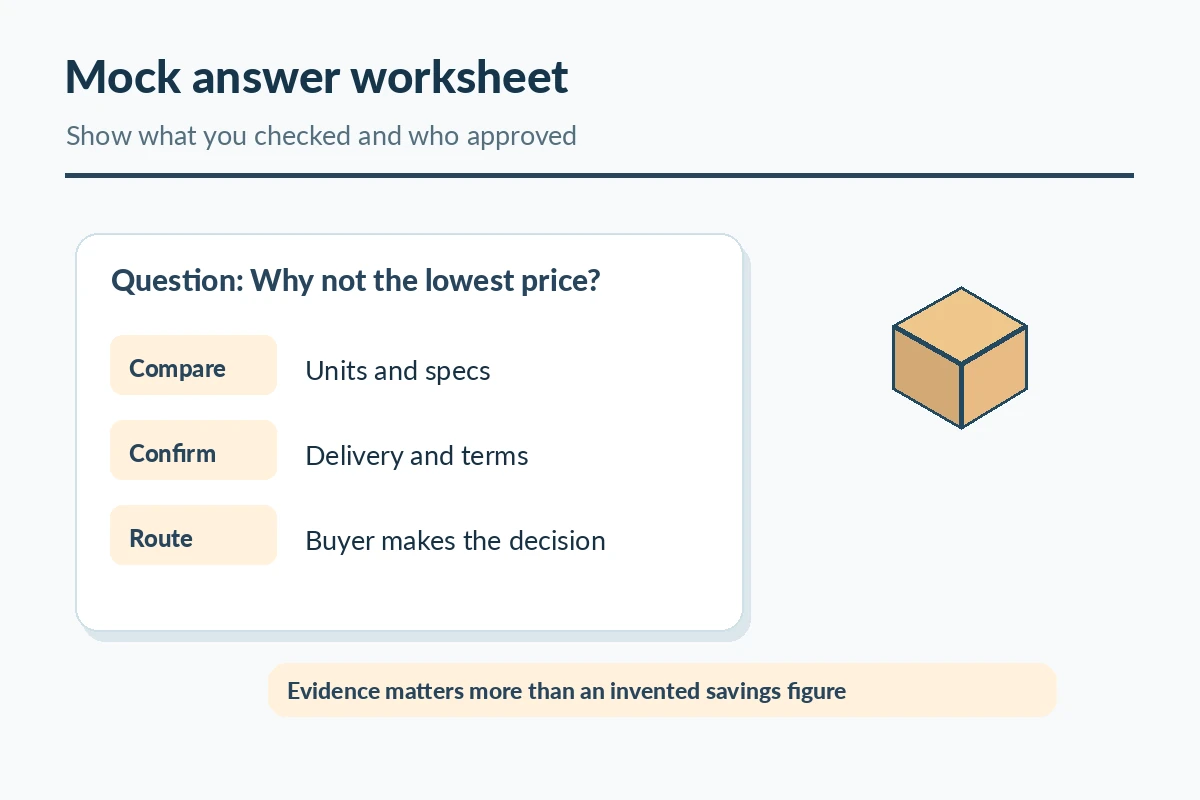
An interviewer may ask, “Three suppliers quote different prices. Which one would you recommend?” Avoid choosing the lowest number before checking comparable quantities, specifications, shipping terms, lead times, and validity dates. In a hypothetical practice table, one supplier quotes a box and another quotes individual units; comparing prices without a common unit is misleading. Describe how you would record differences clearly for the authorized buyer. If the job includes selection authority, ask how the company’s approval rules work instead of assuming it comes with the assistant title.
Try this answer: “I would verify the item and units first, then put delivery dates and included charges in the same comparison sheet. I would flag missing details, contact the supplier only through the approved process, and present the options with unresolved questions to the purchasing lead.” It is a process answer, not a claim that you personally negotiated contracts. Replace the invented scenario with a real school purchasing exercise or administrative example if you have one.
Handle an incomplete requisition request
“What would you do if a department requested equipment but left out its specifications?” is a realistic support question. A sound answer starts by checking the request against known catalog details and the organization’s requisition policy. Ask for the information needed to identify the item; record who clarified the details and when; and avoid ordering a substitute without authorization. When quantities or dates are unclear, explain the ambiguity instead of interpreting it as approval to proceed.
Show that you understand the difference between data entry and source validation. You might have checked part numbers, item descriptions or delivery addresses in a previous office role. That is relevant, even if you never issued a purchase order. Say specifically what you checked and which employee finalized the request. Interviewers are evaluating whether your recordkeeping reduces preventable confusion, not whether you can improvise financial authority that you do not hold.

Respond to supplier delays without promises
A common prompt is, “An essential order is delayed. What are your next steps?” Start by verifying the actual order reference and latest confirmed delivery status. Record the supplier’s update in the approved tracking system and identify the business team affected. Escalate time-sensitive consequences to the requester or purchasing owner; do not promise a revised date to another department until the information and any needed approval are confirmed. If the supplier suggests a different item, treat that as a proposed change requiring review.
A useful hypothetical response: “I would confirm which order is delayed, check the current expected date, ask the supplier for a documented update, and notify the team that owns the deadline. I would present alternatives for authorized review rather than switch products myself.” Do not claim that the delay disappeared or that savings were achieved unless you can substantiate the actual outcome. The strongest action is often keeping the right people informed before they make an incorrect plan.
Give a behavioral example of catching an error
“Tell me about a time you caught a detail others missed” invites a STAR response. Use a true situation from office support, inventory, logistics, or coursework. Describe a mismatch such as quantity, item code, due date, or delivery address, and how you spotted it. State how you communicated the issue and the real result. There is no need for a dramatic percentage, supplier name, or invented dollar amount. Focus on the check you actually performed and the permission to correct or escalate.
For example, in a plainly labeled classroom simulation, you might compare a request form with a sample quote, notice that two item units differ, and ask the instructor to confirm the intended unit before completing a draft comparison. This proves attention to detail in coursework, not professional procurement experience. If you describe paid work instead, state the employer-approved process without disclosing confidential bids or contract terms. The evidence must match your resume.

Discuss purchase orders and approval limits
You may be asked what belongs on a purchase order. The precise fields vary by system, but common elements include vendor identity, item description, unit and quantity, delivery destination, price terms and reference to approvals. Explain that you would compare the draft with the authorized requisition and keep a record of updates. Do not assume that a clerk can approve bills or negotiate prices simply because O*NET lists these activities within a broad occupational category; actual delegation depends on the employer.
When the interviewer asks about a purchase that seems outside policy, describe the control rather than an aggressive confrontation. Document what appears inconsistent, stop any unapproved action within your scope, and bring the issue to the purchasing owner. Show that you understand the audit trail: the original request, any changes, the person approving them and the final status. An interview answer that emphasizes clear records and calm escalation is more credible than claiming flawless compliance across unfamiliar systems.
Ask useful questions about procurement workflow
At the end, ask which team approves substitutions, who owns supplier selection, and what tools track requisitions from request through delivery. You might also ask whether the role mainly supports inventory, services, or capital equipment, because the evidence you should emphasize will differ. These questions reveal that you understand procurement is a controlled process, not simply shopping at the lowest listed price. Avoid asking for confidential supplier contracts or internal pricing during the interview.
If you have not used the employer’s platform, say what adjacent systems you know: spreadsheets, ticket queues, or approved purchasing portals. Be precise about your level of use. Ask what training is available for a new assistant and how exceptions are documented. It is better to demonstrate an adaptable checking method than to promise you can master every proprietary workflow instantly or authorize terms that require formal delegation.
Build a five-minute procurement mock interview
Practice three prompts without reading: compare two quotes with unlike units, clarify a requisition with missing fields, and communicate a supplier delay. For each, follow a simple sequence—check the source, record the difference, obtain clarification, and route a decision to the owner. Have one real evidence example that shows when you caught an error or maintained a tracking log. If your example is academic, label it as academic; if it was team work, explain your contribution.
Before the interview, read the posting again. Procurement assistant may describe an order tracker in one company and a buyer with spending authority in another. Tailor the examples and prepare two questions about scope. Do not make up purchases, contract wins or savings figures to sound experienced. The interview goal is to show how you keep decisions traceable while giving colleagues accurate information when schedules or requirements change.
How We Research Role-Specific Interview Questions
We checked guidance from U.S. university career centers on practicing interviews and using evidence-based answers, then compared it with O*NET occupational descriptions and, where relevant, official agency guidance. The questions and responses are illustrative; they are not actual employer interview transcripts, hiring tests, or promises of employment. Duties, permissions, and training vary by employer and setting. Adapt each response to genuine, nonconfidential experience and verify the job posting.
Sources checked November 10, 2026: careerservices.fas.harvard.edu; careers.uw.edu; www.onetonline.org. Read our affiliate disclosure for editorial relationship information.
More Interview Preparation Guides
No. Compare specifications, units, shipping and delivery requirements, then follow the employer’s selection and approval process.
Yes. Identify it clearly as a hypothetical or coursework exercise and describe the actual work you completed.
Talk honestly about adjacent tasks such as checking fields, tracking requests or compiling records and describe what you need to learn.
Record the proposed change and route it for the appropriate review instead of treating it as automatically approved.
No. Titles and delegated authority vary. Explain what decisions you made personally and what required a buyer or supervisor.