
Operations assistant interviews often ask how you keep routine work moving when several people need updates at once. Prepare evidence of checking priorities, maintaining a shared schedule, and writing a handoff that tells the next person what is still open. A strong answer does not claim that you ran the entire operation. Instead, it explains how you distinguished an urgent problem from a normal request, identified the responsible person, and preserved accurate information. The examples below are hypothetical unless specifically described as a real experience you can replace them with.
Answer the competing-priorities question
“Two managers both say their request is urgent. What do you do?” is an opportunity to show judgment without pretending that urgency is a personal popularity contest. Explain how you clarify deadlines, customer or safety impact, dependencies and the owners of each request. Identify any task that truly cannot wait, then communicate the conflict to the person who can set organizational priorities. If your authority is limited, do not secretly change the work order and hope no one notices. A brief shared status note can prevent both managers from believing their request is already underway.
Try a hypothetical response: “I would ask what deadline and consequence each request carries, confirm what is already committed, and flag the conflict to the operations lead. I would update the task board with the decision and notify both requesters of the next action.” This is not a guarantee that every deadline will be met. In your real example, describe exactly which inputs you used and who approved the revised sequence; never invent an efficiency improvement figure.
Explain how you verify schedule changes
An interviewer may ask about a last-minute meeting, delivery or staff change. Describe checking the source of the update, the affected people, existing constraints, and whether a coordinator must approve the change. Then say where you record the confirmed schedule and how you communicate only the final, authorized version. When a meeting moves, a calendar edit alone may not reach everyone who depends on the room, equipment or handoff. A responsible assistant checks the downstream effect rather than simply dragging an event to a new time.
A good example could come from school events or volunteer work. Perhaps a room became unavailable and you circulated the newly confirmed location after receiving an organizer’s approval. Show the original conflict, your verification step, the message you sent and how you checked that the relevant group got it. If you only proposed the change, say “suggested” rather than “scheduled.” Do not imply that you controlled staffing or business-critical commitments if you assisted the person who did.

Describe a handoff that another person can use
“How do you make sure a task does not fall through the cracks?” calls for a specific handoff structure. Include the request or task ID, current status, next action, owner, deadline or dependency, and location of the approved supporting information. Avoid a note that merely says “pending” without explaining what is pending. For privacy-sensitive operations, include the reference and approved access path rather than copying confidential files into messages. The next shift should know what is open and what not to redo.
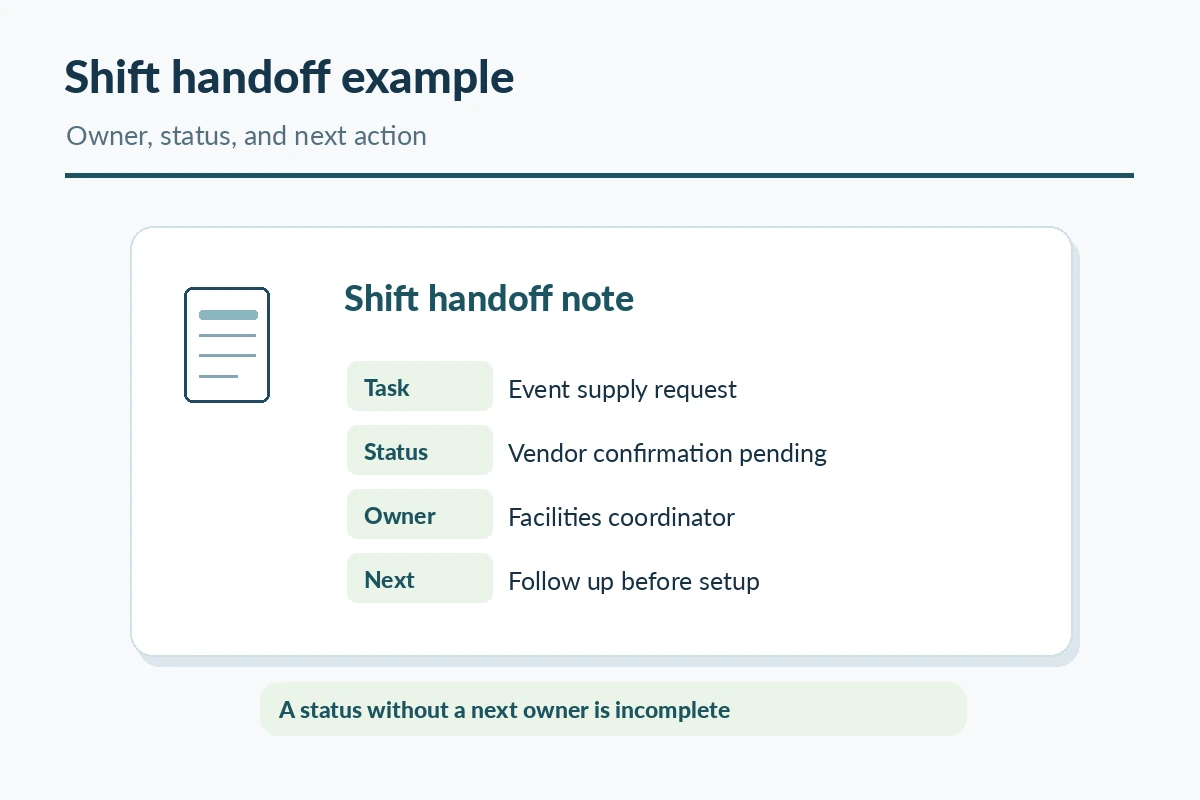
A hypothetical sample is: “Event supply request: vendor confirmation pending; facilities coordinator owns the next check; follow up before tomorrow’s setup; latest approved list is in the shared operations tracker.” This is illustrative, not a real workplace receipt or guaranteed delivery. In an interview, narrate how you kept the status current, flagged any change and let the next person ask clarifying questions. The result may simply be a clean handoff, not an invented performance metric.
Show how you learn an unfamiliar workflow
An interviewer may ask which systems you know. Name the actual scheduling, ticketing, spreadsheet or document tools you have used and what you did in them. A support role can involve many systems, and learning the relationship between them matters as much as memorizing brand names. Describe how you keep a small workflow note during training, check an existing procedure, and ask for feedback before editing critical shared records. Do not pretend that using one calendar makes you an administrator of every operational platform.
Behavioral example: “When our student project moved to a new task board, I reviewed the instructions, practiced on a sample task, and asked the coordinator to confirm the status labels before updating the live board.” That is a reasonable hypothetical answer if labeled as such, but it must not be represented as paid experience. With an actual workplace example, explain your responsibilities and any limits on access. The interviewer should hear an honest learning process, not a promise that errors will never occur.

Practice escalation without passing blame
“A task is blocked because another team has not responded. What do you do?” Start with facts: what was requested, when, by whom and how the lack of response affects the schedule. Send a specific, courteous follow-up through the right channel, noting what decision or file is needed. If the delay threatens a committed milestone, alert the task owner early. Do not label another team incompetent, change their deadline without approval, or report a block as complete merely to make the dashboard look green.
In a STAR response, spend most of the time on what you did personally. Perhaps you organized a list of missing inputs, arranged a short clarification call, and updated the owner as information arrived. If the final result depended on a manager, credit that manager with the decision. Your role can still be valuable: reducing ambiguity, maintaining the work trail and making sure the next person understands the status. Avoid fake counts of tasks saved or hours recovered.
Choose thoughtful questions for the employer
Ask what the operations assistant owns versus what requires approval, which shared systems are used, and how priority conflicts are resolved. Consider: “What is the normal handoff between shifts or teams?” “Who decides when a customer request interrupts planned work?” and “What would good task documentation look like in my first month?” Such questions connect to real work, unlike vague promises that you can handle unlimited simultaneous demands.
A posting may use “operations” for a small front-office workflow, a warehouse desk, or a multi-site team. Read the duties carefully and avoid assuming you will operate equipment, schedule employees, approve purchases, or access sensitive data without training. If the role has shift coverage, ask how changes are confirmed and where urgent information goes when your supervisor is unavailable. Keep your examples in the operational setting relevant to that employer.
Rehearse a short priority-and-handoff exercise
Make three fictitious tasks on paper: a routine report, a meeting room conflict, and an order that is missing essential details. Explain which facts you would check before declaring the order of work. Draft one handoff note with owner, status and next action. Then answer aloud what you would do if a manager challenges your priority decision. The right practice answer acknowledges the manager’s authority and updates the record; it does not become defensive.
Finish by preparing one true example about organizing tasks, one about communicating a change, and one about learning an unfamiliar process. Keep examples specific enough to be useful without revealing employer information. The key distinction is between “I can prioritize everything alone” and “I can keep the right information visible while the authorized owner decides.” That distinction often makes an entry-level operations answer more believable and more useful to the hiring team.
How We Research Role-Specific Interview Questions
We checked guidance from U.S. university career centers on practicing interviews and using evidence-based answers, then compared it with O*NET occupational descriptions and, where relevant, official agency guidance. The questions and responses are illustrative; they are not actual employer interview transcripts, hiring tests, or promises of employment. Duties, permissions, and training vary by employer and setting. Adapt each response to genuine, nonconfidential experience and verify the job posting.
Sources checked November 10, 2026: careerservices.fas.harvard.edu; careers.uw.edu; www.onetonline.org. Read our affiliate disclosure for editorial relationship information.
More Interview Preparation Guides
Compare consequences and dependencies, then ask the designated lead to resolve the conflict. Communicate the agreed order and document it.
Yes, if you identify it as student or volunteer work and describe the specific scheduling or coordination you personally handled.
The task reference, status, next action, owner, relevant deadline and approved location of supporting information.
No. State which changes you can coordinate and when a supervisor or task owner must approve revisions.
Discuss analogous tools you have used honestly and explain how you would learn the employer’s status codes, access rules and escalation path.