
Project coordinator career goals should focus on the reliability of project information: what is due, who owns it, what is blocked, and when a decision must be escalated. Coordinators often prepare updates and follow up on actions, but that does not mean they control budgets, approve scope changes, or promise delivery dates. Build your plan around a specific workflow—such as a milestone register, action log, or weekly status note—and a reviewer who can tell you whether the information helps the team. This makes your growth visible without crediting yourself for decisions or outcomes owned by project leadership.
Choose one project tracking responsibility
Begin with actual tasks from your assignment. You may manage meeting schedules, maintain an action register, request status from workstream leads, or prepare a draft report. O*NET describes milestone monitoring, project documentation, and stakeholder communication as relevant project activities; these are not proof that every coordinator is a project manager. List which items you update and which require someone else’s decision before building a development goal.
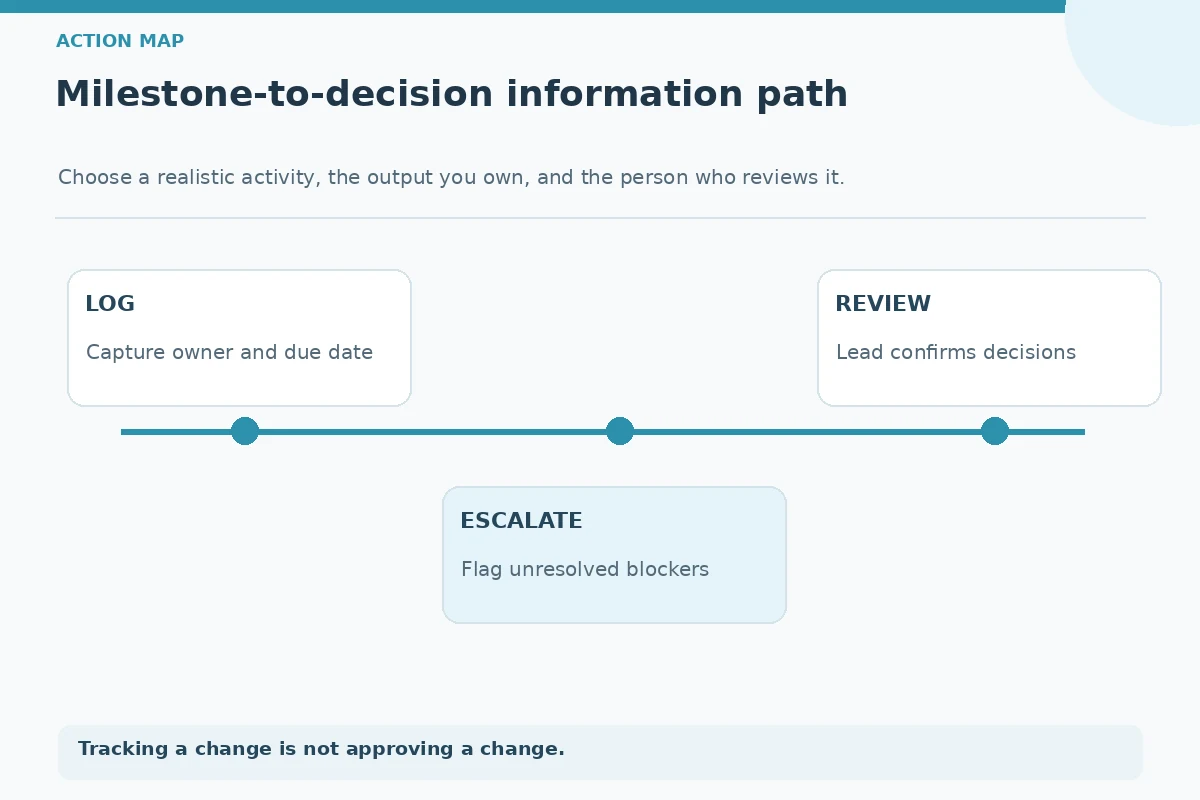
Illustrative objective: “For the next two project cycles, maintain an action log for my assigned workstream, check due dates with task owners, and bring unresolved blockers to the project lead before the weekly review.” It records your activity and the intended handoff. Do not invent a claim that the log reduced delays. Ask the lead to specify what counts as a blocker and which deadlines the coordinator is allowed to change.
Make milestone updates readable and testable
A milestone update should identify the deliverable, agreed owner, target date, current evidence, and any dependency. Avoid coloring an item green simply because someone has not complained. Check what the project considers accepted evidence and whether a status entry has been verified. When progress is uncertain, write “pending owner confirmation” rather than quietly estimating completion as fact. An accurate unknown is more useful than a fabricated precise percentage.
Choose a formatting improvement: standardize status labels, keep decisions in a separate field, or note the timestamp of a status confirmation. Ask stakeholders whether the update helps them decide what to do next. A good milestone is one sample update reviewed by the project lead and revised for clarity. The goal is information quality, not claiming the entire project was delivered on your schedule.
Learn the difference between a risk and an issue
A risk describes a possible future problem; an issue is a problem affecting the work now. Your project method may define specific terms, so follow the team’s framework. A coordinator can document early warning signals, request an owner, and escalate a decision; the project manager or authorized lead may decide the response and accept the trade-off. A growth objective can require timely, well-formed escalation rather than promising no project problems will occur.
For a practical exercise, create a fictional scenario in which supplier information is missing. Write the possible effect on a deliverable, the responsible person to contact, the evidence available, and the decision needed. Then compare that note with the real team’s preferred escalation format. Do not include confidential vendor rates or internal disputes in public examples, and do not describe a simulated exercise as a real project result.
Improve stakeholder updates without over-communicating
Different readers need different levels of detail. A task owner may want one blocked action and its due date; a project sponsor may need the decision, impact, and options summarized. Ask the project lead what information you should share with each audience. Set a goal to write two versions of a status update based on the same approved source, then check whether dates, owners, and risk labels match across versions.
The goal is not sending more email. It is reducing ambiguity about who needs to act. If a meeting produces decisions, record them in a decision log after confirmation, using exact owners and dates. Where sensitive personnel, contractual, or client information appears, stay inside the authorized distribution group. Your records should make handoffs auditable without creating an unofficial source of truth.

Practice change-control handoffs correctly
Project changes can affect scope, cost, schedule, or required approvals. A coordinator may collect the proposed change and its rationale, attach supporting documents, and route it to the appropriate authority. That is different from agreeing to the change on behalf of the team. Record the submitted version, decision owner, and approved outcome. If a sponsor rejects the request, preserve the actual decision and notify affected owners through the approved channel.
A developmental goal could be to prepare a change-request packet using the organization’s template and receive feedback on missing fields. Resist writing “approved scope changes” unless you genuinely held that authority. Learning the decision path is a valuable capability even when your role remains administrative. The same principle applies to budget reports and procurement requests: reporting a figure is not authorization to spend.
Build a project evidence portfolio safely
Save lessons about the process rather than copying live confidential documents. With approval, a portfolio could contain a fictional milestone tracker, a blank escalation template, or a sanitized communication matrix. Do not publish unreleased plans, internal project names, supplier disputes, or customer data. When writing a performance summary, describe the artifact you created and how it was reviewed. Use a count only if it is a true, shareable count.
A credible example is “Maintained the issue and action register for an assigned workstream and prepared weekly updates for project-lead review.” This states scope, output, and supervision. It does not claim you led the entire project or saved money. If you want to move toward a project manager role, ask which planning and decision tasks you can observe or practice with approval before declaring yourself ready.
Set a learning cadence across project phases
A practical timeline follows the work: confirm responsibilities during initiation, improve a recurring log during execution, practice escalation when a blocker arises, and reflect during handoff or closeout. Choose one review conversation at each meaningful stage rather than a rigid schedule that ignores the project. OPM’s individual development plan structure can help record the skill, activity, support, estimated date, and feedback, even outside government work.
Close the cycle by reviewing the output with the manager: Which information was consistently useful? What decisions were delayed because the request was unclear? What responsibility could you take on next with appropriate training? Updating the goal after a project pause or change is not failure. It is a more honest record than marking a milestone complete because a calendar date passed.

How We Research These Career Development Goals
We reviewed occupation-specific primary sources and professional-development guidance, including www.onetonline.org; www.opm.gov, on November 4, 2026. We distinguish typical occupational tasks from what any one worker may actually do. All sample goals are hypothetical and need adaptation to employer policy, supervision, privacy obligations, and available training. JobAsk may offer independent informational resources; see our affiliate disclosure for the site-wide policy. This article provides career-planning information rather than a guarantee of promotion, certification, or a particular performance outcome.
Explore Related Career Guides
Improve one recurring project artifact—such as a status report or action log—and get the project lead to review it.
Use the project’s approved completion criteria and decision owner. Updating a tracker does not grant final acceptance authority.
Show that you recognized a potential blocker, documented evidence, and escalated it to the appropriate person.
No. Training can build methods, but it does not prove you managed scope, budget, or stakeholders in a real assignment.
Use approved sanitized materials or fictional process examples. Never expose employer, client, or vendor confidential information.