
Individual contributor career goals do not have to end in managing people. You can become more capable by handling harder technical problems, improving a repeatable process, making documentation easier to use, or helping peers understand a practice you already know. The key is to define an outcome within your role and show your contribution without implying you control hiring, performance ratings, budgets, or strategic decisions. This guide offers three growth directions—specialist depth, process quality, and peer enablement—and a planning method for employees who want meaningful development while staying on an individual-contributor track.
Define growth separately from promotion
Start by writing what you want to do more skillfully: analyze a difficult case, produce clearer work, reduce handoff confusion, or teach a repeatable method. A job title change is one possible result, but it is not a useful substitute for a learning objective. The OPM individual development plan model separates developmental goals, learning activities, and review dates. That distinction helps even when your employer does not use formal IDPs.
Talk with your manager about whether your organization has a specialist path, skill levels, or assignments that require deeper judgment. Do not assume every company has a dual career ladder. If no specialist promotion structure exists, you can still plan a competency and artifact you want to build. Phrase success as demonstrable development rather than a promise of compensation, rank, or prestige.
Build specialist depth with reviewed work
A depth-focused goal is valuable when you can identify a recurring type of problem and learn to handle it with fewer unexplained assumptions. Examples include drafting a better technical analysis, improving a research method, validating a routine dataset, or creating a more accurate troubleshooting guide. Select a mentor or reviewer familiar with the task. Record what you learned from corrections instead of claiming mastery after one exercise.
An illustrative goal is “Complete two reviewed case analyses in my assigned domain and write down the questions my reviewer raised.” There is no universal requirement that two is enough; the number simply makes the learning activity observable. The deliverable matters more than a label such as “subject-matter expert.” Do not share proprietary analysis outside work or imply an internal reviewer authorized public distribution.

Improve a system before trying to lead a team
Process-focused growth can involve cleaner handoffs, reliable checklists, accessible documentation, or error-reporting routines. Choose a workflow where you have permission to propose an improvement and where someone can assess the result. An individual contributor can collect examples and recommend a revision without becoming the person who approves company policy. That difference allows meaningful influence without inventing management responsibilities.
For example, you might document a recurring mismatch between two team forms, write a proposed field guide, and test it with the process owner. The real deliverable is a reviewed draft and the feedback received. If the change is not adopted, do not call it an implemented organizational improvement. Record what you learned about constraints such as tool access, accessibility, training time, or another team’s responsibilities.
Offer peer support without claiming supervisory authority
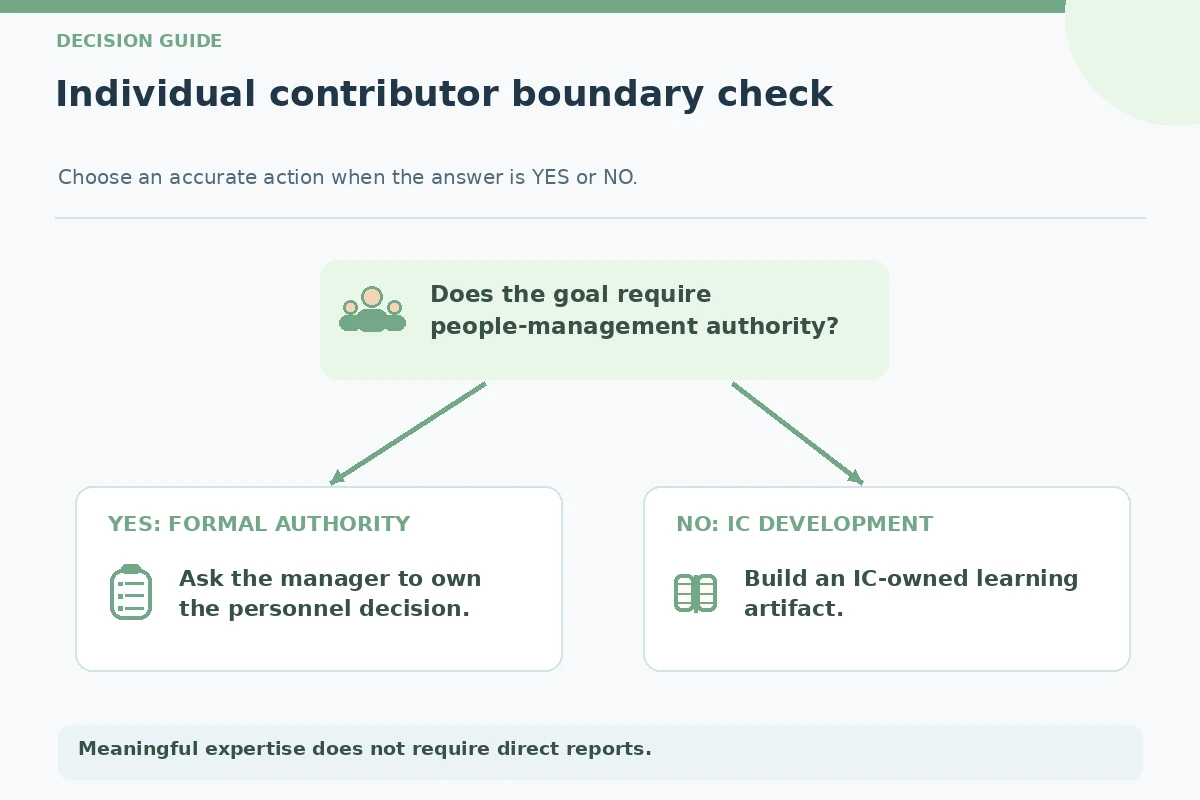
A helpful individual contributor may explain a tool, share approved documentation, pair on a difficult task, or review an example. Those actions differ from conducting performance evaluations, setting another employee’s targets, or promising formal training sign-off. Ask the team lead where peer help is welcome and which subjects require a qualified trainer. Keep feedback supportive and work-specific rather than treating it as an unofficial personnel record.
Illustrative goal: “Draft a one-page reference for an approved workflow, walk two volunteers through it, and revise the guide based on their questions.” Participants and counts are examples, not outcomes to copy as historical facts. If you are not allowed to train on safety-critical or regulated tasks, choose general documentation instead. Respect the learner’s schedule, confidentiality, and choice to ask a supervisor.

Explore career interests without jumping blindly
When you are unsure whether specialist, operations, creative, or analytical work fits, begin with a small test rather than an irreversible career claim. The O*NET Interest Profiler, available through My Next Move, is one tool for exploring interests. It does not certify aptitude, guarantee a suitable job, or replace examination of actual working conditions. Compare interests with your current skills and the duties you enjoy doing repeatedly.
Choose a small approved project or learning activity that represents the new direction. A documentation specialist considering analysis might review a sample dataset and discuss the assumptions with an analyst; a technical contributor considering mentoring might prepare a safe tutorial and request feedback. Afterward, record which tasks felt meaningful and what foundational skills were missing. A choice to remain in your existing specialty is still a legitimate conclusion.
Collect evidence without manufacturing results
Evidence for growth includes approved work samples, reviewer feedback, corrected procedures, or records of training undertaken. Keep confidential customer, colleague, and employer data in its authorized system. Say exactly what you contributed: “drafted the checklist” is different from “owned department policy.” If you cannot verify an impact number, write the practical improvement and review received rather than claiming it saved a made-up percentage of time.
A simple development log uses four fields: learning action, work artifact, feedback, and next step. Review it periodically with the relevant person. Be explicit when an example is hypothetical, and avoid reusing your organization’s restricted documents in a portfolio. Development evidence should help you answer questions about your own work, not create a public archive of internal information.
Request support without asking to manage people
A productive conversation can be concise: “I want to deepen my expertise in this workflow rather than move into direct supervision. Could we select one reviewed assignment and agree on what stronger independent contribution looks like?” If the manager expects leadership development, distinguish mentoring and cross-team coordination from formal personnel authority. Ask what progression actually exists before choosing a title-based goal.
Close by setting a review date and recording one support item, such as training access, a reviewer, or permission to shadow a specialist. The plan may lead to an expert role, a more complex assignment, or better results in the same position. None is guaranteed. A sustainable career goal is one you can actively practice, evaluate, and adjust while remaining honest about your scope.
How We Research These Career Development Goals
We reviewed occupation-specific primary sources and professional-development guidance, including www.opm.gov; www.mynextmove.org; www.onetonline.org, on November 4, 2026. We distinguish typical occupational tasks from what any one worker may actually do. All sample goals are hypothetical and need adaptation to employer policy, supervision, privacy obligations, and available training. JobAsk may offer independent informational resources; see our affiliate disclosure for the site-wide policy. This article provides career-planning information rather than a guarantee of promotion, certification, or a particular performance outcome.
Explore Related Career Guides
Yes, you can develop specialist, process, or mentoring skills. Formal advancement paths vary by employer.
Create a reviewed work artifact, document feedback, and use it to improve the next attempt. Use numbers only when they fit the task.
No. Sharing knowledge does not automatically include performance appraisal, disciplinary authority, or official sign-off.
State the contribution you want to increase and propose a development activity, instead of framing the choice as lack of ambition.
Seek a defined learning assignment or process improvement in your existing role and discuss what opportunities actually exist.