
Teacher professional development goals work best when they name one aspect of instruction you can improve, describe a manageable classroom action, and specify evidence you can review without exposing student information. Instead of promising that every student will reach an arbitrary score, choose an instructional practice—such as checking for understanding, improving lesson transitions, or collaborating on accessible materials—and agree with a coach or supervisor on how to observe progress. The examples below are hypothetical starting points, not school-district mandates. District policy, grade level, student needs, and approved assessment practices should shape your final plan.
Start with one teaching practice you can observe
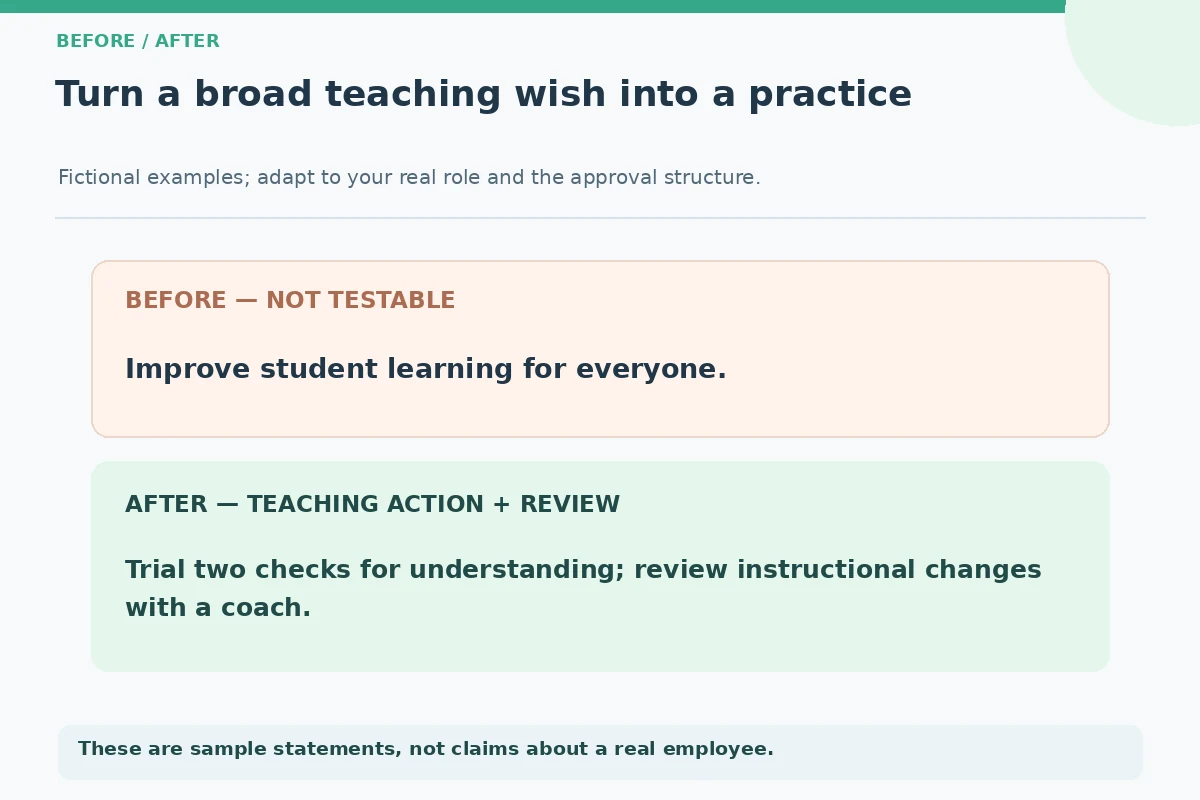
Select an instructional behavior within your control, not a sweeping promise about student achievement. A teacher might want to vary checks for understanding during a lesson, simplify directions for small-group work, or build a more useful exit-ticket routine. O*NET describes lesson planning, evaluation, adapting materials, and professional collaboration as possible duties; the specific plan should match your classroom assignment. Write down the present routine first so a reviewer can tell what you intend to change.
Illustrative goal: “For the next six weeks, use two brief checks for understanding during the weekly lesson selected with my coach; record the adjustment made after each check.” The target is a teaching action and reflection cycle, not a guaranteed grade increase. Establish a realistic observation schedule and confirm that the planned method fits the curriculum. If your school already has a professional growth template, use its terms rather than inventing a parallel performance system.
Use student work carefully as instructional evidence
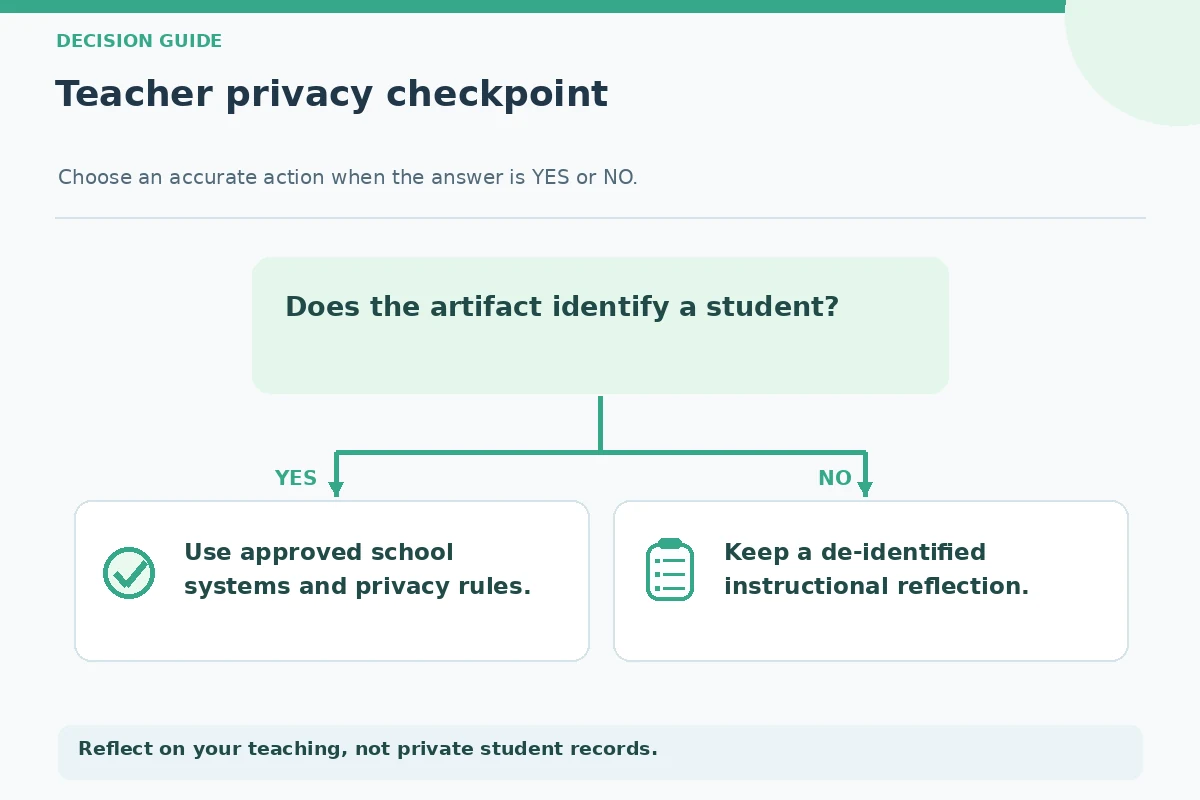
Teaching evidence can include a lesson-plan revision, a blank assessment rubric, a record of strategies tried, or a de-identified summary of what you noticed. Samples of identifiable student work and individual scores may be protected records; do not upload them to personal portfolios or share them outside approved school systems. The Department of Education explains that FERPA provides protections concerning personally identifiable information in education records. Your district determines the appropriate data practices and approved tools.
A useful reflection can say “Students needed another model of the procedure, so I replaced the next warm-up with a guided example.” That statement shows a reasoned instructional response without quoting private records. If you discuss trends, follow school policy for aggregation and minimum group sizes. Ask an authorized supervisor how to document work safely; a personal spreadsheet with names is not automatically a suitable professional development log.

Pair feedback with an actionable practice change
Request focused observation rather than general praise. For example, ask a colleague to note how often directions required a second explanation, or ask a mentor to comment on the clarity of a lesson objective. Agree on the focus before the observation and use the school’s normal observation and privacy rules. Feedback can be recorded as a short note about the instructional move, not as a judgment about individual students. Plan one trial change after the observation instead of ten simultaneous changes.
For a team-based goal, choose a defined collaboration task: co-design one formative assessment, compare approaches to vocabulary scaffolding, or jointly review an accessible lesson template. Make it clear which part you own and what colleagues must approve. An example goal is to bring one revised lesson plan and one reflection to each monthly grade-level planning meeting, subject to the team agenda and administrator approval.
Turn a course or workshop into classroom application
Professional learning is useful when the plan specifies what will happen after the session. “Complete a training on questioning techniques” is an activity, not proof of changed instruction. Add a classroom trial, a mentor discussion, and a revision after observing what occurred. Keep attendance records separate from artifacts demonstrating use. When a course introduces a new digital tool, check district technology, accessibility, and student-data approvals before bringing it into a lesson.
Use a three-part entry: training objective, approved classroom application, and review artifact. For instance, after a reading-support workshop, a teacher may prepare two differentiated practice tasks, discuss them with the assigned specialist, and revise them after teacher reflection. Do not advertise an endorsement or credential the training did not actually award. A course certificate may document attendance; it does not automatically license someone for a specialist role.
Choose realistic milestones and review dates
A semester-long plan can include an initial classroom baseline, a small pilot, feedback, and one review meeting. Avoid setting an exact student score target without understanding district policy and the factors outside your control. The individual development plan approach described by OPM is useful as a planning analogy: define the goal, development activity, estimated date, and feedback partner. It does not replace a school or district evaluation system.
Example timeline: in week one, select a practice and obtain approval; by week three, trial it in a selected lesson; by week six, review teacher-created artifacts with a coach; by the term’s end, decide whether to continue, revise, or discontinue the practice. Treat the schedule as illustrative. An unexpected classroom need, curriculum change, or staffing issue can justify revising dates openly rather than recording a task as complete when it was not.
Describe growth without guaranteeing student results
When you write a performance-review note, separate the action, the observation, and the next decision. A strong version says, “Introduced an exit-ticket check in selected lessons, reviewed patterns in approved classroom tools, and revised two warm-ups after mentor feedback.” That is more defensible than “raised every student’s achievement” without documented causal evidence. Do not attribute all changes in class performance to one intervention; attendance, prior knowledge, and other supports can matter.
If the pilot did not work well, record the constraint. Perhaps exit tickets took longer than the allotted time, or instructions needed an accessible format. State the corrective action and request the next resource. Professional development is not only a showcase of successes; careful reflection about an unsuccessful trial can demonstrate good judgment. Leave individual student identities, diagnoses, and disciplinary details out of public-facing materials.
Prepare a supervisor-ready development conversation
Bring a short document with the proposed practice, reason for choosing it, available support, expected artifact, and review point. Ask: “Does this align with our current instructional priorities?” and “What evidence can I use under our student-data rules?” Those questions are more useful than asking for a broad promise of advancement. If the goal needs dedicated training, scheduled observation time, or specialist input, name the resource before agreeing to a deadline.
Close the discussion by recording what was actually approved. A developmental goal may not be the same as a formal evaluation target, and schools differ in how they connect professional learning to appraisal. Confirm the appropriate process with the district. Keep your private planning notes separate from any official evaluation record and revisit the goal when classroom conditions or the assigned curriculum change.
How We Research These Career Development Goals
We reviewed occupation-specific primary sources and professional-development guidance, including www.onetonline.org; www.opm.gov; studentprivacy.ed.gov, on November 4, 2026. We distinguish typical occupational tasks from what any one worker may actually do. All sample goals are hypothetical and need adaptation to employer policy, supervision, privacy obligations, and available training. JobAsk may offer independent informational resources; see our affiliate disclosure for the site-wide policy. This article provides career-planning information rather than a guarantee of promotion, certification, or a particular performance outcome.
Explore Related Career Guides
Choose one teachable routine, trial it with mentor feedback, and keep an approved reflection artifact. Do not promise learning outcomes beyond your control.
Do not disclose identifiable student education records without the required authority. Use approved, privacy-preserving examples and follow district policy.
No. The practice and review point should be observable, but a fabricated or unsupported score is worse than a clear qualitative reflection.
Only if your actual goal is attendance. For an instructional growth goal, document a relevant classroom trial and reflection as well.
Follow school or district policy, particularly when activities involve observations, new technology, student data, or resources.