
Moving from property management to facilities coordination can make sense if your best work involves organizing maintenance requests, documenting vendor handoffs, tracking service status and communicating building issues. The move does not automatically carry over authority over budgets, safety decisions, building systems or contractor approvals. Compare the actual job descriptions, separate lease-related work from facilities operations and prepare examples that explain your coordination role precisely.
Separate property decisions from building operations
Property management can involve leasing, resident issues, ownership reporting, collections and maintenance arrangements. Facilities coordination may involve work orders, access logistics, inventory, planned maintenance, contractor visits and internal occupant communications. Some organizations combine these duties; others split them across property management, facilities managers, building engineers, security staff and external vendors. A title alone does not show which team owns a task.
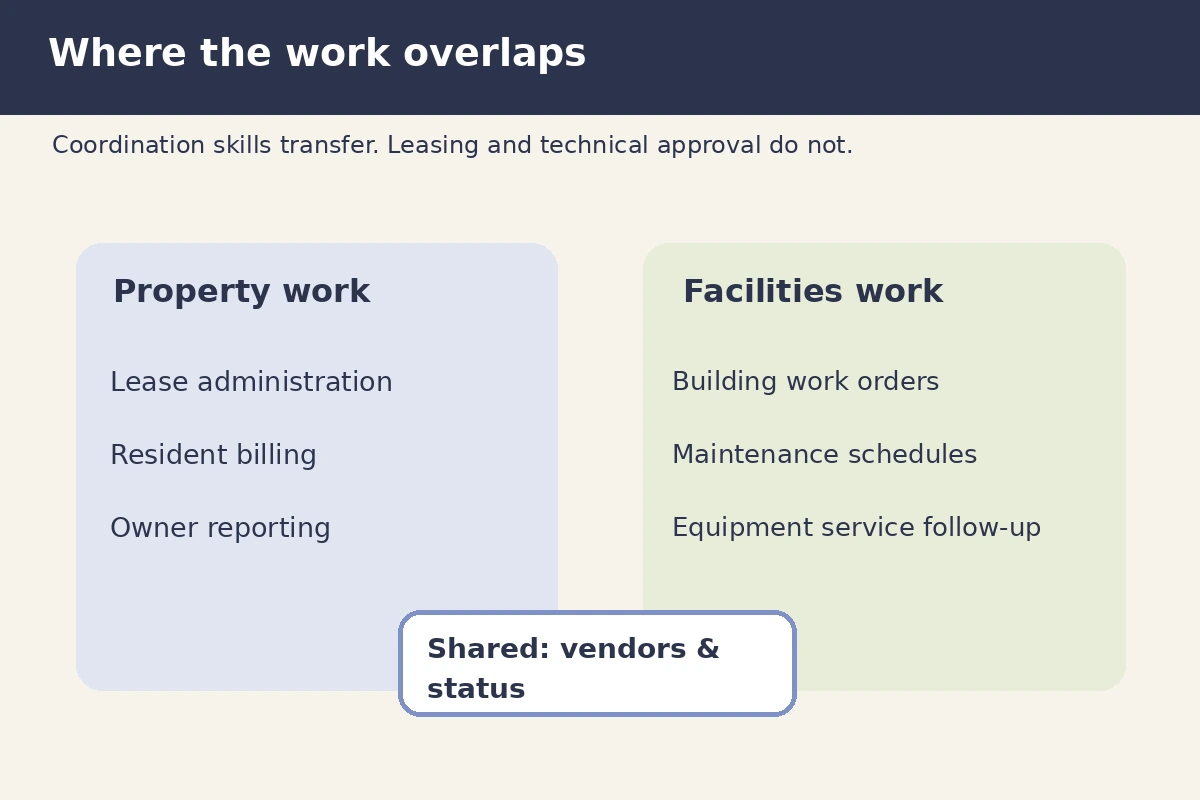
Draw a boundary chart from vacancies you are considering. Put tenant applications, rent collection and lease enforcement on the property side; equipment service scheduling, space requests and maintenance records on the facilities side; put contractor communication and status follow-up in the overlap. For each item, note who is authorized to approve the next step. This helps you describe transferable work without claiming that you performed technical repairs.
Identify the maintenance workflow you can prove
Describe how a legitimate issue came into your queue, which information you checked, what procedure defined its priority, which team you contacted and how you updated the requester. Useful records may include ticket category, location, asset, access instructions, assigned vendor and completion confirmation. You can explain this as a workflow without revealing residents’ personal information or a company’s building-security details.
A careful résumé bullet might read, ‘Coordinated maintenance requests with approved vendors, kept status records current and confirmed closeout with onsite staff.’ Use only the actions that match your own history. Do not call yourself a licensed technician, safety inspector or contract approver unless those qualifications and authorities are genuine. The relevant skill is reliable coordination, not an inflated job title.

Respect the difference between urgency and authorization
A facilities employee may receive an urgent report such as water near electrical equipment. The correct response depends on site-specific emergency plans and training. A coordinator should follow the organization’s emergency notification and access procedures and alert authorized personnel rather than inventing a repair or asking an untrained occupant to handle electrical systems. In a fictional interview example, state what you would report and whom you would contact.
For routine requests, confirm that the location and scope are clear, verify available access arrangements, route work to the approved team and update the status as new information becomes authorized. Avoid promising a completion date that a technician or vendor has not confirmed. A good handoff records uncertainty, dependencies and ownership instead of disguising every open issue as resolved.
Prepare a sample work-order handoff
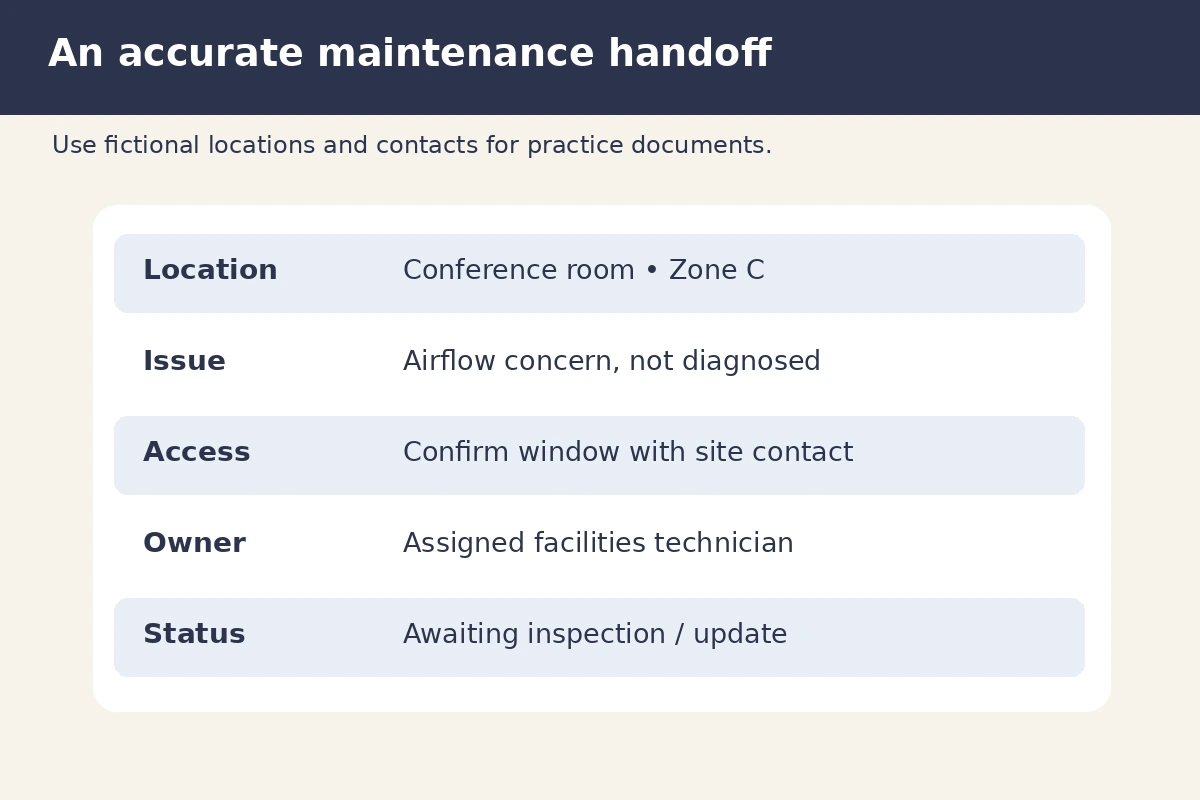
Create an invented service request with fields for building zone, issue description, requester contact route, urgency category, equipment identifier if applicable, vendor assignment, next checkpoint and completion evidence. Keep each field short and make the responsible party obvious. Where a decision depends on an inspection, include ‘awaiting technician review’ rather than inventing a safety clearance.
The sample should demonstrate how you prevent work from disappearing between teams. For example, a hypothetical meeting-room ventilation complaint might require confirmation of the room, schedule, access window and contact for status updates. You would not diagnose an HVAC fault from a message alone. Include a visible escalation point for findings beyond your role.
Research the credentials and systems employers request
Some facilities roles are administrative, while others involve building systems, licensed trades, emergency planning or substantial budgets. Check advertised requirements for computerized maintenance management systems, building access rules, vendor purchasing, inspections and specialized certificates. Never assume property management experience replaces a trade license or employer-required safety training. Ask whether system access and training are provided during onboarding.
If you have used a property ticketing platform, explain the functions you know—request intake, assignment, status updates and reporting—without renaming it as a facilities system you have never seen. To close a software gap, practice with fictional tickets or a freely available demo when permission allows. Show that you understand the workflow before describing any technology as mastered.
Tell a convincing interview story
Choose a real incident where several people needed a coordinated handoff. Explain the reported problem, which facts you verified, the approved contact you used, the follow-up you scheduled and how the outcome was confirmed. If your role was to chase a vendor update, say so. Do not claim that you personally repaired the equipment or approved invoices that belonged to a manager.
Ask the interviewer how the facility distinguishes urgent incident reporting from routine service tickets, who approves vendor work, and how success is measured for the coordinator. Those questions help reveal whether the position is largely scheduling, occupant support, purchasing, safety administration or technical operations. Match your examples to that actual mix rather than a generic idea of facilities work.
Choose an achievable first facilities role
Shortlist positions such as facilities coordinator, maintenance scheduler or workplace services assistant only where the stated requirements fit your experience. For a manager-level opening, investigate the additional expectations around budgets, contracts and building systems. Compare one posting from each employer rather than assuming the same title means the same work.
Before applying, remove any resume language that implies unauthorized safety certification, contractor selection power or engineering judgment. Prepare an anonymized description of one real handoff and one fictional work-order template. Keep confidential building access information out of both. The strongest career-change story is that your coordination skills are already tested and you know exactly where new training is needed.
How We Research Career Transitions
We compare published U.S. occupational task descriptions with the practical workflow differences in each transition. The examples above are fictional unless explicitly described as duties the reader should verify from their own experience. O*NET profiles describe occupations broadly, not every employer’s position; BLS descriptions and the employer’s vacancy provide further context. Review date: November 10, 2026. We do not imply that a transferable skill substitutes for a required credential, a hiring decision, or authorization to approve technical, medical, legal or personnel matters.
Sources reviewed November 10, 2026: www.onetonline.org (O*NET property managers oversee property operations, maintenance, budgets and communications with residents, owners and contractors.) www.onetonline.org (O*NET facilities managers coordinate building systems, safety, repair operations and space planning, with varied authority by role.) www.bls.gov (BLS discusses facility operations including building maintenance, safety, contracts and organizational coordination.). This is independent informational material, not a promise of employment or paid placement. See the JobAsk affiliate disclosure. The exercise templates and interview lines are illustrative, not an employer-approved process.
Explore Related Career Guides
Often it overlaps in maintenance scheduling, vendor communication and status tracking. The degree of overlap depends on the facility, systems, technical duties and employer-specific decision authority.
Some coordinator roles emphasize administration, while others require trade knowledge or qualifications. Read the actual vacancy and never claim a credential you do not hold.
Avoid sharing resident information, building access details, vendor pricing or internal records without authorization. Use a fully fictional workflow example instead.
Follow site rules and refer technical or safety decisions to authorized personnel. Coordination of a ticket is not proof of expertise in equipment repair or inspection.
Ask who owns triage rules, approves vendor work and signs off completed repairs; the answer defines the coordinator’s actual scope.