
Remote property management assistant jobs usually center on communication and tracking rather than owning or visiting buildings. Possible duties include logging maintenance requests, updating vendor schedules, organizing documents, and routing resident questions to authorized staff. Verify whether the role handles leasing, payments, emergencies, or applicant screening, because these activities can have different authority and legal requirements. An advertisement marked “remote” still may require local property knowledge, specific hours, or a licensed manager’s oversight.
Identify work suited to remote property support
Many property tasks require coordination between residents, maintenance vendors, onsite personnel, and managers. An assistant may receive a work-order request, confirm the unit identifier, categorize the issue under a written procedure, notify the assigned coordinator, and update the ticket after receiving a completion report. Other roles involve answering routine inquiries, preparing documents, scheduling approved inspections, or organizing rent ledger questions for a manager. O*NET describes property managers’ broad responsibilities; an assistant’s job is a narrower subset that depends on the employer’s staffing model.
Distinguish a coordinator from an independent property manager. The assistant may pass along an authorized lease document but not necessarily negotiate terms, determine tenant eligibility, set rent, or approve expenditures. State requirements for real-estate or property-management activities vary, and the vacancy should identify when licensing is required. Look for the reporting line, process for escalating emergencies, and whether field staff handle physical inspections or repairs. If the employer expects you to personally open properties or meet residents, it is not purely home-based work.
Search companies, property firms, and verified job pages
Useful queries include “remote maintenance coordinator property,” “property management virtual assistant,” “remote leasing administration assistant,” and “property operations support work from home.” Review official careers pages of legitimate property management firms, community association services, or building operations providers. A listing on a broad board may omit state eligibility or a field-service component. Find the original posting, confirm the company and requisition, and note the properties’ time zone, after-hours coverage, and escalation expectations.
Do not confuse a contractor advertising “remote property management” with an employee opening. Ask who hires and pays you, whether work is for one portfolio or many clients, and what technology and training are supplied. Some scams misuse property names or promise easy rental commissions; verify independently through the property company rather than sending identity information through a chat invitation. The FTC warns job seekers to research the real organization and avoid fees or fake equipment checks.

Build a maintenance ticket example with clear ownership
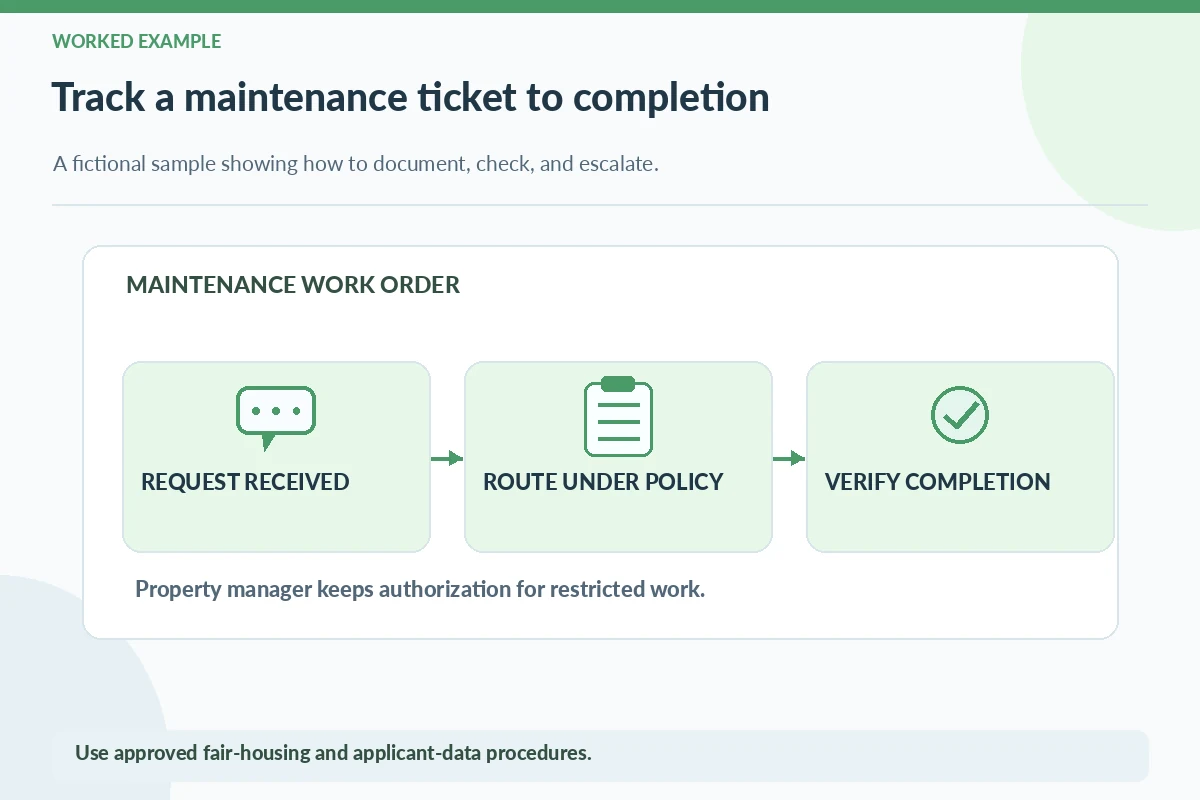
A hypothetical workflow: a resident submits a nonemergency leak report. The assistant logs the request, checks which information is missing, follows the documented routing rule, contacts the authorized maintenance scheduler, and updates the case after confirmed vendor feedback. The assistant does not diagnose the leak, promise an unapproved repair, enter the property, or authorize a payment outside assigned rights. Serious safety concerns follow the employer’s emergency escalation protocol, not a generic online checklist. Use this illustration to understand the process, not as a claim that you have handled resident incidents.
In your application, connect that structure to your real experiences. For example, a help desk worker might have documented service tickets and verified completion with a customer. An office coordinator might have scheduled contractors and maintained records. Explain the specific software, how requests were prioritized, and who approved the action. If you have never worked with rental agreements or tenant data, identify that gap. Do not imply a customer-service ticket qualifies you to make binding leasing decisions.
Check fair housing and applicant-information boundaries
Housing-related work intersects with fair housing protections. HUD explains that the Fair Housing Act prohibits housing discrimination based on protected characteristics, including race, color, religion, sex, disability, familial status, and national origin. An assistant handling applicant emails or marketing materials should follow an approved, nondiscriminatory process and seek manager or legal review when a request is unclear. Never assume you may independently screen applicants, change the stated criteria, or disclose an applicant’s private information.
Ask the employer how it controls applicant records, rent ledger access, service histories, and vendor contact details. If asked to send documents from your personal email or to use your home phone for emergency calls, clarify the approved tools and boundaries. Do not describe a protected characteristic as a “preference” in marketing or invent a rule about who may rent. Worksite laws and licensing requirements can vary across states; the role description and qualified local guidance must govern actual tasks.
Compare fictional assistant and manager job listings
Imagine a remote posting to monitor a portfolio’s maintenance queue, check vendor appointment status, and report unanswered resident messages. This is support coordination: the output is an accurate log and a timely handoff. Another hypothetical posting asks a remote employee to negotiate leases, authorize contractor work, and make final screening decisions. That is materially broader, possibly regulated work requiring greater authority and experience. A job seeker should not treat both roles as interchangeable simply because both are advertised as “remote property management.”
For the first role, a relevant resume sentence could be “Maintained work-request records, confirmed appointments with the assigned vendor team, and escalated unresolved cases to a supervisor,” if truthful. For the second, an applicant should check licensing, authorization, and required experience before applying. When you see a vague description, request specifics about approval limits and who communicates final decisions to residents. Do not provide a portfolio of real resident complaints or addresses as an interview attachment.
Create a practical pre-application review
Confirm the company’s official posting, approved location, schedule and on-call duties, the portfolio type, property software, team roles, and any field visits. Mark each task as coordination, recordkeeping, communication, decision, or onsite work. Ask who can approve expenditures, respond to emergencies, discuss lease terms, and handle applicant screening. Prepare a concise, genuine ticket-tracking example and a statement about secure document handling rather than promising to manage buildings independently.
After applying, note the requisition, employer URL, location requirements, contact, and follow-up date. In an interview, ask how work orders move from resident request to confirmed completion and how the remote assistant knows a case is closed. If the role involves housing rules or state licensing, refer to the employer’s procedures and qualified local sources rather than making a blanket legal assertion. The best application shows you can keep records moving while respecting the real decision owner.

How We Research Remote Work Responsibilities
We reviewed primary occupational, regulatory, and consumer-protection sources from onetonline.org; hud.gov; consumer.ftc.gov on November 4, 2026. The practical job-search workflows and sample records here are illustrative, not real job offers, professional advice, a certification, or a promise of employment. Requirements vary by employer, jurisdiction and actual duties; verify official postings and ask the decision owner when a task exceeds your authority. No paid relationship with these organizations is claimed. Read our affiliate disclosure.
Related Job Search Guides
Some coordination roles can, but other positions require property visits, resident meetings, or local after-hours coverage.
That depends on the jurisdiction and duties. Verify with the employer and relevant state authority.
Only when the employer has expressly authorized that person and amount through its procedures.
Do not assume so. Follow the authorized screening process and applicable fair housing requirements.
Real service-ticket tracking, scheduling, vendor communication, careful records, and appropriate escalation can be relevant.