
An undergraduate research CV should document your actual research preparation and scholarly record, even if that record contains no journal articles. Begin with your education and the research roles or course-based projects most relevant to the program. Identify methods, supervisor or course context, and your contribution. Then separate posters you truly presented, manuscripts with a real submission status, and ordinary class papers. A CV can be longer than a job resume when appropriate, but length is not an accomplishment; accurate authorship and precise research status are the real strengths.
The following examples are hypothetical writing models, not a record of any actual applicant. Replace tools, roles, dates, outputs, awards, and measurements with evidence from your own coursework or employment. Never use a credential, title, or result that you cannot explain and verify.
First decide whether the application expects a CV or resume
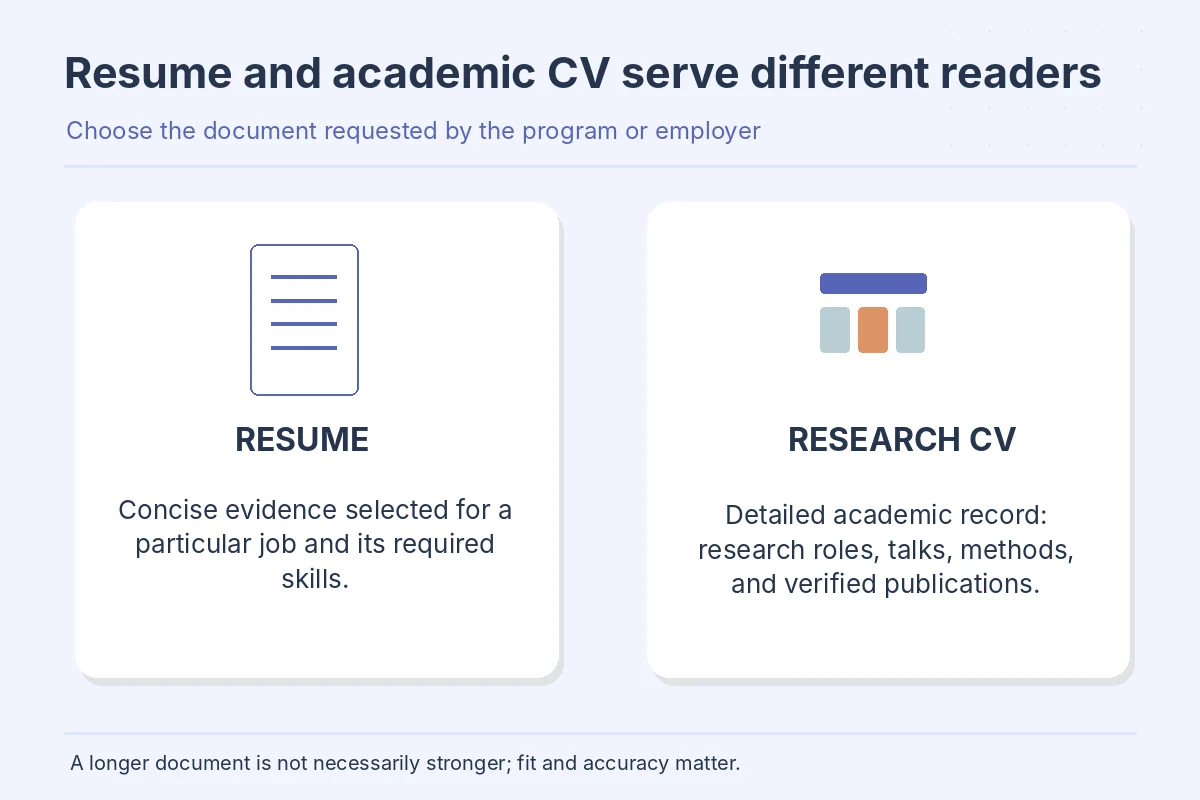
Academic research posts, fellowships, and graduate programs may request a CV, while an industry internship may prefer a short targeted resume. Penn Career Services distinguishes the CV’s academic record from a resume’s concise role-based evidence. Read the exact submission instruction rather than using a long CV for every employer. If the application accepts either document, ask what the reader needs to see: detailed research history, methods, presentations and citations, or only the strongest practical skills. Keep both versions sourced from the same truthful master record.
Open with exact degree and research affiliation
Give your school’s official name, degree status and date, major or concentration, and meaningful academic honors. If a role was in a faculty lab, use the actual lab or department, supervisor when appropriate, your title, and month-year dates. If the work happened only within a class, label the course or class project rather than assigning yourself an unrelated “research assistant” job title. Academic CVs may include more precise course or thesis information than a general resume, but this extra detail should help the reader understand your involvement rather than inflate your status.
Describe methods with contribution and scope
A research entry should answer what problem the team or course investigated, what you personally did, what method or tool you used, and whether the work produced a verifiable output. The hypothetical line “Organized coded observations for an instructor-led behavioral study and checked a sample of records against the coding key” demonstrates action without claiming to be the principal investigator. Where a project used sensitive participant or sponsor data, describe the procedure broadly and honor the sharing rules. Do not disclose identifiers, unpublished methods, or collaborators’ confidential files just to make your CV seem detailed.
Treat a class report differently from a publication
An assignment submitted to a professor is a meaningful piece of scholarly writing, but it is not automatically a peer-reviewed publication. A manuscript drafted by a team is not “published” because it exists on a drive. Use labels that reflect the verified stage: class paper, manuscript in preparation, formally submitted, accepted, or published. Penn recommends specifying publication status when relevant, and Oregon State provides examples of distinct publication stages. Confirm authorship and citation details with your supervisor before listing work under a Publications heading. Avoid implying editorial acceptance from a submission receipt.
| Research output | Where it belongs | Accurate status |
|---|---|---|
| Class term paper | Course Projects | Completed academic assignment |
| Presented campus symposium poster | Presentations | Poster presented, with verified event |
| Manuscript submitted to journal | Publications or Manuscripts | Submitted, not accepted |
| Published journal article | Publications | Cite published record and author order |

Credit poster presentations precisely
A poster displayed at a public student research symposium may fit under Presentations, with authors, full title, event, location or online format, and date. A draft poster created solely for class review should be described as a course project instead. If your research group presented a poster and you did not personally present, do not imply you gave the talk; list coauthorship or preparation accurately when permitted. Include only awards you actually received. A strong presentation entry clarifies what audience saw the material, not merely the visual polish of the slide deck.
Use sections that reflect real activity
An early undergraduate CV might include Education, Research Experience, Methods and Technical Skills, Presentations, Awards, and Relevant Leadership or Teaching. A Publications heading may be absent when there is nothing accurate to list. Another student with substantial fieldwork might lead with that research. The University of Connecticut provides undergraduate CV examples using separate technical skill categories; select categories that describe your own work, not a universal checklist. Avoid listing every tool you encountered in a lecture or every student organization you joined without a clear role.
Keep references, links and credit appropriate
Research applications may ask for references or recommenders separately from the CV. Do not publish someone’s contact information without permission; follow the instructions for the particular program. A link to an approved poster or public abstract can help verify a record, while an inaccessible private drive link adds little. Review author order, title spelling, event name, publication status and dates against official materials. When a manuscript or dataset is restricted, describe the contribution without leaking the material. The same principle applies to a thesis under review.
Two realistic before-and-after bullet examples
These examples illustrate a change in precision, not a claim about any real applicant. Do not paste the improved version unless the action, context, and scope match work you completed.
Before: Published pioneering research in class. After: Wrote a course research report and presented the analysis during seminar.
Before: Authored a journal article under review. After: Contributed to a coauthored manuscript submitted to a journal; status verified with the research supervisor.

Prepare a reviewer-friendly final CV
Use clear typography, consistent section dates, real academic titles and an uncluttered document. There is no need to stretch a first-year student’s CV to a fixed page count with filler. Check that every research activity is named by the organization that hosted it and distinguish independent projects from supervised assignments. Open exported PDFs to ensure characters and citation italics remain legible. Finally compare this CV to your targeted resume: the CV can carry more academic history while the resume should emphasize the strongest evidence for a single job. Neither document should promise admissions or hiring success.
How We Research and Verify Examples
We compared Penn STEM CV guidance, UConn undergraduate research materials, Oregon State research listing examples, and the University of Florida research CV resource. Examples are hypothetical; author order and statuses must be verified from original records.
Primary sources used in this guide: careerservices.upenn.edu — Penn explains when undergraduates use STEM CVs and how to list research and publication status.; ugradresearch.uconn.edu — UConn recommends organizing undergraduate research CVs with specific technical skills and credible experience.; career.oregonstate.edu — Oregon State explains how to present undergraduate research, posters and publication stages clearly.; careerhub.ufl.edu — University of Florida identifies research CVs as tools for graduate programs and academic opportunities.. Source pages were reviewed on November 15, 2026.
JobAsk explains its approach to commercial relationships and reader trust in its affiliate disclosure. This is independent career information, not a placement guarantee or a claim of affiliate approval.
More Resume and Cover Letter Guides
No. Leave it out until you have a verifiable entry; research experience and presentations can demonstrate valuable work.
Not automatically. Identify a class talk as coursework, and reserve conference or symposium labels for real events.
No. Submitted, accepted, in press and published refer to distinct verifiable statuses. Confirm the exact stage with the team.
A CV does not have a universal one-page rule. Include relevant academic evidence without padding, and follow the recipient’s instructions.
Yes. Label it as course-based research, describe the tasks you completed, and distinguish it from a paid or appointed laboratory role.