
Translation skills on a resume should answer three questions before anything else: which source language the applicant reads, which target language they write, and what kind of material they have actually translated. Those details reveal more than “bilingual” or “fluent translator.” A person may speak two languages comfortably without having experience producing professional written translations. Start with the specific job posting and name only the direction, domains, tools and review duties you can substantiate. Keep spoken interpretation on a separate line if the job asks for it and you have that experience.
The Bureau of Labor Statistics distinguishes translators, who work with written material, from interpreters, who work with spoken or signed language. It describes the need to preserve meaning, tone and cultural context, often with terminology resources and software tools. This occupational description helps explain the field but does not establish a candidate’s qualifications. A student who translated original short articles for a course can describe the exercise honestly. They should not claim certified legal or medical translation, court interpreting, or a professional credential simply because the source text used specialized words.
State the Language Direction and Subject Area
Write language direction explicitly. “Spanish to English translation” states something different from “English to Spanish translation.” Some candidates genuinely work in both directions; others have stronger writing proficiency in one target language. The resume should match the actual assignment history. Add a relevant subject area, such as software help text, public communication or general business correspondence, only when supported by real work. Do not infer specialized legal or clinical competence from general language fluency.
Terminology management can be a concrete skill. If you built a glossary, checked names and product terms against an approved reference, or resolved inconsistent wording with a reviewer, describe those tasks. A hypothetical bullet might read: “Prepared a Spanish-to-English translation of a student orientation guide, maintained a terminology list and revised phrasing after instructor feedback.” This is a classroom example, not paid client experience or a claim that an organization approved the final document. Precision about the audience and review cycle makes a modest project useful.

Distinguish Translation, CAT, and Post-Editing
Computer-assisted translation tools and machine translation are not the same thing. The BLS describes CAT tools as systems that use stored segments or translation memories, while machine translation produces automatically generated text that a person may review. List a named tool only if you have actually used it and can describe the task. If you revised machine-generated text, say “post-edited” when accurate rather than “translated from scratch.” If you used a glossary spreadsheet without a commercial CAT product, list terminology tracking instead of inventing a software proficiency.
A translation workflow can involve source review, terminology research, a draft, human revision and final approval. Who performed each stage matters. If another translator reviewed and released a client deliverable, the resume should credit your draft work and response to comments without claiming sole certification or sign-off. If you worked in a team on localization, identify the content you were assigned and how you handled strings, context or style constraints. Do not replace precise authorship with “managed localization” when you only edited a subset of text.

Show Real Review and Terminology Work
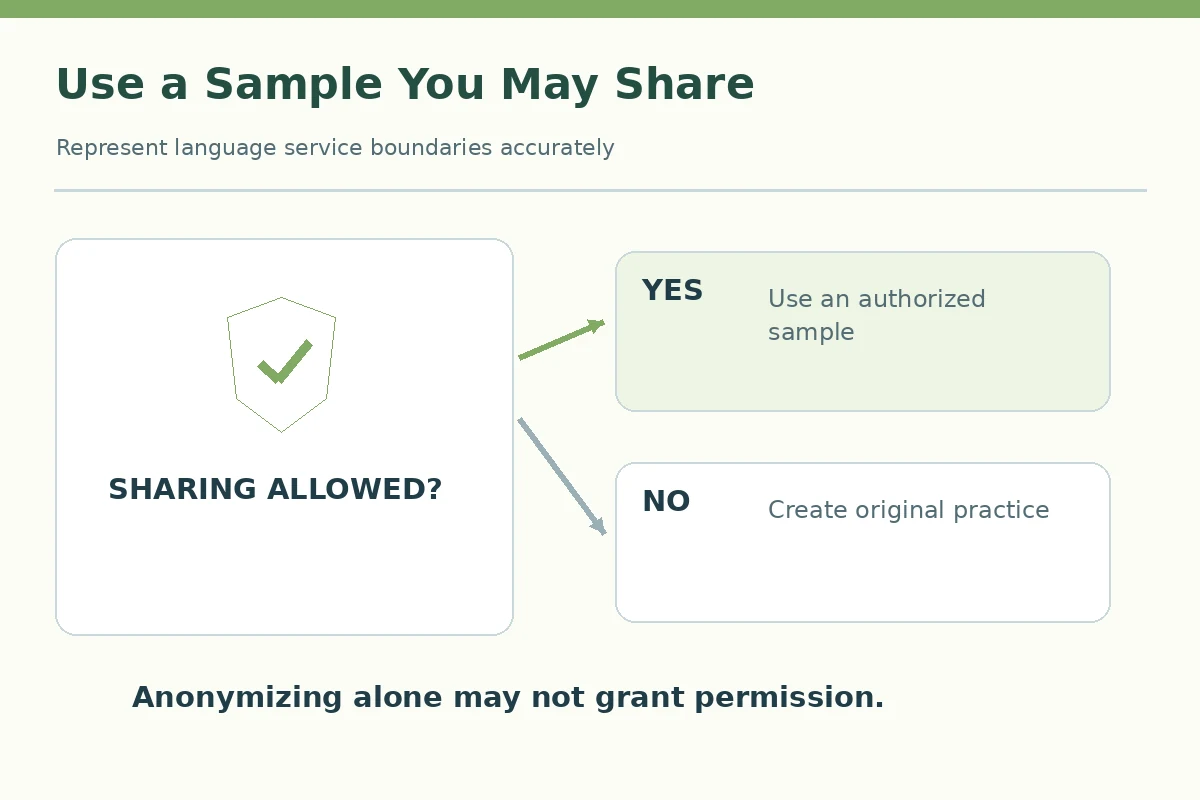
Confidentiality is a material part of portfolio decisions. Even when the translator wrote the target text, a client may control whether the source and translation can be shared. Do not reproduce private contracts, patient records, internal communications or unreleased documents in a public sample. Use an original text you own or material with clear permission, and label any sample as personal practice if it was not client-approved work. A portfolio caption should include direction, genre, your responsibility and whether the example is illustrative.
Credentials deserve a separate check. A course completion certificate does not automatically make someone a certified translator, and language ability tests may measure different capabilities from written translation. Name the granting body and precise credential only when it exists and is current as required. Some specialized jobs require particular certification or authorization; follow the employer and jurisdiction’s actual requirements. Do not put “certified” next to a language pair merely because a project was reviewed by a teacher.
| Evidence you have | Accurate resume treatment | Do not claim |
|---|---|---|
| You translated text from Spanish into English | State Spanish → English and genre | Bidirectional professional expertise |
| You edited machine output | Name post-editing and your review scope | All work was translated from scratch |
| Client material is under restriction | Use an original permitted sample | Anonymization always grants permission |
Protect Client Content in Work Samples
An accurate skills section groups work sensibly: language directions, subject areas, document types, terminology methods, CAT tools genuinely used and editing or quality-review tasks. Avoid one long row containing every language you can recognize. Where the target role is localization rather than standard document translation, identify actual experience with UI strings, context notes, glossaries or review tools. When the task is interpretation, describe the relevant spoken or signed mode separately; written translation samples do not by themselves demonstrate interpretation performance.
Employers may ask about volume, deadlines or error checks. Use real records when reporting word counts, number of documents or revision rounds. Avoid claiming a universal accuracy percentage without a clear method and reviewer data. A strong statement can show that you compared terminology with an approved glossary and resolved reviewer comments; it does not need an invented customer-satisfaction score. The resume should remain understandable to someone who does not use the same software as the candidate.
Check Each Skill Against Actual Evidence
Before submitting, check every language direction for accuracy, confirm the role type, test any portfolio links, and read sample permissions one more time. If a document is not authorized for sharing, remove it rather than obscuring a client name and hoping that is sufficient. Translators build trust by preserving the meaning of someone else’s work; a resume should reflect the same discipline by preserving the facts of the applicant’s own experience.
A bilingual applicant seeking a translation role may also have valuable proofreading or editing experience that is not itself a translated deliverable. Label that work separately. A resume that says “reviewed target-language terminology and corrected formatting” is clearer than one that calls all multilingual editing professional translation. The objective is to help a manager match the candidate to a real assignment with known direction and subject matter.
If you have no shareable professional sample, create a small original practice text and document the glossary decisions or editorial revisions you made. Never present a public machine-generated sample as a confidential customer assignment. Keep the source, target and role description together so reviewers know what to judge. Only list a software or certification name when you can produce truthful evidence for it.
How We Research and Check Sources
We checked the following authoritative references on 2026-11-14 for the specific occupational, assessment or resume-writing points described here: www.bls.gov — The BLS differentiates written translation from spoken interpretation and describes terminology and CAT-assisted workflows. careercenter.umich.edu — The University of Michigan Career Center recommends showing transferable skills through specific actions and work examples. www.onetonline.org — O*NET discusses translation, written material and related language-service tasks. Examples in this guide are hypothetical, not actual candidate test scores, qualifications, credentials, endorsements or employer decisions. Verify the current job posting and any institution-specific requirements before submitting. Read our affiliate disclosure for editorial transparency.
More Resume and Cover Letter Guides
No. State only the directions in which you can actually produce written translation and identify your real experience.
No. Translation is written-language work; interpreting concerns spoken or signed communication.
No. Software familiarity and a professional credential are different claims.
Not without the necessary permission. Prefer original or explicitly authorized samples.
Yes when you performed it. Identify the workflow rather than claiming you independently wrote every sentence.