
A remote e-commerce catalog assistant may review product names, SKU identifiers, measurements, approved images, category assignments, inventory notes, or publishing queues. The role is different from packing goods in a warehouse and different again from owning an online retail business. O*NET’s Online Merchants profile lists a broad range of online commerce tasks; no single catalog posting should be presumed to include all of them. Start by distinguishing product-content accuracy from pricing authority, inventory purchasing, order fulfillment, and customer refunds. The vacancy should specify the worker’s true part of that chain.
Look for product-data responsibilities in the posting
Search official retailer, brand, distributor, marketplace-service, or e-commerce agency careers pages for catalog operations assistant, product content coordinator, listing quality specialist, and merchandising data support. A credible listing names a system or workflow, explains what data must be checked, and says who reviews publication. ‘Boost product ratings and earn per click’ is not the same occupation. Record whether the post is fully remote, hybrid, region restricted, or linked to a physical distribution site. A warehouse shipping role cannot necessarily be done from home simply because orders arrive online.
Draw the line between a listing edit and a business decision
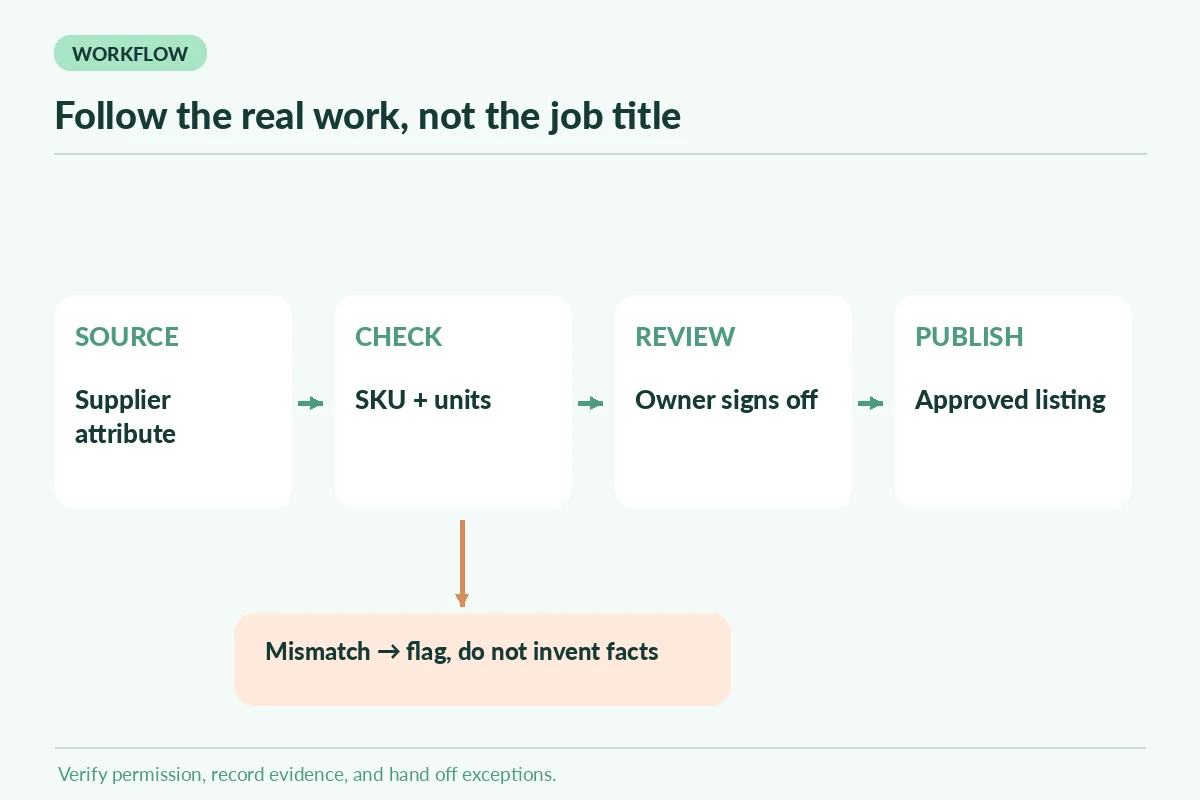
Correcting a typographical error in an approved description may be within a catalog assistant’s scope. Changing a price, declaring a product compliant, approving a refund, publishing a health claim, or placing a reorder can require a separate authorized owner. Ask who supplies source data and who signs off on exceptions. Never copy competitor claims into an official product page as if they were verified company facts. Use accurate verbs in applications: ‘validated attributes,’ ‘queued corrections,’ or ‘approved prices’ only when the last was genuinely your responsibility.
Make a safe product-attribute work sample
Build a fictional catalog of five everyday objects such as notebooks, reusable bottles, pencil cases, lamps, and desk organizers. Include SKU, title, size, material, image status, source reference, and exception flag. Deliberately add one inconsistent unit, one duplicated identifier, and one missing image permission; show a correction log for each. Label it a synthetic sample. Do not scrape an employer’s private supplier feed or upload real customer-order data. This demonstrates classification, tracking, and review without implying access to a commercial system you have never used.
Review how descriptions and images are approved
Ask where product descriptions originate, whether edits require trademark or marketing review, and how approved images are licensed and versioned. O*NET includes creating merchandise descriptions and uploading imagery among online merchant activities, but employee-level permission varies. A good workflow ties the live listing to a source record and an accountable approver. If an employer asks you to make unverified performance, safety, medical, or environmental claims, seek a documented review route rather than improvising language that might mislead customers.
Separate inventory updates from stock ownership
A catalog system can display available quantity, a reserved amount, incoming stock, and a product’s public availability. These may be driven by different applications and updated at different times. A remote assistant can flag mismatches and route exceptions, but should not promise replenishment or alter supplier purchasing without authorization. In a sample, show a stale stock count as ‘needs warehouse verification’ instead of asserting that the item is available. This distinction prevents a catalog worker from making claims that depend on physical inventory checks.

Watch for the product-optimization task scam
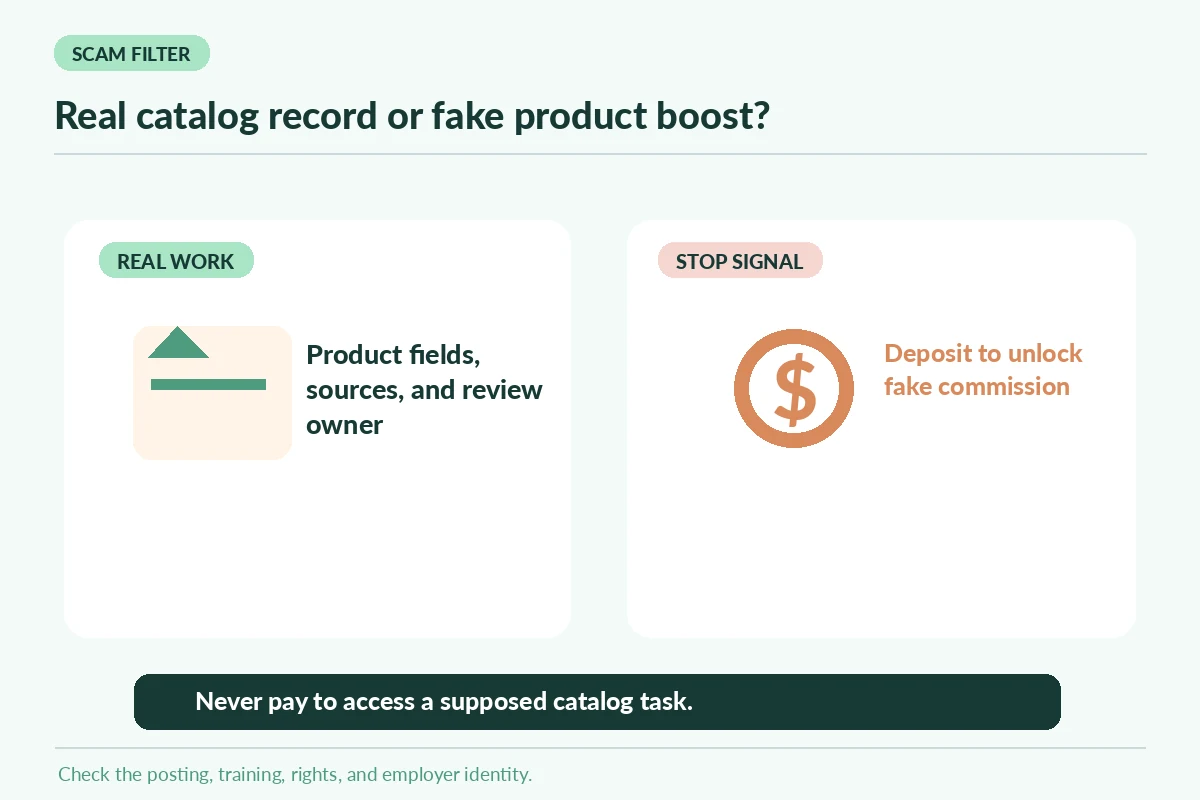
The FTC and FBI describe fake work-from-home jobs in which a supposed platform asks people to optimize products or ratings, displays growing fake earnings, and eventually demands that users deposit money, often cryptocurrency, before withdrawing commissions. A job that revolves around repetitive clicks, ratings, or ‘boosting’ rather than auditable catalog records is a serious warning sign. Do not transfer funds, buy credits, or provide wallet details to unlock another batch. Independently find the company’s real website and recruitment contact before sending documents.
Check customer access and payment permissions
Catalog jobs sometimes touch customer questions or order-status data, but not every worker needs account numbers, addresses, or payment credentials. Ask whether the position uses redacted data during training, who handles customer refunds, and what permissions are available to new hires. A request to use your personal bank account to process shop payments is not routine catalog support. Keep a written list of allowed actions and escalation paths, and use employer-provided systems only after verifying the hiring organization and security process.
Compare the training plan with the advertised tools
A realistic onboarding process shows the product schema, approved style guide, naming convention, catalog platform permissions, and route for exceptions. Ask how new hires validate variants such as size and color and how they catch differences between a supplier feed and a product page. Be cautious if an employer provides no quality standards yet promises unusually high earnings for random screen taps. Tool familiarity is useful, but do not describe a practice spreadsheet as professional experience with a specific proprietary platform.
Use a truthful application paragraph
Illustrative example: ‘I built a practice catalog with ten fictional SKUs, checked naming and unit consistency, recorded missing image permissions, and prepared an exception log for review.’ This is a credible account of a self-directed exercise when true. It is not equivalent to managing thousands of paid listings. If you worked in retail, you can instead explain real stock-accuracy or product-label tasks and how you would transfer the method to a digital catalog. Avoid invented sales increases, conversion rates, or compliance approvals.
Ask about deliverables, shifts, and metrics
Clarify whether the role measures valid corrections, exceptions resolved, approved listings, turnaround time, or something else. Ask how rework is counted and who can override a supplier field. Remote listings may still involve fixed coverage for launches, promotions, or customer-support handoffs; verify hours and location restrictions. Do not rely on unconfirmed compensation rates or job-board badges alone. A written role description with real deliverables and an official application route is more informative than an advertisement using the phrase ‘easy e-commerce income.’
Make the apply-or-reject decision explicit
Apply when you can show disciplined product-data work, the employer is identifiable, and the listing defines source records, review rights, and the actual location of the work. Ask when price, inventory, refund, and publication approvals are ambiguous. Reject requests to prepay, manipulate ratings, or put your own money into a platform for release of commission. An effective remote catalog search is a search for structured operations work, not a hunt for low-effort optimization clicks.
How We Research Remote Job Guidance
We reviewed the role-specific occupational, professional, or government guidance linked below and compared it with practical questions that a real applicant can ask. The examples in this article are fictional, not employer testimonials or live openings. A job title and its remote eligibility can vary by organization; the official advertisement and written access rules should control the decision. No source promises a job, a particular salary, an interview, or automatic qualification.
Sources checked on November 4, 2026: www.onetonline.org (O*NET describes online merchant operations, including product descriptions, image uploads, orders, payments and inventories; individual remote support roles may have narrower scope.); consumer.ftc.gov (FTC identifies fake optimization and rating tasks that demand deposits to release supposed commissions.); www.ic3.gov (FBI warns that fake home-based optimization jobs can require cryptocurrency transfers to unlock supposed earnings.). Review our affiliate disclosure; this article does not claim any paid partnership.
Related Job Search Guides
No. A support role may maintain product content and exceptions while other staff control prices, purchases, fulfillment, and finances.
Usually not for basic product-listing work. Ask which account permissions the role truly requires.
Treat requests to pay deposits for product optimization or rating tasks as a scam warning, especially when a platform promises release of earnings after payment.
Yes, as a labeled fictional demonstration that shows fields, corrections, source checks, and escalation notes.
Ask which product fields you may change independently and which require merchandising, finance, or compliance approval.