
Business development manager interview questions should reveal how you define a qualified opportunity, test commercial assumptions, coordinate sales handoffs, and distinguish a forecast from a signed agreement. Prepare a real example of researching an account, qualifying a need, documenting the next step, and measuring only results you can attribute to your contribution. Do not invent revenue, closed deals, or decision rights you never had.
What a business development interview really tests
Job titles vary widely across employers. One business development manager may focus on new-account prospecting and partnerships; another may manage a sales team or own a revenue target. O*NET describes sales representatives identifying potential customers, understanding needs, and coordinating agreements, while sales managers may set goals, review reports, and oversee activity. Read the job description before deciding which competencies to emphasize.
Identify the actual stage you owned: lead discovery, first meeting, needs assessment, proposal coordination, negotiation support, or account handoff. Do not turn a prospecting assignment into a claim that you personally signed the contract or led the entire commercial team.
How do you decide whether a lead is qualified?
Explain which information must be confirmed for that employer’s market: a real business need, a relevant contact, feasible timing, product fit, and a reasonable next action. There is no universal acronym that makes a lead qualified in every company. If you use a framework, explain what you checked and which assumptions remained open.
A useful hypothetical answer: “I would review the target customer profile, identify the stated problem, confirm who is involved in the decision, and summarize the unanswered questions before recommending a next meeting.” Avoid presenting a name in a spreadsheet as a revenue opportunity unless the evidence supports it.
How would you defend a pipeline forecast?
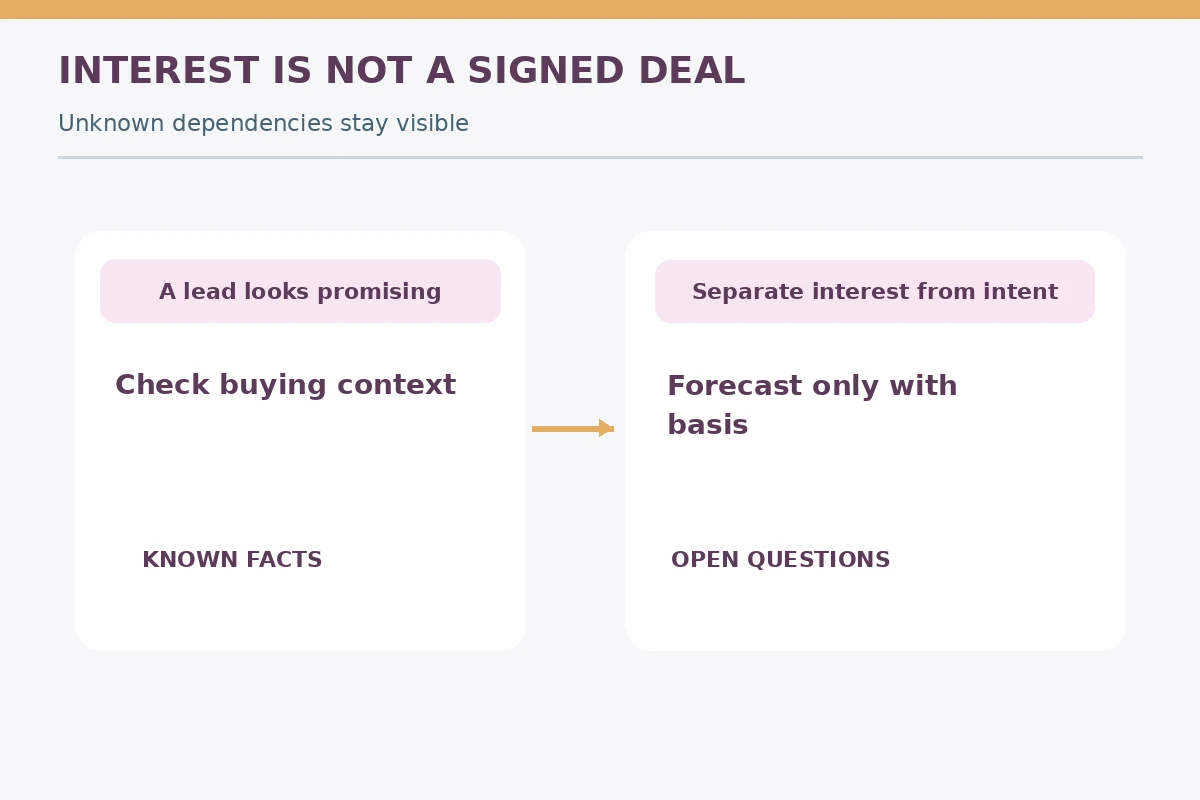
A forecast should disclose its basis and uncertainty. Talk about pipeline stage definitions, documented next steps, expected decision dates, dependencies, and how you handle stalled opportunities. Do not convert informal interest into booked revenue. If a forecast changed, an interviewer wants to hear what evidence led you to revise it rather than a confident number without support.
For practice, imagine a prospect expressing interest but waiting for procurement review. You could label the opportunity as pending, record the known dependency, and update the forecast following team rules. State clearly that this is a hypothetical case, not proof of a deal you closed.

Describe a strong discovery conversation
Begin with preparation: what the business sells, the contact’s role, and a researched reason for outreach. Then ask clear questions about the customer’s workflow, constraints, current solutions, and criteria for evaluating alternatives. Reflect the answers rather than forcing the customer into a script. After the conversation, document agreed next steps and unresolved issues in the approved account system.
Interviewers may ask whether you would promise a product feature to keep the conversation moving. Answer that you would confirm feasibility with the responsible product or technical team. A credible business development candidate protects customer trust and the internal teams who must deliver.
How do you work with sales, marketing, and delivery?
A business development handoff should distinguish verified customer needs from assumptions. Explain what you would give account executives, implementation leads, or operations colleagues: contact context, decision participants, known requirements, open questions, and customer commitments that were actually made. Ask who owns the next step and how updates come back to the pipeline.
One team may create an opportunity and another may negotiate terms. Say how you contributed and how credit was assigned, if known. Avoid “I generated the entire revenue” when you discovered a lead but another team qualified, priced, and closed the work.
How do you respond when a deal stalls?
Avoid saying you pressure every prospect until they agree. Instead, describe checking whether the obstacle is timing, missing information, stakeholder alignment, or a genuine mismatch. Then agree on a legitimate next step or stop pursuing a poor fit. This demonstrates judgment about customer time as well as internal resources.
If a prospect says budget approval is pending, document that dependency rather than marking the deal lost or won automatically. In a real example, explain what you learned and what changed in your outreach or qualification process, without inventing improvements in conversion rate.
What numbers can you discuss truthfully?
Distinguish activity measures such as researched accounts, conversations booked, and qualified opportunities from outcomes such as deals signed or revenue recognized. Use numbers only when you know their definitions and can identify the reporting source. A meeting count from your own calendar is not automatically the same as a qualified pipeline count in the company CRM.
You can still tell a useful story without a large dollar figure. Explain the scope of your account research, the quality of stakeholder notes, and the transition to the next owner. For a team outcome, name your part rather than claiming exclusive credit.
A structured example for a manager-level interview
Suppose the interviewer asks about a partnership opportunity that looked attractive but lacked clear buyer commitment. A hypothetical answer might explain reviewing the customer profile, asking discovery questions, identifying implementation dependencies, then recommending a limited next-stage discussion instead of inflating the forecast. The outcome may be a better-informed decision, not a signed deal.
Replace that practice situation with your actual account or project. A manager candidate should also clarify which actions they could authorize: pricing, staffing, contracting, discounts, and public claims may require approval even when you manage the customer relationship.

How We Research and Verify Interview Advice
We compare each question with occupation-specific duties described by the O*NET and the U.S. Office of Personnel Management structured-interview guidance. CareerOneStop recommends preparation with evidence from actual experience. We distinguish past-experience questions from hypothetical situations, check that examples do not imply permissions beyond the job, and avoid promising hiring results. Specific employer procedures may differ. See our affiliate disclosure; this informational article does not presume an affiliate arrangement.
Related occupation source: additional O*NET task reference provides context for prospecting and customer relationships. The tasks listed there are examples of occupational duties, not permissions that apply automatically to any individual employee.
More Interview Preparation Guides
No. Use verifiable activity, qualification, and handoff evidence. A number without a sound definition or a true connection to your work is less useful than a specific decision.
Yes, if you accurately separate your contribution from pricing, negotiation, approval, and final signature by other people.
Explain the documented evidence, stage assumptions, dependencies, uncertainty, and approval process rather than inventing a confident probability.
Not necessarily. Employers define these titles differently. Use the specific posting and reporting structure to understand whether the role centers on prospecting, partnerships, individual sales, or staff leadership.
Be clear about experience leading projects, coordinating people, or influencing without formal reports. Do not claim hiring or performance-management authority you did not hold.