
Part-time barista jobs combine customer conversations, drink preparation, payment accuracy and keeping work areas clean. A job title alone cannot tell you whether the shift is an early opening, a midday rush or an evening close. Build a shortlist using the café’s actual operating routines and your reliable availability. This article helps you assess roles and prepare a truthful application; it does not claim that specific coffee shops are hiring today.
O*NET’s barista profile identifies beverage preparation, orders, payments, cleaning and food handling as relevant tasks. The broader BLS food-and-beverage service profile says part-time work is common and shifts can include mornings, evenings, weekends and holidays. These are useful role characteristics, but individual café menus, hygiene procedures and experience requirements depend on the employer.
Choose the Part-Time Work Arrangement That Fits
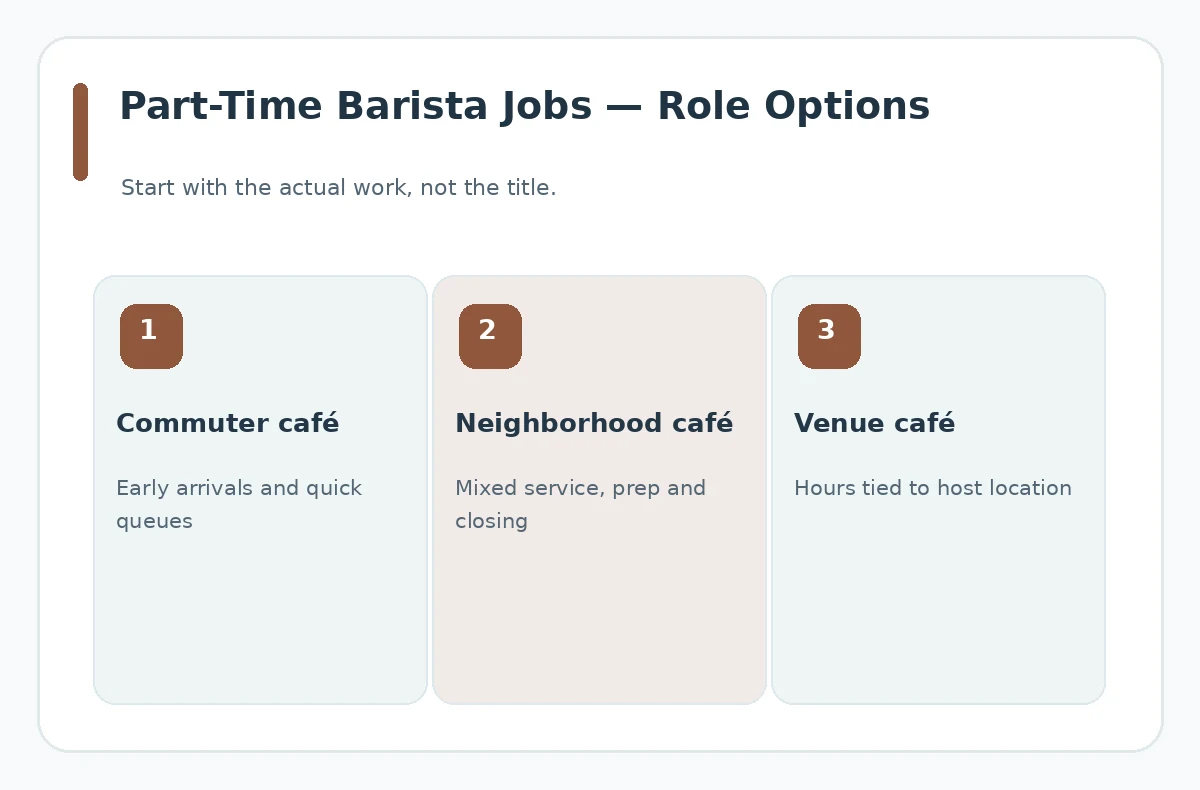
Decide which environment suits you: a high-volume commuter café, a neighborhood coffee shop or a café inside a venue such as a bookstore. The first may emphasize speed and queue management during short peaks; the second may combine drink service with restocking and regular customers; the third may follow the opening hours and rules of a larger business. Rather than labeling one easier, read the posting for tasks, busiest hours, whether food preparation is included and how many coworkers are on a shift.
Build a small decision sheet before applying. Record the posted role, employer, source URL, actual tasks, minimum requirements, weekly hours, shift start and end, commute or technology needs, and questions still unanswered. Treat unknown fields as unknown rather than filling them with guesses. A repeated keyword such as “flexible” is not a work schedule, and a role label does not establish the complete duties. Revisit the employer’s own description immediately before the interview because a third-party search result may be outdated.
Separate Required Tasks From Assumed Qualifications
A barista who can make espresso drinks still needs to follow the establishment’s recipes, cleaning practices and handling instructions. New applicants can offer hospitality, cashiering, teamwork or responsible equipment use without claiming professional coffee training. Ask what hands-on instruction is included and who checks drink quality during onboarding. If the job requires a food-handler credential, verify the requirement locally and with the employer instead of assuming every U.S. jurisdiction follows the same rule. To go further, our guide “Barista Jobs With No Experience” shows how to prepare for a first café role.
Ask for the Actual Weekly Schedule
Opening a café may require arriving before the door opens to customers. Closing may continue after the advertised closing time because cleaning, cash reconciliation and restocking are part of the work. Ask whether weekend availability is required, how shifts are assigned and whether staff rotate between opening and closing. If you have classes or another job, give the earliest time you can actually arrive. Commuting after a late close and availability on holidays matter more than a vague promise to be flexible. For the fuller picture, see our guide “Part-Time Delivery Jobs”.
When comparing hours, separate the number printed in an advertisement from the schedule you can genuinely maintain. USAJOBS explains its own work-schedule filters and cautions applicants to read each announcement for actual hours and flexibility; that government-site definition is not a universal rule for every private employer. Confirm whether assignments rotate, whether mandatory training falls outside your normal availability, and how far in advance rosters are shared. Write your firm availability boundaries before an interview rather than promising every shift.
Find and Verify Specific Employer Postings
Search “part time barista,” “coffee shop associate part time,” and “café team member” plus the place you can reasonably commute to. A chain and an independent shop may advertise through different channels, so check the employer’s own careers page or verified contact details. Read a full description for cash handling, food service, equipment and cleaning. Save the posting date and schedule notes. Do not pay for an interview, training access or a supposedly guaranteed opening. Our guide “Part-Time Tutoring Jobs” goes into more detail.
Verify the employer through independently found contact details. The Federal Trade Commission warns that fake job offers may ask for money, send counterfeit checks or seek personal information through convincing messages. Do not pay an application middleman for a guaranteed position. Avoid sending sensitive documents by informal chat before you have checked the organization and its hiring procedure. Suspiciousness does not prove a listing is fraudulent, but it is a reason to stop and verify before acting.
Turn Your Actual Experience Into Evidence
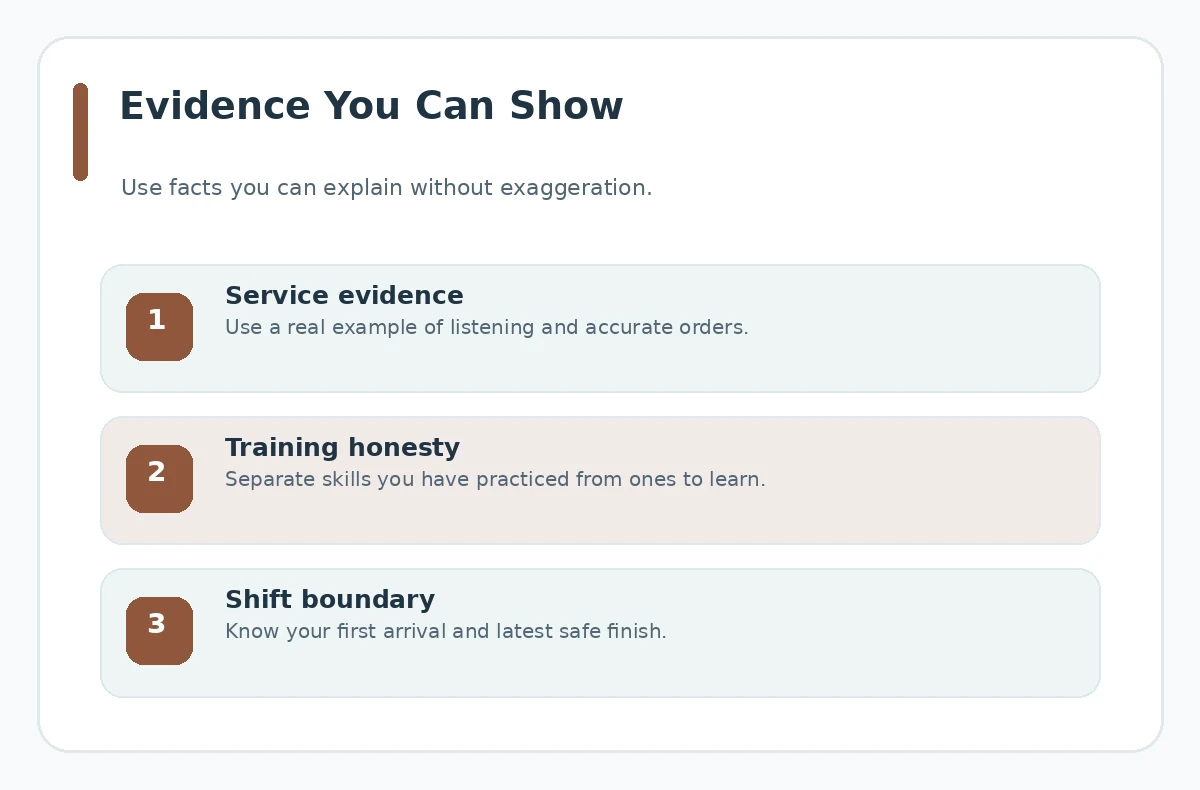
For an application, match one true experience to one real demand. Handling a student-club sales table can demonstrate making change and keeping a simple log. Serving guests at a volunteer event can show polite explanations and line management. Classroom or kitchen activities can show following written instructions, if accurately described. Hypothetical answer: “During a volunteer fundraiser, I labeled orders, repeated customer requests to avoid errors and wiped the service area between rushes.” Label it as volunteer experience; do not suggest it was a paid café job.
Compare Roles With a Short Screening Table
The following matrix is an editorial decision aid, not a table of live openings or universal employment requirements. Rewrite each row after reading an employer’s complete posting.
| Role setting | Likely task focus | Question to confirm |
|---|---|---|
| Commuter café | Early arrivals and quick queues | Check your earliest dependable arrival |
| Neighborhood café | Mixed service, prep and closing | Ask how closing duties are split |
| Venue café | Hours tied to host location | Check events and weekend coverage |
Questions Worth Asking the Hiring Team
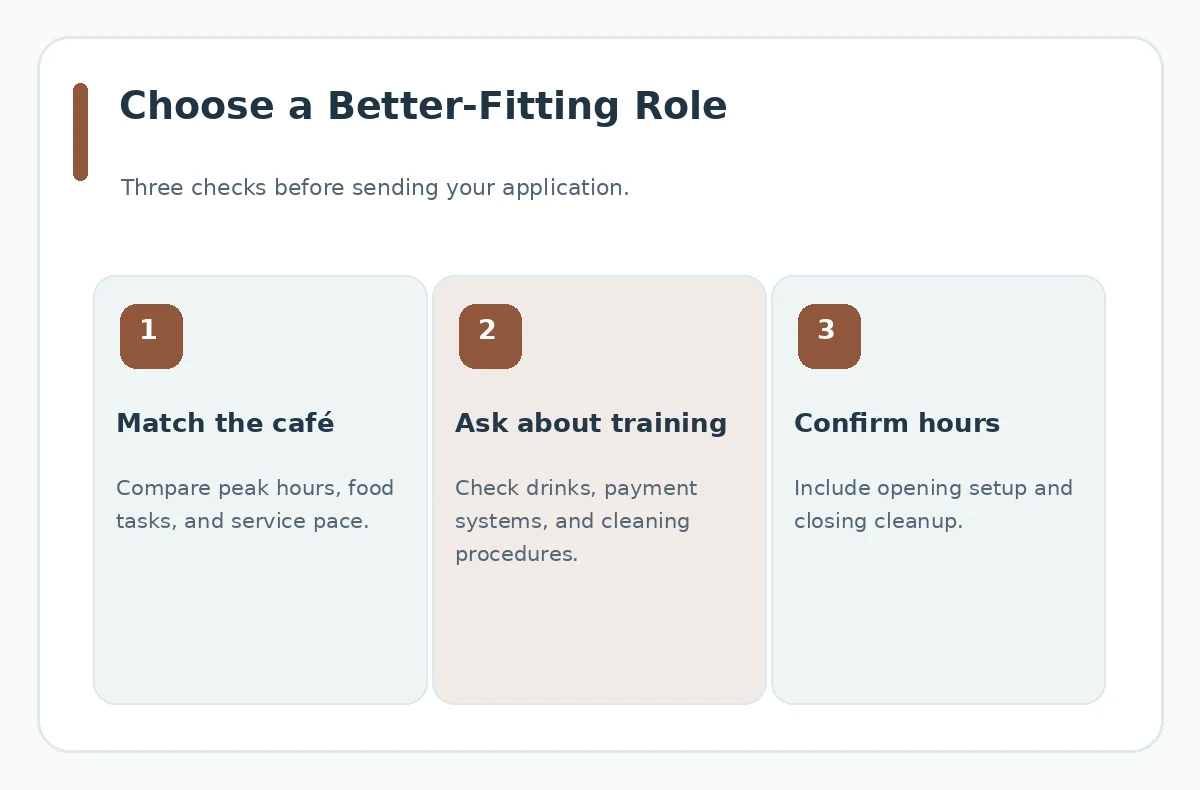
Ask what percentage of a shift involves drinks, food, checkout and cleaning; what the first week of training looks like; how café safety and sanitation rules are taught; when rosters are released; and whether late cleaning is included in the scheduled hours. If tips are mentioned, request the employer’s written explanation instead of assuming a particular amount. Before accepting, confirm exact working hours, location and who to contact about a schedule conflict.
Build a One-Week Application Shortlist
Use a one-week, low-waste application loop. On day one, write your non-negotiable schedule and required work conditions. On day two, make a shortlist of role types and employers you can verify. Then, on days three and four, send tailored applications only where the requirements fit. On day five, record dates, closing questions and any verified responses. Review the shortlist again before following up. The point is not a fixed number of applications; it is to preserve clear, accurate information and avoid repeatedly applying to unsuitable or stale listings.
If an employer replies, keep a written record of what was confirmed: position title, worksite, duties, training, available hours and next action. Ask for written offer details before relying on oral promises. Do not invent test results, attendance records or customer ratings to fill a résumé gap. A narrower and more truthful application is more useful than one optimized around unsupported claims. If the job is not suitable after you learn its conditions, remove it from your shortlist without treating that as a personal failure.
How We Research These Part-Time Job Options
The occupational descriptions and consumer guidance linked in this article were reviewed on October 21, 2026. The cited sources support typical task categories, work settings and fraud precautions; they do not confirm any particular employer opening, pay offer, staff policy or future job outcome.
Sources consulted: O*NET outlines barista responsibilities including beverage preparation, payments, customer orders and cleaning. BLS notes that part-time work is common in food and beverage service and that shift times vary. FTC warns not to pay for promised employment and to verify suspicious job offers. We also use USAJOBS schedule guidance to illustrate why posted work arrangements require close reading. We do not rank individual employers or promise that a job is available.
For site-wide policy see the JobAsk affiliate disclosure. All hypothetical experience or interview examples in this article are illustrative, not accounts of real candidates or employer results. Confirm applicable work terms, safety policies, and qualifications with the employer; this is not individualized legal or financial advice.
Related Job Search Guides
- Weekend-Only Part-Time Jobs: Find Shifts That Fit Your Schedule
- Remote Part-Time Customer Service Jobs: Verify Hours, Tools, and Hiring
- Remote Customer Service Jobs: Compare Phone Shifts, Duties, and Employers
- Early Morning Part-Time Jobs: Compare Opening Shifts and Travel
- Entry-Level Customer Service Jobs: Show How You Solve Problems
Some roles train new starters; check the posting. Describe real customer service, cash handling or hygiene-related habits instead of claiming barista experience.
Some cafés need weekend coverage, while others do not. Ask about required days and how far ahead schedules are set.
Not necessarily. Ask when paid closing tasks such as cleaning and restocking usually finish.
Only if you can genuinely demonstrate it and it matters to the role. Accuracy and reliable service are often more relevant.
No. These depend on the employer and location. Request written details rather than treating perks as guaranteed.