
Quick answer. Relocation can have a fixed move date while the final day in a job still needs confirmation. Relocation creates two separate timelines: moving logistics and employer coverage. A good notice communicates the employment date without disclosing private travel or household plans. A useful relocation resignation letter should make the decision, the actual final work date, and the handoff commitments unmistakable.
Decide What the Message Must Accomplish
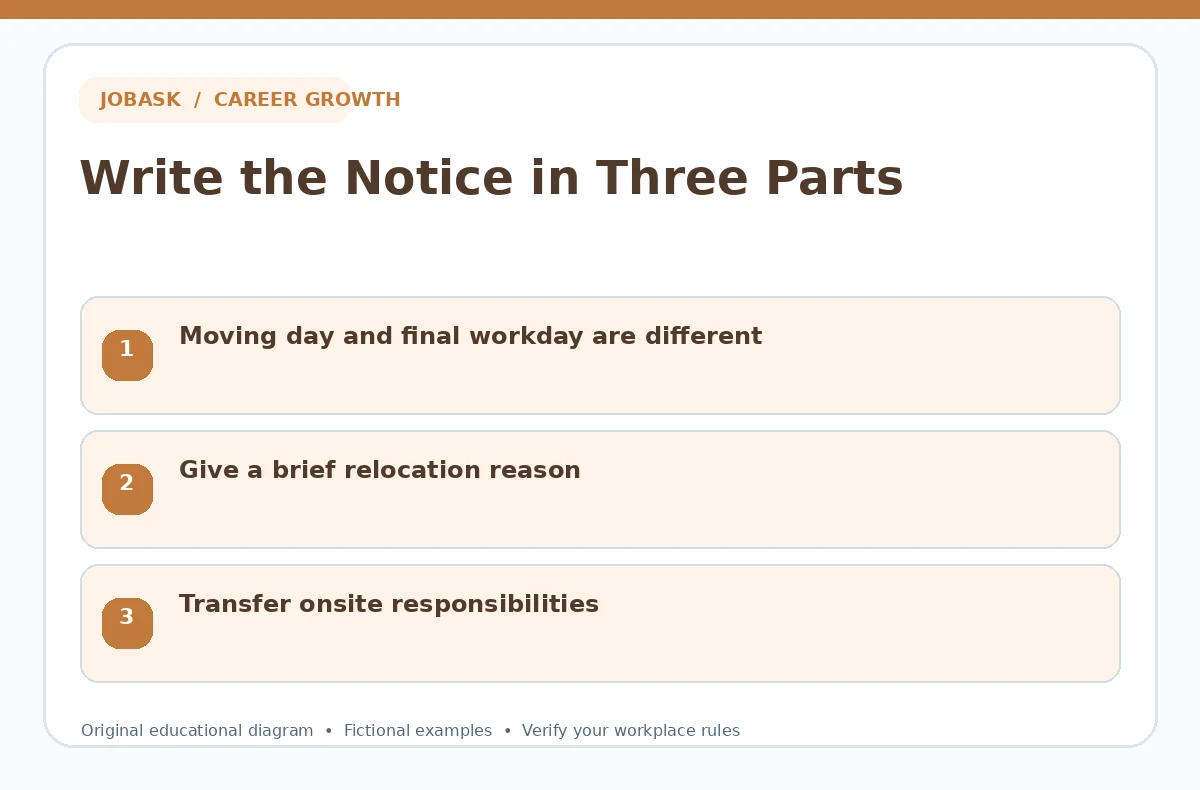
Two dates matter when a move drives the departure. The moving day is about transport, housing and family logistics; the final working day is about customer coverage and employment administration. Build a short calendar that keeps them on separate lines. If a journey begins on Monday, for example, do not automatically state Monday as the final shift without checking what you actually agreed to work. State only a date you can support and verify the organization’s expectations before sending formal notice.
Before you write, examine whether you truly intend to leave or are exploring a location transfer. A request for a remote arrangement should be a separate proposal, not buried in a letter announcing final resignation. Our guide “Resignation Letter Due to Relocation” covers dates and handover example.
You may mention moving to another location without naming an address or explaining your partner’s employment. The employer generally needs staffing clarity, not the household details behind the decision. If the workplace has recurring deadlines after you move, list those responsibilities explicitly and document the transfer of ownership. Avoid implying that geographic distance alone automatically changes employment obligations. Can that reader accurately schedule coverage? If not, revise the workday line and remove extra background.
Set the Final Date and Recipient Correctly
A relocation note should not inadvertently ask for a transfer in the same sentence as an unconditional resignation. If remaining employed remotely or at another branch is genuinely an option you want to explore, request that conversation first. Do not describe it as approved until the employer has confirmed the arrangement. If leaving is certain, the letter can stay focused on the move and the workday. These communication routes serve different decisions, and blending them can confuse the recipient. Our guide “Resignation Letter for Personal Reasons Without Oversharing” adds more detail on this.
Such arrangements must be separately confirmed and documented.

Use a Three-Part Departure Decision Matrix
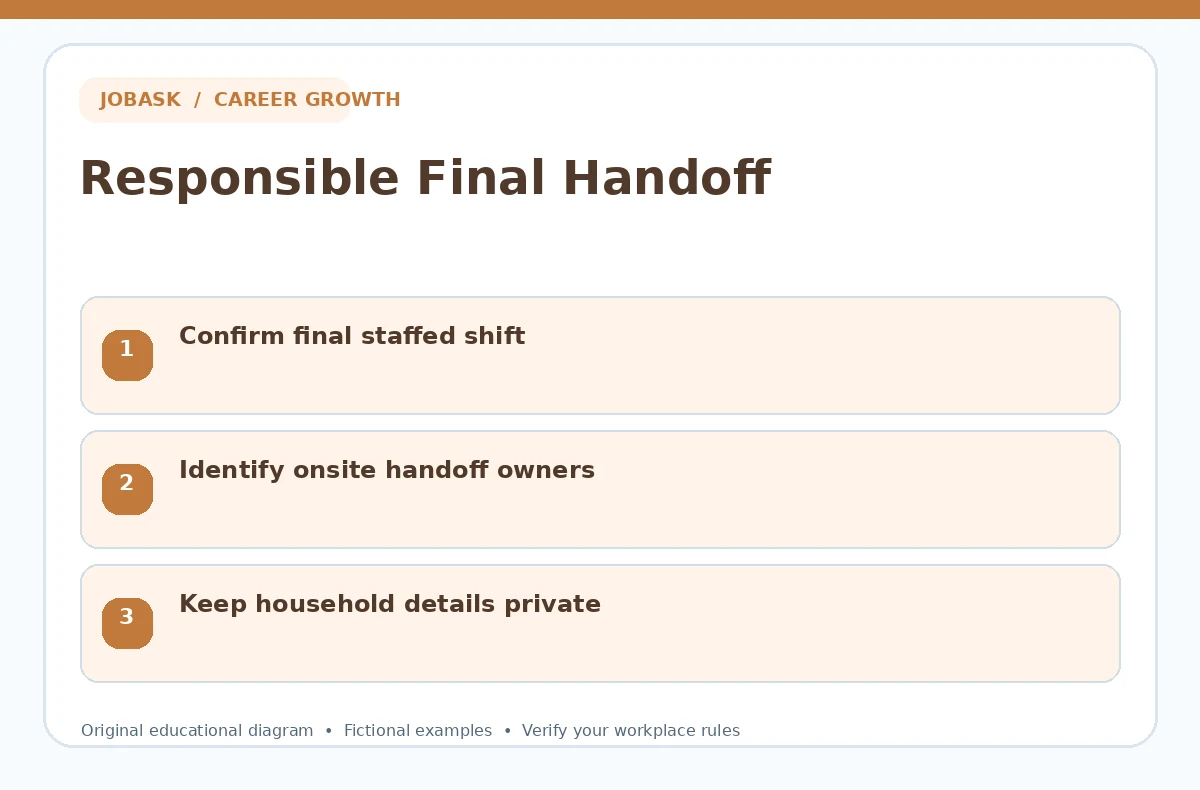
A relocation notice needs coordination among the departing worker, the supervisor responsible for local coverage and whoever handles any official paperwork. The employee knows the move schedule; the employer knows which onsite tasks cannot be paused. Confirm the last staffed day before deciding what handoff to offer. The moving destination or family travel plan is not inherently required to schedule the organization’s next inventory, appointment or client visit.
| Decision point | Action to verify |
|---|---|
| Move logistics | Identify your immovable travel date privately |
| Employment date | Set the actual last staffed shift for the employer |
| Coverage plan | Arrange approved handoff of recurring and time-sensitive work |
Only send facts that are already accurate.
Adapt This Clearly Hypothetical Resignation Example
An office role may involve small physical duties that are easy to overlook when preparing a move: receiving keys, checking paper stock, opening a secured mail drawer or showing a colleague where approved supplies are kept. List onsite tasks separately from digital responsibilities. The receiving manager can then designate someone physically present for the former and an appropriate system owner for the latter. Do not promise to continue handling an onsite duty from another city without an agreed arrangement.
Fictional example — not a real employer, employee, or outcome: Dear [Manager Name], I am writing to resign from my position as [Job Title] because I will be relocating. My planned last working day is [Date]. I am grateful for the opportunity to contribute to the team. Before leaving, I can update the current project tracker and organize a handoff for the next reporting cycle. Thank you for your support and understanding. Best regards, [Name]. Our guide “Retirement Letter to Your Employer” goes into more detail.
The fictional candidate is not promised a remote transfer, moving allowance, early release or endorsement from the employer. Treat these as separate conversations.
Compare the two. Relocation can have a fixed move date while the final day in a job still needs confirmation.
Keep Sensitive Details and Unsupported Claims Out
A short reason such as “I am relocating outside the area” is usually more useful than a long explanation of family decisions. Keep employer correspondence proportionate to its business purpose. Ask whether the notice recipient actually needs that information. Confidentiality and accuracy remain relevant even during a departure.
Avoid adding a new address, family employment details, travel itinerary or financial strain unless you consciously choose to disclose them. The move itself is enough context for a brief notice. Such arrangements must be separately confirmed and documented.
Document the Work Handoff Without Overpromising
Consider a fictional employee who gives up a weekly inventory task because of relocation. The useful handoff identifies the current stock record, the date of the next check and the person authorized to access the supply area. There is no need to disclose the employee’s new home address or which family member prompted the move. This illustrates a general principle: tell the employer enough to prevent work from being missed, not enough to reconstruct the person’s private travel plans.
Document any onsite responsibilities that someone physically present must assume, such as equipment checks, room access or mail distribution. Identify approved contacts and return company property through the organization’s process.
Hypothetical handoff scenario. Their letter records a final shift and offers to document the supply register for the person assigned to continue it.
Check the Final Draft Against Reality
Before sending, inspect the message for ambiguity about the new location. “I will be working from somewhere else” may be read as a remote-work proposal rather than a resignation. “I am relocating and my last working day will be [Date]” says something different. Keep the hypothetical wording aligned with your actual decision. If employer property must be shipped or returned before departure, ask for approved instructions rather than inventing shipping arrangements or including a personal destination in the formal letter. Our walkthrough on how to resign from a remote job with a clear digital handoff sets out each step.
Check whether the resignation email unintentionally promises remote work after the move. Make sure any alternative arrangements have been accepted separately before changing the wording.
Read the relocation draft for two kinds of ambiguity: a departure date that is confused with a moving date, and a suggestion that remote work or a transfer has been arranged when it has not. The actual final shift belongs in the letter. Unfinished onsite responsibilities belong in a task sheet. The move itself may explain the decision without revealing a new home address or a partner’s employment details. For the fuller picture, see our guide “Short Notice Resignation Letter With a Realistic Handover Plan”.
How We Research These Departure Scenarios
For relocation-specific correspondence, we consulted Indeed’s relocation letter advice regarding a clear final day and transfer of work. The UNLV Career Services resignation section informed the formal letter format. Both were checked on 2026-10-20. Neither supports promising a transfer, moving reimbursement or a uniform notice entitlement.
Read the site-wide affiliate disclosure. This guide contains no affiliate links.
Explore Related Career Guides
- Resignation Letter: Clear Templates and a Professional Handoff Plan
- Retirement Resignation Letter: Last Day, Handoff, and Benefits
- Resignation Letter for a New Opportunity: Keep It Brief and Specific
- Formal Resignation Letter Format: Write, Sign, and Deliver It Clearly
- Immediate Resignation Letter: What to Say When You Cannot Give Notice
Usually the staffing decision can be explained with a general relocation statement; share exact details only when they are actually needed for an administrative purpose.
You can explore that option, but a transfer or remote arrangement is not automatic. Discuss it separately and secure confirmation before treating it as agreed.
It should clearly name your last working day. A moving date may be different and need not appear unless it changes the handoff.
The appropriate timing depends on workplace processes and your circumstances; this article does not establish a universal requirement.
Write down which tasks require physical presence, who can take responsibility and any approved access or property-return steps.