
A resignation letter for personal reasons does not need to tell the story behind your decision. The practical essentials are your decision to leave, your intended final working date, a respectful tone, and a feasible next step for work you are handing over. Choose one level of explanation—none, a broad reference to personal circumstances, or a specific detail you voluntarily want to share—and do not confuse disclosure with courtesy.
Indeed’s June 2026 guidance describes the option to keep personal details general; UNLV Career Services gives an example of concise, respectful notice. The exact information requested by your own employer may differ, so review any applicable employment documentation.
Choose Your Privacy Boundary Before Drafting
Your reason may involve family responsibilities, a change in priorities, relocation, health concerns, or something else entirely. Decide what you want the permanent employment record to contain before you write a sentence about it. A formal resignation message can be clear even when the cause is private. The goal is to provide information the organization needs to plan, not information that satisfies somebody’s curiosity.
Think in three levels. Minimal: “I am resigning from my position.” Broad: “I am resigning for personal reasons.” Specific: “I am leaving because I will be relocating.” Select the level that accurately reflects your situation and comfort. Do not claim a medical diagnosis, family emergency, or caregiving obligation simply because you think those explanations sound more acceptable.

Keep the Decision and Date Unmistakable
State your role, employer, and final day in a sentence that cannot be confused with a request for temporary leave. For example, “Please accept this as notice of my resignation from [Role] at [Company], with my last working day on [Date].” Insert an actual calendar date after reviewing your notice arrangements. If the date is only proposed, say that you would like to discuss or request it. Our immediate resignation letter guide covers what to say when you cannot give notice.
Personal circumstances sometimes change during an exit. That does not make a vague date more helpful. If you cannot determine the last day, discuss options with the appropriate manager rather than writing “whenever I am able.” A documented final date also helps you understand which projects should be completed first and which routine tasks must be reassigned.
Use a Respectful Hypothetical Personal-Reasons Letter
Hypothetical sample, not an account of a real worker: “Subject: Resignation Notice — [Name]. Dear [Manager], Please accept my resignation from [Role] at [Company]. My last working day will be [Date]. I am stepping away for personal reasons and would prefer to keep the details private. Thank you for the opportunities and support I have received. During my remaining time, I can prepare an accurate summary of open tasks for the colleague you designate. Sincerely, [Name].”
Remove the sentence about privacy if it feels unnecessarily defensive; “for personal reasons” is often enough. If appreciation would be insincere, a short courteous closing may be more authentic than exaggerated praise. Only offer work you can realistically finish. Avoid copying a sample that describes responsibilities, dates, or accomplishments you do not actually have.

Respond to Follow-Up Questions Without Escalating
A manager may ask whether anything at work could change your mind or whether a scheduling adjustment is possible. You can listen without reversing your decision. A useful conversational response is, “I appreciate you asking. I have made the decision to leave, and I would like to focus on a smooth transition.” This is a suggested script, not proof that your employer cannot require particular employment information under any circumstance.
If you would consider another arrangement, separate that negotiation from the resignation itself. “I would be willing to discuss a reduced schedule before setting a final departure date” is not the same as a final notice. If you want the decision to remain final, do not imply that an offer of flexibility automatically changes it. Keeping these messages separate prevents confusion for both parties. For a step-by-step method, see how to withdraw a resignation.
| Your situation | Most useful next step |
|---|---|
| No explanation | State the decision and last working date. |
| Broad explanation | Use “personal reasons” without unnecessary detail. |
| Voluntary detail | Share only a specific reason you are comfortable recording. |
| Employer asks questions | Clarify what is necessary; seek advice for disputed obligations. |
Offer a Handover You Can Actually Deliver
Make a short list of open assignments, due dates, record locations, and decisions requiring a new owner. Ask your manager who should receive the list. Providing a list does not mean volunteering for indefinite support after the final date. Coordinate access changes through approved channels, and do not attach confidential customer, personnel, or medical records to a personal message.
The tone of a personal-reasons resignation can stay warm without becoming emotional. A focused offer—“I can update the weekly status sheet before my last day”—is more credible than an unlimited promise to take calls after departure. If circumstances prevent even a brief handover, say so accurately and ask whom to notify about the outstanding tasks.
Review Policies Without Making Legal Assumptions
Before sending, check your written contract if any, employer notice guidance, benefit materials, and approved process for returning property. This article does not state that a particular length of notice is legally mandatory or that you can always withhold any requested information. Different agreements, jurisdictions, and circumstances may affect what is required or appropriate.
Consider whether you are making a separate request for time away, an accommodation, or a correction to a workplace issue. A resignation letter is not automatically the best way to resolve every sensitive concern. Where rights or significant financial consequences are involved, obtain guidance from an appropriate qualified source before assuming the sample applies to your situation. Our guide “Resignation Letter Due to Relocation” covers dates and handover example.
Do a Final Privacy and Accuracy Check
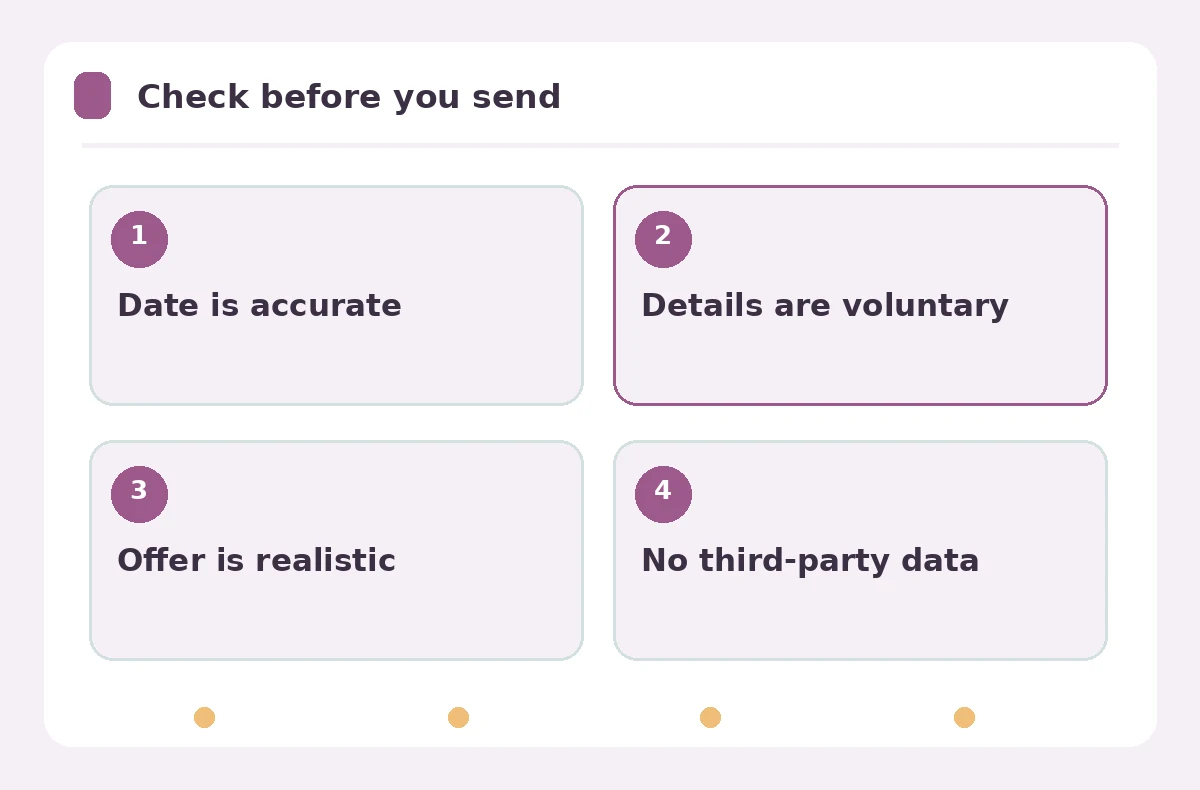
Read the draft as though it will remain in an HR file. Is every fact necessary and true? Have you inadvertently revealed information about a family member who did not consent to that disclosure? Does the last day match what you intend to communicate? Check the correct recipient and any required copy to HR before sending. Keep a record of your notice, but not protected employer documents.
Finally, decide how you will tell coworkers who need to know. An appropriate team farewell need not repeat the personal reason. A simple “I will be leaving after [Date]; [Manager] will confirm transition contacts” can be enough once the organization has decided on the announcement. Your formal letter and your social goodbye do not need to contain the same level of personal detail.
How We Research This Resignation Situation
The letter wording, decision table, and diagrams are original editorial examples, not actual employee correspondence. We used these sources for the specific points indicated: source guidance; source guidance; University HR. Source guidance is not a substitute for your own agreement or workplace policy.
This article provides general US career communication guidance, not individual legal, financial, tax, or HR advice. Employers, states, contracts, collective-bargaining terms, and plan documents differ. JobAsk does not claim paid placement, sponsorship, or an approved affiliate relationship in this guide; see the JobAsk affiliate disclosure. All sample letters are explicitly hypothetical and must be edited to reflect real circumstances.
Explore Related Career Guides
- Retirement Resignation Letter: Last Day, Handoff, and Benefits
- Short Notice Resignation Letter With a Realistic Handover Plan
- Resignation Letter for a New Opportunity: Keep It Brief and Specific
- Nurse Resignation Letter: State Your Last Shift and Protect Patient Handoffs
- Formal Resignation Letter Format: Write, Sign, and Deliver It Clearly
A concise personal-reasons statement is a common editorial option. Review your own employment terms and obligations for anything specific.
Only include personal information you genuinely want or need to disclose, and do not invent a reason. Sensitive employment issues may need separate advice.
State the accurate final date and explain the shortened timeframe briefly if appropriate. Check any notice terms before relying on a generic template.
No. They communicate different actions. If you want leave or a revised schedule, make that request clearly rather than implying you have already resigned.
Only offer a feasible handover step. Ask the appropriate manager what is most useful within the time you actually have.