
Use acronyms on a resume only when their meaning will be clear to the intended reader. Spell out unfamiliar organization names or internal systems at first use, keep recognized product names accurate, and never let an acronym imply a credential you have not earned. University of Illinois and Georgetown career guidance both caution against confusing jargon and unexplained abbreviations. The goal is not to ban every abbreviation, but to make your actual work understandable to a recruiter who may not share your previous workplace vocabulary.
Identify four kinds of shorthand first
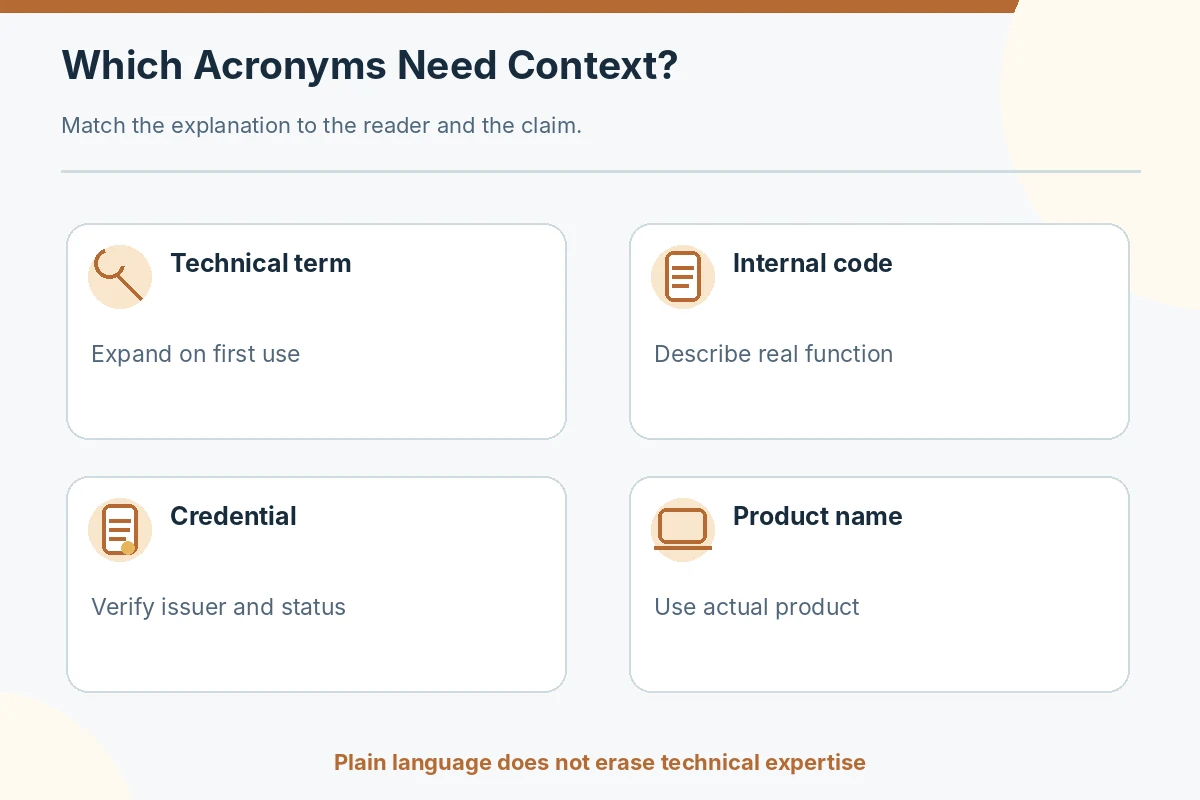
Sort your abbreviations into widely recognized job terms, formal credential names, software or method names, and employer-specific codes. These are not interchangeable. A department’s old project code may be meaningless outside the organization, while the name of an industry-standard application can be relevant if the posting uses it. A professional designation may be regulated or tied to a real issuer, so spelling it out cannot substitute for earning it. Start by identifying what the letters actually stand for and whether you have the right to claim them.
Apply the first-use expansion test
For an unfamiliar name, a practical pattern is “full name (ACRONYM)” the first time it appears. The University of Illinois explicitly recommends expanding acronyms at first use and using the shorter form later in the same document. This helps a nonexpert understand a skill without making the line excessively long. Example: “Prepared quality assurance (QA) checklists for manager review.” QA is a familiar term in some fields but less obvious in others. Use your judgment for the target audience rather than treating every acronym as mandatory or universally understood.
Keep names of software products exact
Do not expand a software brand into an invented phrase or replace the real tool with a generic acronym that could refer to several products. If you used Microsoft Excel, name it accurately; if you used a specialized platform, provide enough context to identify the work you performed. A resume line can say “Updated tickets in the team’s help desk system” when the proprietary system name would add no value or is confidential. Avoid writing “CRM administrator” merely because you entered customer records in a customer relationship management platform under supervision.
Separate credentials from coursework and exposure
A certification abbreviation can be meaningful only if the credential was actually awarded and is still valid when described as active. A training module that mentioned a certification is not the same thing as passing the issuer’s examination. State the full credential name and issuer, with status and dates where relevant, using the issuer’s official wording. If you attended introductory training, label it as training. The abbreviation should never be used as a shortcut to suggest a license, professional title, clearance, or authorization you do not hold.
Translate internal team or department codes
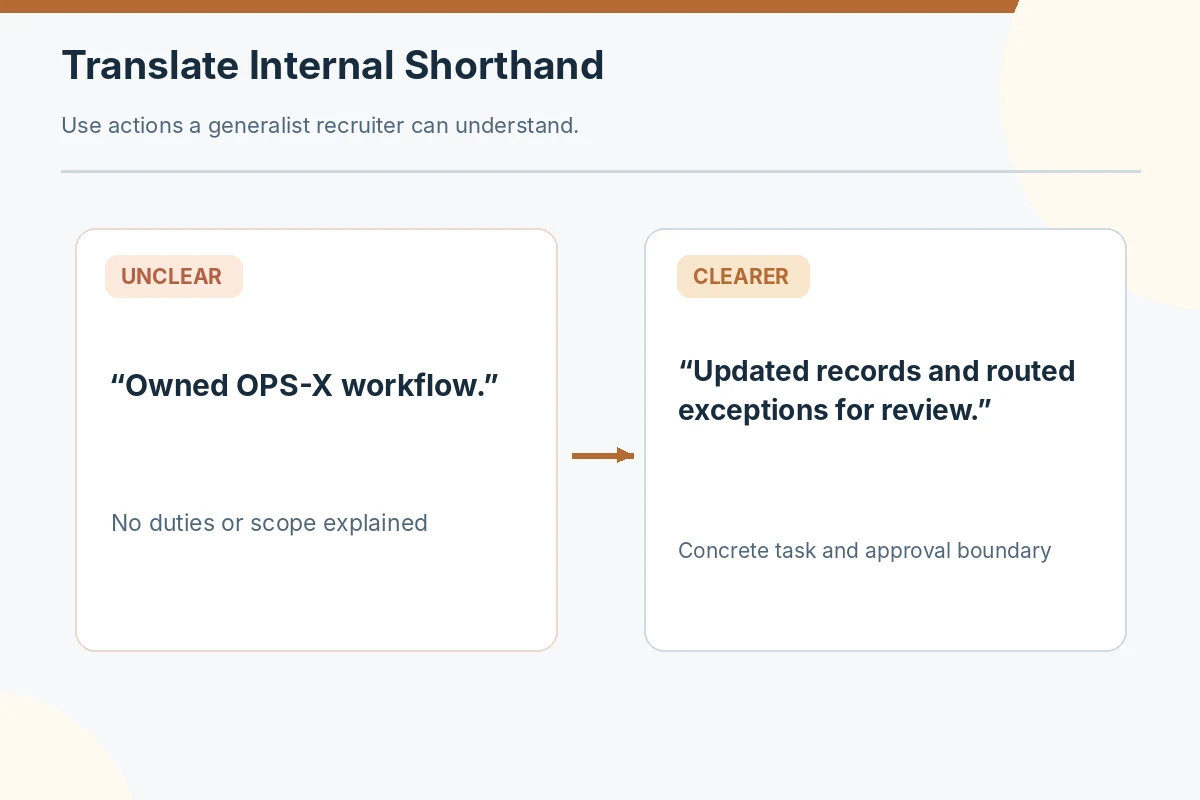
Hiring managers outside your former workplace are unlikely to recognize labels such as “OPS-2,” “CX Squad,” or a made-up workflow code. If those strings are internal jargon, describe the function: “customer issue escalation team” or “inventory reconciliation process.” The exact name may matter for formal employment records, but resume bullets should explain skills that transfer. Do not expose confidential project code names or customer categories. A precise plain-English phrase will often be more useful than repeating internal shorthand no one else can verify.
| Situation | Recommended description | Accuracy check |
|---|---|---|
| Common technical term | Spell out once if audience varies | Avoid inventing expertise |
| Internal team code | Replace with plain function | Protect confidential labels |
| Formal certification | Use issuer and accurate status | Do not claim an unearned award |
| Product or software name | Use actual recognizable name | Do not embellish tool access |
Check the vacancy before choosing abbreviations
An employer posting may use a familiar technical shorthand; using the same legitimate term can improve comprehension for domain reviewers. But the posting also may be read by generalist recruiters. A two-layer line can serve both audiences: the full concept plus the actual abbreviation in parentheses. Never insert acronyms merely because they appear in the job description when you cannot demonstrate the underlying work. Georgetown advises relevant customization and warns against misleading or exaggerated resume claims. Accuracy has priority over keyword mimicry.
Replace misleading shorthand with a real action
Compare “Owned QA” with “Recorded product defects and sent test notes for review.” The first is ambiguous and may imply formal authority; the second tells the reader what the candidate did. Similarly, “Ran HRIS” might be too broad for someone who entered employee contact changes under restricted access. A clearer sentence names the authorized action and context, not just a system category. These examples are hypothetical: adapt them only if you actually performed the work and can explain the review or approval limits.
Avoid unnecessary abbreviations in dates and titles
Use one consistent month/year style for jobs and education. Shortened months can be acceptable, but mixing formats or using ambiguous numeric dates can confuse international or generalist readers. Prefer recognizable job titles and full organization names for the primary header. Do not shorten “assistant manager” into a cryptic abbreviation or convert an internal grade to a senior title. UC Santa Barbara recommends clear employer and title fields with readable dates. The resume should help someone locate the correct position, not force the reader to decode a workplace-specific taxonomy.
Use a simple audience test with another person
Give a trusted reader the text of a bullet without explaining your job. Ask them to say what the acronym means and what you personally did. If they cannot, expand the term or replace it with concrete duties. This is especially useful when shifting from research, military, healthcare, or information technology into another industry. The reviewer does not need to know every specialist term; they should understand the outcome of your work. Keep confidential information out of any draft you share for review.
Be precise with degrees and educational abbreviations
Use the official degree award and school record rather than inventing a shorter or more prestigious label. Familiar degree abbreviations may be appropriate with the institution’s exact title, but readers should not mistake an unfinished program for a completed degree. Distinguish majors, minors, courses and certificates. If a credential is in progress, state the stage accurately. The acronym itself adds little if the reader cannot tell whether it is a qualification, a class, or an unaccredited training badge. Confirm the issuer’s terminology before publication or submission.

Review each acronym in the final exported document
Search the file for capital-letter sequences and punctuation-heavy abbreviations. For each, ask whether the meaning is apparent, whether the term is relevant, and whether the surrounding sentence attributes the correct responsibility. Check that expansions are consistent: the same acronym should not refer to two different concepts in the document. Make sure neither the acronym nor its expansion introduces a false claim. Export the file and inspect the layout, since a long expansion may force a heading or bullet across a page break.
Build a miniature terminology key for yourself
Create a private list with four columns: shorthand, full term, actual evidence, and reader action. For example, “QA / quality assurance / reviewed a test checklist / expand once”; or “internal desk code / ticket routing queue / logged requests / replace with function.” This key is a drafting tool, not part of the resume. It helps you choose which terms to keep, translate, or omit. You should finish with language that can be read quickly while preserving the real titles, tools and scope of your experience.
How We Research Practical Resume Writing
We reviewed career-service guidance from universities and other identifiable public career resources, compared this topic with existing JobAsk titles from the supplied WordPress record, and separated broadly recommended writing conventions from facts only an applicant can verify. Source pages were checked on November 16, 2026. Examples and names are hypothetical unless stated otherwise; actual employer instructions and applicant records control. This is editorial guidance, not a guarantee of screening results.
Research and further reading: University of Illinois resume guidance; Georgetown resume content guide; Northern Illinois resume guidance.
For editorial and commercial transparency, see our affiliate disclosure. No product placement, paid reviewer, or applicant tracking outcome is implied here.
More Resume and Cover Letter Guides
No universal rule requires every familiar abbreviation to be expanded. Explain terms a mixed audience may not recognize, especially at first use.
Not as a completed credential. Distinguish coursework or training from a credential the issuer actually awarded.
Use relevant terms if you truly did the work, while making key phrases understandable to readers unfamiliar with specialist shorthand.
Usually translate them into recognizable functions unless the exact code is publicly meaningful, shareable and relevant.
No. Pair a true product or tool name with a task and the scope of your access or responsibility.